

Safe Schools Improvement Act of 2021 This bill requires states to direct their local educational agencies (LEAs) to establish policies that prevent and prohibit bullying and harassment of elementary and secondary school students. In particular, these policies must prohibit bullying and harassment based on race, color, national origin, sex, sexual orientation, gender identity, disability, or religion. Further, LEAs must provide (1) students, parents, and educational professionals with annual notice of the conduct prohibited in their disciplinary policies; (2) students and parents with grievance procedures that target such conduct; and (3) the public with annual data on the incidence and frequency of that conduct at the school and LEA level. The Department of Education must conduct and report on an independent biennial evaluation of programs and policies to combat bullying and harassment in elementary and secondary schools. The National Center for Education Statistics must collect state data to determine the incidence and frequency of the conduct prohibited by LEA disciplinary policies.
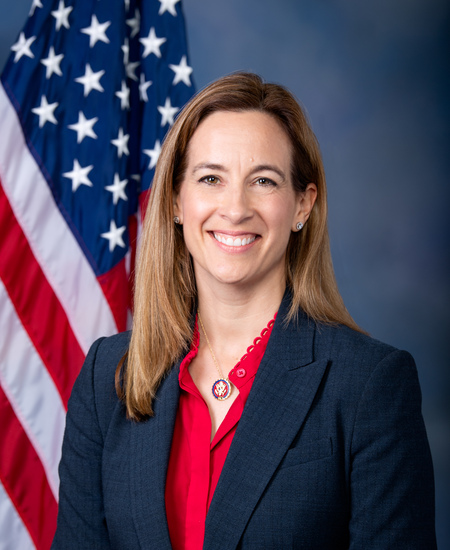
Rep. Mikie Sherrill
Sponsored bills
America's Red Rock Wilderness Act This bill designates specified lands in the following areas of Utah as components of the National Wilderness Preservation System: (1) Great Basin, (2) Grand Staircase-Escalante, (3) Moab-La Sal Canyons, (4) Henry Mountains, (5) Glen Canyon, (6) San Juan-Anasazi, (7) Canyonlands Basin, (8) San Rafael Swell, and (9) Book Cliffs and Uinta Basin. The bill sets forth administrative requirements for (1) the exchange of state-owned lands within such areas, (2) federal reservation of water rights, (3) measurement of setbacks for roads with adjacent wilderness, (4) authorized livestock grazing, and (5) withdrawal of such lands from disposition under certain public land laws.
Expanding Pathways to Employment Act This bill directs the Department of the Treasury to provide long-term grant funding for workforce development programs that have demonstrated a positive impact on worker earnings and for postsecondary education programs that have demonstrated a positive impact on student graduation.
Animal Welfare Enforcement Improvement Act This bill revises the licensing process of the Department of Agriculture (USDA) for animal dealers and exhibitors to expand USDA's oversight and enforcement of animal welfare requirements. The bill also authorizes citizen suits to enforce the Animal Welfare Act. Dealers and exhibitors must apply to USDA for licenses or renewal licenses each year. In order to obtain the licenses or renewals, dealers and exhibitors must meet certain standards for the humane treatment of animals and pass inspections as specified by this bill. USDA may not issue or renew such licenses if the dealers or exhibitors have violated laws relating to animals or if the issuance of the licenses would facilitate the circumvention of state or local laws that prohibit the private ownership of certain animals. Further, USDA must suspend the licenses of dealers or exhibitors whose violations present a risk to animal welfare. USDA must revoke the licenses if the violations persist or if the licensees commit multiple violations. Dealers and exhibitors with suspended or revoked licenses may not be (1) granted another license, (2) granted another license through another person or entity, or (3) employed by another licensee to work with animals during the period of the suspension or revocation.
Federal Retirement Fairness Act This bill modifies the federal civilian service that is creditable service under the Federal Employees Retirement System (FERS). Specifically, it expands the nondeduction service that may be creditable under FERS. Nondeduction service is federal service where an employee's pay is not subject to retirement deductions (e.g., service under a temporary appointment). Currently, nondeduction service performed before January 1, 1989, is creditable under FERS so long as a deposit is made into the retirement fund to cover the period of nondeduction service. This bill allows nondeduction service performed on or after January 1, 1989, to be creditable under FERS so long as a deposit is made into the retirement fund.
Sgt. Ketchum Rural Veterans Mental Health Act of 2021 This bill requires the Department of Veterans Affairs (VA), during FY2022, to establish and maintain three new centers of the Rural Access Network for Growth Enhancement (RANGE) Program in areas with interest from personnel and a need for additional mental health care for rural veterans. The RANGE Program serves veterans in rural areas who are experiencing mental illness. The bill requires the Government Accountability Office to conduct a study and report on whether the VA has sufficient resources to serve rural veterans who need mental health care that is more intensive than traditional outpatient therapy.
This concurrent resolution expresses the sense of Congress that title IX of the Education Amendments of 1972 applies to the National Collegiate Athletics Association (NCAA) and that the NCAA should work to prevent sex-based discrimination in its programs and activities.
Strategic Lebanon Security Reporting Act This bill requires the Department of State to submit to Congress a strategy and report concerning the implementation of a United Nations (U.N.) Security Council resolution adopted on August 11, 2006, which calls for the disarming of armed groups along the Israeli-Lebanese border. Specifically, the State Department must develop a strategy for implementing the resolution. The strategy must address Lebanon's control of its southern border, cooperation between Lebanon and U.N. forces, and prevention of border tunnels. In addition, the State Department must report on the implementation of the resolution, including issues related to the Lebanese armed forces, U.S. security interests, and the extent of Hizballah's influence within Lebanon and its armed forces.
Essential Caregivers Act of 2021 This bill requires skilled nursing facilities, nursing facilities, intermediate care facilities for the intellectually disabled, and nearby inpatient rehabilitation facilities to establish an essential caregivers program during a public health emergency. Under the program, facilities must allow each resident to select up to two essential caregivers to provide daily living assistance, emotional support, or companionship during the emergency. Facilities must afford such caregivers 12 hours of access to residents each day (or unlimited access for end-of-life care), and caregivers must agree to follow facility protocols for staff safety. Facilities may deny access to caregivers who violate protocols, subject to certain notification requirements; the Centers for Medicare & Medicaid Services must establish an appeals process relating to such decisions and may take specified enforcement actions against facilities that violate the bill's requirements.
Respect for Peace Corps Volunteers Act This bill allows the official seal or emblem of the Peace Corps and the name Peace Corps to be used on any death announcement, plaque, grave stone, or other grave marker of a former volunteer, officer, or employee of the Peace Corps.