

Maddy summaryHR 3985 establishes a new Office within the U.S. Department of State to monitor and combat Islamophobia abroad. The bill requires the State Department to appoint a Special Envoy who will coordinate efforts to track Islamophobic incidents globally and mandate specific reporting in three key State Department documents. These reports must detail physical violence against Muslims or Muslim institutions, hate propaganda in media, government responses, religious freedom protections, and anti-bias education efforts in foreign countries. The provisions apply to annual human rights, foreign assistance, and religious freedom reports, requiring detailed descriptions of Islamophobia occurrences and governmental actions. The new reporting requirements become effective 180 days after the bill's enactment.
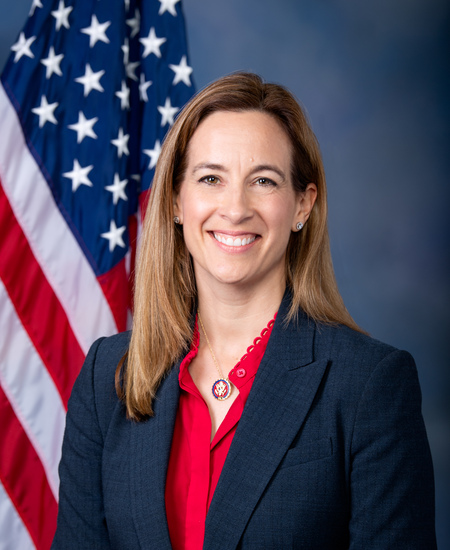
Rep. Mikie Sherrill
Sponsored bills
Maddy summaryThe AUKUS Undersea Defense Act authorizes the transfer of Virginia-class submarines from the U.S. Navy to Australia as part of the trilateral security partnership between the U.S., Australia, and the United Kingdom. It establishes procedures for Australia to pay for these submarines and related costs, while creating a "Submarine Security Activities Account" to accept Australian contributions for non-nuclear aspects of submarine security activities. The bill also includes provisions for repair/refurbishment of submarines and training to support the development of Australia's submarine industrial base. These measures aim to enhance undersea capabilities and defense cooperation in the Indo-Pacific region among the three nations.
Maddy summaryThis bill requires federal agencies collecting demographic survey data to begin including questions on sexual orientation, gender identity, and variations in sex characteristics (intersex traits) within 360 days of enactment. Agencies must review existing surveys to identify gaps, develop privacy-protective methods for collecting this data (including anonymization and data destruction protocols), and incorporate it into relevant reports within three years. The law applies to all federal surveys that collect standard demographic data (like race, ethnicity, and age), such as the census or health surveys, but does not compel individuals to disclose their status. It emphasizes maintaining confidentiality, allows limited agency waivers if standards can't be met, and mandates a congressional report on implementation within two years.
Maddy summaryHR 3850, the Pride In Mental Health Act of 2023, establishes a federal grant program to improve mental health and substance abuse services for LGBTQ+ youth (including nonbinary, intersex, and Two Spirit individuals). The bill directs the Health and Human Services Secretary to fund eligible organizations to provide trauma-informed care, cultural competency training for caregivers, school bullying prevention guidelines, and family support resources. It explicitly prohibits grant funds from being used for conversion therapy or advertising related to such therapy. The bill also requires data collection on LGBTQ+ youth mental health and a federal survey to measure psychological distress.
Uyghur Human Rights Protection Act This bill designates certain residents of the Xinjiang region in China as prioritized refugees of special humanitarian concern and addresses other related issues. This priority designation shall apply to individuals (and the spouses, children, and parents of such individuals) who (1) reside in or fled Xinjiang and who suffered persecution on account of their peaceful political, religious, or cultural activities or associations, or have a well-founded fear of such persecution; or (2) have been formally charged, detained, or convicted for certain peaceful actions related to Xinjiang. Such an individual may not be denied admission into the United States based primarily on an arrest or other adverse government action due to that individual's participation in protests. The bill also waives certain immigration-related requirements for such individuals. Furthermore, a Chinese national seeking refugee status shall be considered to have been persecuted on account of political opinion if the Chinese government revoked that individual's residency in any region of China because the individual submitted a nonfrivolous application for a U.S. immigration benefit. Similarly, if the Chinese government revoked a Chinese national's citizenship, nationality, or residency because that individual filed for a U.S. immigration benefit, that revocation shall constitute a changed circumstance. (Among other things, a changed circumstance may allow an individual who has been rejected for asylum to apply again.)
Maddy summaryThe American Family Act establishes a monthly child tax credit of $250 per month for each child under age 6 and $300 per month for each child aged 6-18, with income limits of $150,000 for joint filers and $112,500 for other filers. The credit is refundable, meaning it can be paid even if the taxpayer owes no income tax, and will be adjusted annually for inflation. The bill includes detailed rules for determining eligibility, including requirements that the child resides with the taxpayer for more than half the month and provisions to prevent fraud through recapture of improperly received payments. The credit will be paid monthly in advance rather than as a single annual payment, with specific mechanisms for calculating and distributing the payments.
Maddy summaryHR 3808 extends the visa cap for Afghan allies from 38,500 to 58,500, covering Afghan nationals who worked with U.S. forces or international missions in Afghanistan (e.g., interpreters, translators) under the 2009 Afghan Allies Protection Act. It requires the State Department to create a strategy within 180 days to improve processing efficiency, including reviewing staffing, data collection, and appeal procedures for pending applications. The bill also adds provisions for reimbursing applicants' medical exam costs, allowing virtual interviews for visa applications, and ensuring denials include appeal options. These changes directly affect Afghan allies awaiting visas and aim to accelerate their resettlement in the U.S.
Maddy summaryHR 698, the Assault Weapons Ban of 2023, prohibits the sale, manufacture, transfer, and possession of specific firearms and ammunition devices commonly referred to as "assault weapons" and "large capacity magazines" in interstate commerce. The bill defines "semiautomatic assault weapons" to include rifles like AR-15s and AK-47s, as well as firearms with specific features such as folding stocks, pistol grips, threaded barrels, and detachable magazines holding more than 15 rounds. It exempts law enforcement, military, antique firearms, and weapons already lawfully owned before the law's enactment (known as "grandfathered" weapons). The bill also requires new identification markings on these weapons and large capacity magazines, and adds background check requirements for transfers of grandfathered weapons.
Maddy summaryThis bill requires federal agencies to incorporate bird-safe design features in public buildings during construction, acquisition, or major renovations (over 50% facade alteration). It mandates the General Services Administration to develop and update a design guide with strategies like specialized glass, lighting modifications, and maintenance practices to reduce bird collisions. The guide must be shared with all federal agencies and include input from bird conservation experts. Exemptions apply to historic sites, the White House, Supreme Court, and Capitol complex. Annual reports on compliance and bird fatality assessments must be submitted to Congress.
Maddy summaryHR 3768, the Midwives for MOMS Act of 2023, provides federal grants to support midwifery education and increase access to midwifery services. It allocates $15 million annually (2024-2028) for accredited midwifery schools to directly support students, expand programs, and train clinical instructors, with 50% of funds dedicated to student support. The bill also authorizes $20 million annually for nurse-midwifery programs in nursing schools, prioritizing students who will work in underserved health professional shortage areas and increasing racial/ethnic minority representation. These provisions directly affect midwifery students, educational institutions, and communities with limited access to maternity care, aiming to expand the midwifery workforce through targeted funding.