

Maddy summaryThis bill, HR 2253 (Puppy Protection Act of 2025), sets new federal standards for commercial dog dealers who sell puppies to the public. It requires specific housing sizes based on dog size (e.g., 12-30 square feet per dog), daily exercise in safe outdoor areas, clean water and nutritious food twice daily, and annual veterinary exams including dental checks. The bill also limits breeding frequency (max 2 litters in 25 months), sets age minimums for breeding (18 months for small dogs, 2 years for large dogs), and mandates health screenings to prevent genetic diseases. These requirements apply directly to commercial dealers, with final regulations to be issued within 18 months of enactment.
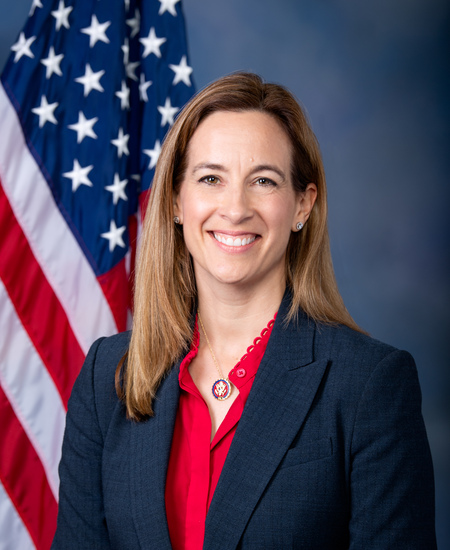
Rep. Mikie Sherrill
Sponsored bills
Maddy summaryHR 2195, the Feed Hungry Veterans Act of 2025, would expand eligibility for food assistance under the Supplemental Nutrition Assistance Program (SNAP) to more veterans. It adds four new qualifying categories to the existing rules: veterans with a "catastrophically disabled" determination under military disability law, veterans under 65 receiving a pension, and veterans meeting specific combined disability rating thresholds. The bill amends the Food and Nutrition Act to include these new groups in SNAP eligibility, directly affecting veterans who currently may not qualify under existing disability rating criteria. The changes would take effect on October 1, 2030.
Maddy summaryThis bill, HR 2102 (Major Richard Star Act), allows veterans with combat-related disabilities to receive both full military retired pay and veterans' disability compensation simultaneously, without the previous offset that reduced retired pay. It directly affects veterans already eligible for both benefits due to combat-related injuries, removing the requirement that their retired pay be reduced by the disability compensation amount. The key provision amends Title 10 and Title 38 to eliminate the offset rule (sections 5304 and 5305 of Title 38) for these veterans. The change applies to payments starting after the bill’s enactment date, effective for all qualifying veterans. This is a policy change to increase financial support for affected veterans, not a new benefit.
Maddy summaryThis bill requires health insurance plans (including employer-sponsored and individual plans) to cover up to a full year's supply of contraceptives in a single fill, without copays or deductibles. It applies to all contraceptives already covered under existing law, making it easier for insured individuals to access longer-term supplies. The policy change takes effect for plan years beginning January 1, 2026, and mandates government outreach to inform providers and enrollees about the new coverage option.
Workplace Violence Prevention for Health Care and Social Service Workers Act This bill requires the Department of Labor to address workplace violence in health care, social service, and similar sectors. Specifically, Labor must issue an occupational safety and health standard that requires certain employers to take actions to protect workers and other personnel from workplace violence. The standard applies to employers in the health care sector, in the social service sector, and in sectors that conduct activities similar to those in the health care and social service sectors. Among other elements, the standard must require each employer to (1) develop a workplace violence prevention plan, (2) promptly investigate incidents of workplace violence, and (3) provide relevant training and education to employees. The bill requires certain hospitals and skilled nursing facilities to comply with this standard as a condition of Medicare participation.
Maddy summaryHR 2578, the Drug Testing for Special Government Employees Act, requires federal agencies to implement drug testing for special government employees in sensitive positions. Before hiring, individuals must pass a pre-employment drug test, and current employees in these roles must undergo random testing within 90 days of the law's passage. A positive test result results in a 12-month ban from employment or rehire for both new applicants and current employees. This applies to roles involving access to classified information, national security responsibilities, or mission-critical duties as defined by the bill.
Maddy summaryHR 2585, the Armenian Genocide Education Act, establishes a federal program through the Library of Congress to develop educational resources about the 1915-1923 Armenian Genocide for K-12 schools. It requires the Librarian to create and distribute accurate teaching materials, provide teacher training workshops, and maintain an online resource hub focused on the genocide's history, lessons, and prevention of hate. The program directly supports local educational agencies, independent schools, and educators by offering professional development and curriculum resources. It defines key terms like "denial" and "distortion" to guide the educational content, aiming to improve understanding of this historical event and its relevance to preventing modern-day hate crimes.
Sanctioning Russia Act of 2025 This bill imposes penalties on certain persons (individuals and entities) if the President determines that the Russian government or a person acting at Russia's direction is involved with (1) refusing to negotiate a peace agreement with Ukraine; (2) violating a negotiated peace agreement; (3) initiating another invasion of Ukraine; or (4) overthrowing, dismantling, or seeking to subvert the Ukrainian government. If the President makes such a determination, the bill requires certain actions including the President must impose visa- and property-blocking sanctions on specified persons such as the Russian president, certain Russian military commanders, and any foreign person that knowingly provides defense items to the Russian armed forces; the President must increase the rate of duty on all goods and services imported from Russia into the United States to at least 500% relative to the value of such goods and services; the President must increase the rate of duty on all goods and services imported into the United States from countries that knowingly engage in the exchange of Russian-origin uranium and petroleum products to at least 500% relative to the value of such goods and services; the Department of the Treasury must impose property-blocking sanctions on any financial institution organized under Russian law and owned wholly or partly by Russia, and any financial institution that engages in transactions with those entities; and the Department of Commerce must prohibit the export, reexport, or in-country transfer to or in Russia of any U.S.-produced energy or energy product.
Maddy summaryThe Nutrition CARE Act of 2025 requires Medicare to cover medical nutrition therapy services for beneficiaries with eating disorders starting January 1, 2026. It directly affects Medicare beneficiaries with eating disorders, including an estimated 1.6 million people on Medicare Part B, with specific focus on underserved groups like 420,500-560,700 Black, Indigenous, and People of Color beneficiaries. The bill mandates coverage through registered dietitians or nutrition professionals, requiring at least 13 hours of services in the first year (including initial assessment) and 4 hours annually thereafter, with referrals from physicians or psychologists. This addresses a current gap where Medicare does not cover medical nutrition therapy for eating disorders at any treatment level. The policy change aims to improve access to a critical treatment pillar for a condition with high mortality rates and significant healthcare costs.
Save America's Forgotten Equines Act of 2025 or the SAFE Act of 2025 This bill permanently prohibits the slaughter of equines (e.g., horses and mules) for human consumption. (Current law prohibits the slaughter of dogs and cats for human consumption. This bill extends the prohibition to equines.) Specifically, this bill prohibits a person from knowingly (1) slaughtering an equine for human consumption; or (2) shipping, transporting, possessing, purchasing, selling, or donating an equine to be slaughtered for human consumption or equine parts for human consumption. The bill subjects a violator to a fine. The bill applies to conduct in or affecting interstate or foreign commerce or within the special maritime and territorial jurisdiction of the United States. However, it does not apply to an activity carried out by an Indian for a religious ceremony. As background, in recent years, the appropriations acts have prohibited the Department of Agriculture (USDA) from using federal funds to inspect horses before they are slaughtered for human consumption. Therefore, there are currently no USDA-inspected horse slaughter facilities in the United States.