

Build America's Libraries Act This bill establishes and provides funds through FY2024 for the Build America's Libraries Fund, from which the Institute of Museum and Library Services (IMLS) must allocate funding to states and, through them, need-based grants to libraries to make long-term improvements to library facilities. The IMLS must also award grants to Indian tribes and organizations that primarily serve and represent Native Hawaiians. Specifically, the bill requires each state that receives an allocation, and each library that receives a grant, to carry out certain activities to improve library facilities. These activities include constructing and renovating library facilities, investing in infrastructure projects to improve internet access and connectivity, improving indoor air quality, and making facilities accessible to individuals with disabilities. The bill also outlines administrative and oversight provisions, including by requiring library projects to use iron and steel products that are produced in the United States.
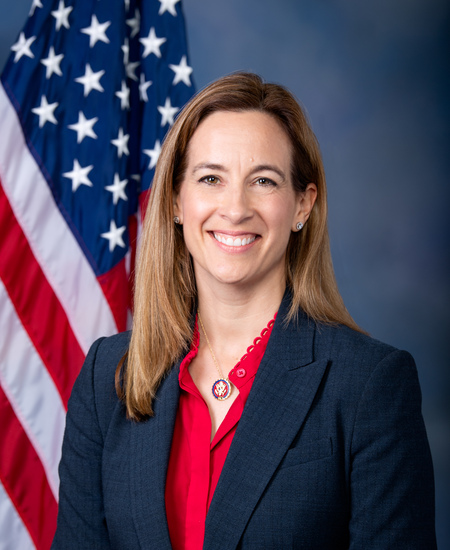
Rep. Mikie Sherrill
Sponsored bills
Stop Foreign Interference in Ballot Measures Act This bill prohibits contributions or donations by foreign nationals in connection with state or local ballot initiatives or referenda.
Fund for Innovation and Success in Higher Education Act or the FINISH Act This bill establishes and revises programs to increase access to higher education for high-need students, increase their graduation rates, improve the efficiency of postsecondary education, and evaluate higher education programs. Specifically, the bill authorizes the Department of Education to award grants to institutions of higher education (IHEs) and other entities to develop and implement evidence-based innovations, including pay-for-success initiatives, in order to improve postsecondary access and increase graduation rates of high-need students; approve up to five pay-for-success pilot initiatives each fiscal year to allow IHEs and private entities to use grants for improvement of student outcomes; and independently evaluate the effectiveness and efficiency of all higher education grant programs. The bill also encourages IHEs to make all forms of postsecondary instructional content, including open educational resources (e.g., textbooks), widely available. Open educational resources either reside in the public domain or have been released under a copyright license that permits their free use, reuse, modification, and sharing with others.
Alzheimer's Caregiver Support Act This bill authorizes grants to expand training and support services for families and caregivers of individuals living with Alzheimer's disease or a related dementia. The Department of Health and Human Services may award these grants to community organizations and health care and social service providers.
Unemployment Insurance Technology Modernization Act of 2021 This bill requires the Department of Labor to study and report on the technology needs of federal and state unemployment compensation programs. Based on this study, Labor must develop, operate, and maintain a modular set of technology capabilities to modernize the delivery of unemployment compensation. Before the deployment of the technology capabilities to all states, Labor must select at least four states to participate in a pilot program to test the technology capabilities and demonstrate that they meet requirements. The bill establishes accessibility requirements for filing online unemployment compensation claims. In addition, it prohibits the technology capabilities from relying solely on a high-risk automated decision system to (1) deny a claim for unemployment compensation, (2) reduce the amount of unemployment compensation for which a claimant is eligible, or (3) deny a claimant's right to appeal an unemployment compensation decision.
Federal Death Penalty Abolition Act of 2021 This bill prohibits the imposition of a death penalty sentence for a violation of federal law. It eliminates statutory authority for the death penalty as a sentencing option for federal offenses. It also requires a person who was sentenced to death before enactment of this bill to be resentenced.
Restoring Integrity to America's Elections Act This bill revises provisions regarding the Federal Election Commission (FEC), including to change FEC membership. Specifically, the bill reduces the number of appointed members of the FEC from six to five and permits no more than two members to be affiliated with the same political party. Further, it removes the Secretary of the Senate and Clerk of the House as ex officio members. Next, the bill establishes the Blue Ribbon Advisory Panel to recommend to the President individuals for nomination to the FEC. The President shall appoint the FEC chair, subject to Senate confirmation. The bill distributes the FEC's powers between the chair and the other FEC members. Further, it requires the FEC to ensure that its forms allow for the use of an accent mark as part of an individual's identification. The bill modifies the process for (1) the FEC to initiate an investigation, and (2) a party aggrieved by the FEC's dismissal of the party's complaint or the FEC's failure to take action on the party's complaint to seek judicial review in federal court. Additionally, individuals who submit written comments regarding requests for advisory opinions must be given an opportunity to appear at FEC hearings on those requests. The bill also permanently extends the FEC's administrative penalty authority. Finally, the bill provides statutory authority for limitations on ex parte communications as applied to FEC members and employees. It also specifies that FEC attorneys may represent the FEC before the Supreme Court.
Coronavirus Medicaid Response Act This bill increases the Medicaid federal matching rate, also known as the Federal Medical Assistance Percentage (FMAP), for states and U.S. territories that experience economic downturns (i.e., high unemployment) beginning on or after January 1, 2020, in accordance with specified requirements and limitations. The bill's increase is in addition to previously enacted FMAP increases relating to COVID-19 (i.e., coronavirus disease 2019) but may not result in an FMAP greater than 95%.
Juneteenth National Independence Day Act This bill establishes Juneteenth Independence Day as a federal holiday.
Protecting LGBTQ Youth Act This bill expands programs that prevent and treat child abuse and neglect to address issues facing lesbian, gay, bisexual, and transgender youth. Specifically, these programs include (1) research and reporting requirements, (2) providing technical assistance, (3) grants to states and local agencies to train child-welfare personnel, and (4) community-based prevention-service grants, among others.