This resolution supports the designation of National Health Care Awareness Month.
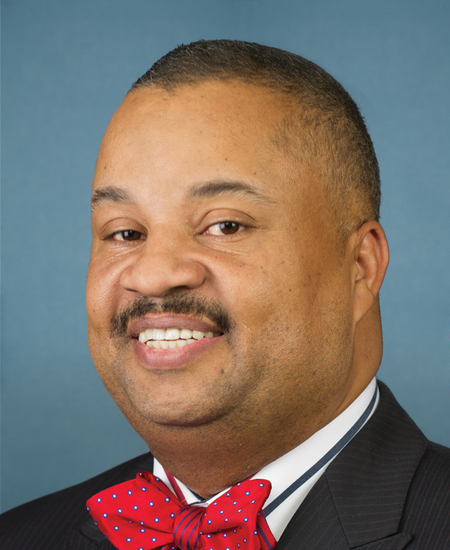
Rep. Donald M. Payne, Jr.
Sponsored bills
Choose Medicare Act This bill requires the Department of Health and Human Services (HHS) to establish public health insurance plans and addresses health insurance costs. Such public plans must be offered on health insurance exchanges and (1) meet the requirements of a qualified health plan; (2) cover benefits at the gold plan level; and (3) cover reproductive services, including abortions. Additionally, the bill makes a series of changes related to health insurance costs, including requiring employers to refer employees to health care navigators to assist with enrollment, establishing an annual limit on out-of-pocket costs for services under Medicare, providing HHS with the authority to negotiate prices under the Medicare prescription drug benefit program, expanding the premium-assistance credit by benchmarking the credit amount to the second-lowest cost gold plan and increasing the income threshold for eligibility, requiring qualified health plans to reduce cost sharing for low-income plan holders, providing funding for states to provide reinsurance to health insurance issuers and to assist individuals with out-of-pocket costs for plans offered through health insurance exchanges, applying the premium rate-setting requirements to large group health plans, and requiring HHS or states to take corrective actions to address unreasonable premium rates set by insurance issuers.
Migratory Bird Protection Act of 2021 This bill prohibits the incidental taking (e.g., capturing or killing) of migratory birds by commercial activities unless the activity is authorized under a permit or is identified as posing de minimis risk to migratory birds. The U.S. Fish and Wildlife Service (USFWS) must regulate such incidental taking, including by (1) issuing general permits for certain industries, (2) creating a mitigation fee for any incidental taking of migratory birds, and (3) identifying categories of de minimis risk activities that are exempt from liability for the taking of migratory birds. In addition, the USFWS must establish and maintain a research program (1) to evaluate the impacts of commercial activities on birds, (2) to evaluate the effectiveness of best management practices and technologies to avoid or minimize such impacts, and (3) to develop new or improved best management practices and technologies.
Creative Economy Revitalization Act This bill requires the Department of Labor to award grants to government and nonprofit agencies to provide programs that employ individuals and provide public access to art or arts programming.
Cultivating Organic Matter through the Promotion Of Sustainable Techniques Act or the COMPOST Act This bill makes composting a conservation practice for purposes of Department of Agriculture (USDA) conservation programs. The bill also requires USDA to establish a competitive program to award grants and loan guarantees for projects that expand access to food waste composting.
Twenty-First Century Dams Act This bill addresses dam infrastructure and safety. First, the bill provides resources for programs related to state dam safety, the rehabilitation of high hazard potential dams, and the inspection of dams. In particular, the bill reauthorizes through FY2026 the National Dam Safety Program. In addition, the bill reauthorizes through FY2026 a program related to the rehabilitation of structural measures and a program related to water infrastructure. Next, the bill allows a new tax credit for maintaining and enhancing hydroelectric dams that is equal to 30% of the basis of any qualified dam safety, environmental, and grid resilience enhancement property placed in service in a taxable year. It also allows a 30% credit for qualified obsolete river obstruction removal expenditures for demolishing and removing certain nonpowered or hydroelectric dams. The bill directs the Department of the Army to establish a program to carry out dam removal projects. Further, the bill establishes the Dam Removal Council to (1) coordinate with participating federal agencies to annually notify all known dam owners of the availability of dam removal funding and provide guidance on the existing programs of participating agencies; (2) evaluate and submit to Army recommendations for dam removal projects, technical assistance programs, and funding allocations; and (3) develop a dam removal strategy. The bill requires certain dam assessments, including a joint assessment by the U.S. Geological Survey and the Department of Energy. The bill also authorizes specified federal agencies to undertake certain activities related to federal dam infrastructure.

9/11 Responder and Survivor Health Funding Correction Act This bill increases funding for and otherwise modifies a federal program that provides medical monitoring and treatment to responders and survivors who suffer from health conditions related to the September 11, 2001, attacks on the World Trade Center. Among the changes, the bill allows certain health care providers other than physicians to determine whether an individual's health condition is related to the attacks, and it establishes a research program to study the impacts of the attacks on health and educational outcomes of individuals who were 21 years of age or younger when the attacks occurred.
This bill requires airports to broadcast in terminals automated announcements about the penalty for interfering with cabin or flight crews.
Equal Pay for Equal Work Act This bill establishes the National Equal Pay Enforcement Task Force to improve enforcement of equal pay laws.
Medical Device Nonvisual Accessibility Act of 2021 This bill requires certain medical devices with a digital interface to meet nonvisual accessibility standards established by the Food and Drug Administration (FDA). Specifically, the FDA must establish regulations to require a Class II or Class III medical device with a digital interface to provide a blind or low-vision user access to the same services and information, and generally the same ease of use, as provided to a user who is not low-vision or blind. (The FDA classifies medical devices in three classes. Class I devices are low-risk, Class II devices are moderate-risk, and Class III devices are high-risk.) A Class II or Class III medical device that does not meet the nonvisual accessibility standards established under this bill may not be sold.