

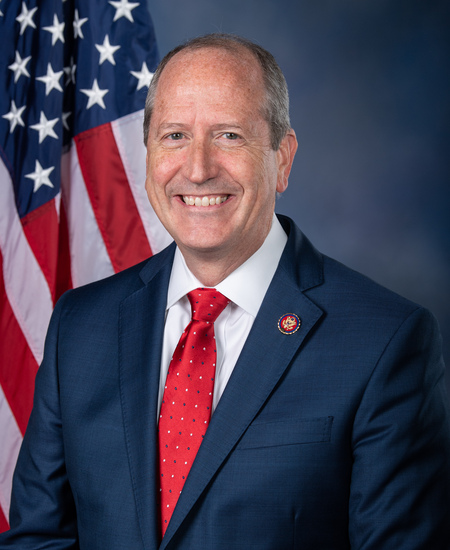
Guard Reimbursement for Unhealthy Bites Act or the GRUB Act This bill requires the Department of Defense to pay National Guard members a per diem for each day they performed duty between January 26, 2021, and March 15, 2021, in response to the attacks on January 6, 2021, on the U.S. Capitol building and grounds. The per diem rate must be equal to the proportional meal rate determined by the Defense Travel Management Office for the National Capital Region.
Rep. Dan Bishop
Sponsored bills
Advanced Nuclear Deployment Act This bill sets forth requirements to provide for the rapid deployment of new nuclear reactors. Specifically, the bill excludes from Nuclear Regulatory Commission (NRC) fees preapplication activities and review of an application for an early site permit to demonstrate an advanced nuclear reactor on a Department of Energy (DOE) or Department of Defense site. The NRC must also develop and implement (1) risk-informed and performance-based strategies and guidance to license and regulate micro-reactors, and (2) schedules to complete review activities applicable to the licensing of micro-reactors within two years. In addition, the NRC must establish and carry out an expedited procedure for issuing a combined license to construct a new nuclear reactor on or adjacent to a site that already has an existing reactor. Finally, the bill establishes a pilot program that allows DOE to make long-term power purchase agreements for power generated by commercial nuclear reactors.
Fair Access to Banking Act This bill restricts certain banks, credit unions, and payment card networks from refusing to do business with a person who is in compliance with the law. Restrictions include prohibiting the use of certain lending programs, initiating the process of terminating an institution's depository insurance, and instituting specified civil penalties.
Death Tax Repeal Act This bill repeals the estate and generation-skipping transfer taxes. It also makes conforming amendments related to the gift tax.
Treatment and Relief through Emerging and Accessible Therapy for PTSD Act or the TREAT PTSD Act This bill requires the Department of Veterans Affairs (VA) and the Department of Defense (DOD) to furnish stellate ganglion block to certain veterans or members of the Armed Forces (including reserve components) diagnosed with post-traumatic stress disorder (PTSD). Blocking the stellate ganglion (a group of nerves at the base of the neck) by injecting a local anesthetic is a treatment that may alleviate PTSD symptoms. The bill authorizes this treatment for any veteran or member of the Armed Forces who (1) is enrolled in the VA health care system or TRICARE program, (2) has been diagnosed with PTSD, and (3) has elected to receive stellate ganglion block after being informed by a physician of the risks and benefits. Such treatment may be furnished at a VA medical center, DOD medical facility, or through health care provider under the Veterans Community Care Program or TRICARE health insurance program. The bill also requires the VA and DOD to update the VA/DOD Clinical Practice Guideline (CPG) for the Management of PTSD to ensure that information about stellate ganglion block is included.
Immigration Detainer Enforcement Act of 2021 This bill expands statutory provisions to authorize the Department of Homeland Security (DHS) to request a law enforcement agency to detain an individual who has been arrested for violating any law (if the individual is believed to be an unlawfully present alien), where current provisions only explicitly authorize detainer requests for individuals arrested for violating controlled substances laws. The bill also modifies other related provisions. A law enforcement agency that has received a detainer request may hold the targeted individual for up to 48 hours. DHS may enter into agreements with law enforcement agencies to indemnify such agencies against claims for wrongful detention resulting from a detainer request. No provision of federal, state, or local law may restrict any government entity from (1) providing DHS with access to databases with information relating to issued detainers, or (2) holding an individual subject to a detainer. DHS shall periodically certify to Congress as to which state or local entities have not complied with a detainer request. Such entities shall be ineligible for compensation for costs related to honoring detainer requests. State and local entities that comply with DHS detainer requests shall have prioritized access to (1) certain law enforcement-related grants, and (2) certain excess federal property.
David Dorn Act of 2021 This bill increases criminal penalties for rioting and related offenses (e.g., inciting a riot). Specifically, the bill increases the maximum prison term from 5 to 10 years. Additionally, if a fine is imposed for an offense, the bill sets a minimum fine amount of $1,000.
Patrick Underwood Federal Law Enforcement Protection Act of 2021 This bill revises the federal criminal statute that prohibits assaulting, resisting, or impeding certain federal officers or employees. Among other changes, the bill increases the applicable penalties for such offenses.
This joint resolution proposes a constitutional amendment limiting Representatives to three terms and Senators to two terms. Terms beginning before the ratification of this amendment do not count towards these term limits.
This joint resolution proposes an amendment to the Constitution to require that the Supreme Court consist of nine Justices.