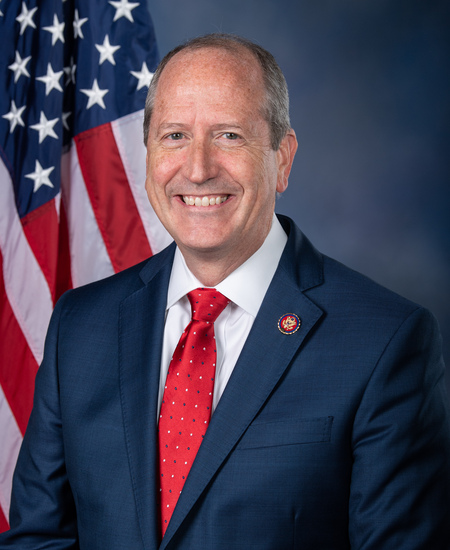
This bill moves portions of four counties encompassing the Fort Bragg Military Reservation and Camp Mackall from the Middle District to the Eastern District of North Carolina.
Rep. Dan Bishop
Sponsored bills
U.S. Military Right to Carry Act This bill requires a state that receives funds under the Edward Byrne Memorial Justice Assistance Grant Program to have implemented (1) a law or policy authorizing members of the Armed Forces who are outside of their state of residence under orders to renew a permit to carry a concealed firearm through the mail, and (2) a law or policy that treats members of the Armed Forces on active duty in the state as residents of the state for purposes of issuing a permit to carry a concealed firearm in the state. The Department of Justice must reduce by 5% the amount that a state would otherwise receive under the grant program if the state fails to comply with either requirement.
Regulations from the Executive in Need of Scrutiny Act of 20 21 This bill revises provisions relating to congressional review of agency rulemaking. Specifically, the bill establishes a congressional approval process for a major rule. A major rule may only take effect if Congress approves of the rule. A major rule is a rule that results in (1) an annual effect on the economy of $100 million or more; (2) a major increase in costs or prices for consumers, individual industries, government agencies, or geographic regions; or (3) significant adverse effects on competition, employment, investment, productivity, innovation, or the ability of U.S.-based enterprises to compete with foreign-based enterprises. In addition, the bill establishes a congressional disapproval process for a nonmajor rule. A nonmajor rule may only take effect if Congress does not disapprove of the rule.
Home Defense and Competitive Shooting Act of 2021 This bill removes short-barreled rifles (barrels of less than 16 inches in length) from the definition of firearms for purposes of the National Firearms Act. It also eliminates the prohibition on the transportation of such rifles in interstate commerce and treats persons who acquire or possess a short-barreled rifle as meeting the registration or licensing requirements for such rifle where such requirements are determined by reference to the National Firearms Act. The bill preempts state or local laws that impose a tax or recordkeeping requirements on short-barreled rifles. The Department of Justice must destroy records relating to the registration of certain rifles within one year after the enactment of this bill.
Lawful Interstate Transportation of Firearms Act This bill revises criminal provisions related to the interstate transportation of firearms and ammunition. An individual may transport a firearm between two places (e.g., states) where it is legal to possess, carry, or transport the firearm. During transport, the firearm must be unloaded and secured or securely stored. Additionally, an individual may transport ammunition, or a detachable magazine or feeding device, between two places where it is legal to possess, carry, or transport the ammunition, magazine, or feeding device. During transport, the ammunition, magazine, or feeding device must not be loaded into a firearm and must be securely stored. The term transport includes staying in temporary lodging; stopping for food, fuel, vehicle maintenance, an emergency, or medical treatment; or any other activity incidental to the transport. The bill prohibits the arrest or detention of an individual for a state or local firearm or ammunition violation unless there is probable cause to believe the individual failed to comply with the provisions of this bill, and there is probable cause to believe the individual committed another crime.

Defending Our Defenders Act This bill establishes federal criminal offenses involving the murder of federal, state, or local law enforcement officers. Violators are subject to life in prison or death. The bill sets forth aggravating factors (e.g., intent to ambush or prior history of promoting violence against a law enforcement officer) to be considered in determining whether to impose the death penalty.
Foreign Influence Transparency Act This bill addresses foreign influence in higher education and in certain other academic, religious, and artistic pursuits. Current law exempts from foreign agent registration requirements a person engaging in activities in furtherance of religious, scholastic, academic, or scientific pursuits or of the fine arts. The bill specifies that this exemption applies only to those activities that do not promote the political agenda of a foreign government. Under current law, an institution of higher education (IHE) must disclose to the Department of Education (ED) a gift or contract that is from a foreign source and is valued at $250,000 or more, considered alone or in combination with all other gifts from or contracts with the foreign source. The bill instead requires an IHE to disclose such a gift or contract that is valued at $50,000 or more, considered alone or in combination with all other gifts or contracts. An IHE must include in its disclosure report the contents of any such contract and make the contents available for public disclosure. Additionally, an IHE that enters into an agreement with a Confucius Institute (i.e., a cultural institute directly or indirectly funded by the Chinese government) must immediately make available the full text of the agreement to the public, ED, and Congress. Finally, the bill prohibits an IHE that does not comply with these disclosure requirements from enrolling foreign students under the Student and Exchange Visitor Program.
Jump-Start the Economy with Jobs Act This bill requires each state that offers pandemic unemployment assistance (PUA) or pandemic emergency unemployment compensation (PEUC) to condition benefit eligibility for a long-term unemployed individual on an employer's confirmation that work is unavailable for the unemployed individual. Specifically, each state unemployment agency must request confirmation from the unemployed individual's most recent employer that the individual's position is not available at the time of the request. Unless the employer provides this confirmation, the state must terminate the individual's PUA or PEUC. The bill's provisions apply only to long-term unemployed individuals who have received PUA or PEUC for more than 30 weeks of unemployment.
This resolution calls on the Office for Civil Rights within the Department of Education and state attorneys general to assist elementary and secondary schools in complying with existing civil rights laws and investigate and enforce such laws. In addition, the resolution condemns the practice of requiring teachers to receive education in critical race theory as a condition of certification.
Contents of Our Character Act of 2021 This bill prohibits agencies from using federal funds to conduct or promote specified workplace training related to race or sex.