This resolution recognizes Claudette Colvin as an integral figure of the civil rights movement and honors her actions leading to the Montgomery Bus Boycott and the related Supreme Court ruling that found segregation on buses to be unconstitutional.
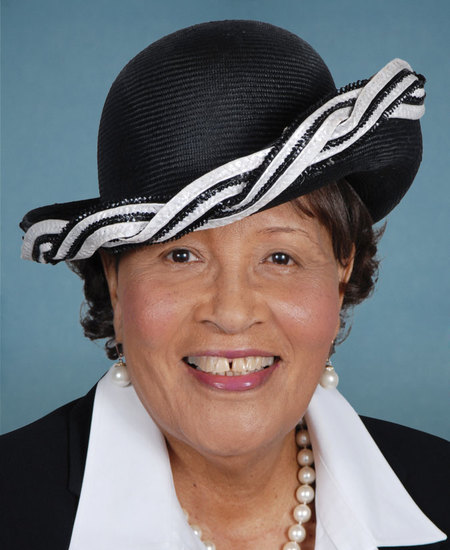
Rep. Alma S. Adams
Sponsored bills
This resolution recognizes the contribution of the Greensboro Four to the civil rights movement and the significant role they played as a catalyst for the mobilization of college students coalescing in the formation of the Student Non-Violent Coordinating Committee. The resolution (1) recognizes that ethnic and racial diversity of the United States enriches and strengthens the nation, and (2) encourages states to include the history and contributions of the Greensboro Four in their educational curricula.
Maddy summaryHRES 893 is a non-binding House resolution designating January 1 to February 1, 2022, as "National Trafficking and Modern Slavery Prevention Month." It urges the public, government agencies, and organizations to raise awareness about human trafficking through educational programs and activities during this period. The resolution does not create new laws or allocate funds - it is a symbolic measure to promote existing anti-trafficking efforts and partnerships. It directly affects all U.S. citizens by encouraging nationwide awareness, but it has no legal force or direct impact on specific groups.
This resolution expresses the sense of the House of Representatives that the proposed constitutional amendment known as the Equal Rights Amendment has been duly proposed by Congress and ratified by the states and is therefore valid as the Twenty-Eighth Amendment to the Constitution. (The proposed amendment prohibits the United States or any state from denying or abridging equal rights under the law on account of sex.)
This resolution expresses support for the principles of Transgender Day of Remembrance, memorializing the lives lost to anti-transgender violence this year.
Maddy summaryHRES 798 is a symbolic House resolution expressing the sense of Congress about the link between firearm violence and intimate partner violence, honoring victims like Gladys Ricart. It cites statistics showing firearms are used in 59% of intimate partner homicides, with women facing a 5x higher risk of being killed when an abusive partner has access to a gun. The resolution recommends specific policy actions, including strengthening background checks, restricting firearm access for those subject to domestic violence restraining orders, and supporting research on the disproportionate impact on Black, American Indian/Alaska Native, and Hispanic women. It does not create new law but urges Congress to advance related legislation like the Zero Tolerance for Domestic Abusers Act. The resolution directly addresses the intersection of firearms and intimate partner violence affecting millions of women, particularly in marginalized communities.
This resolution expresses the sense of the House of Representatives that (1) lesbian, gay, bisexual, transgender, queer, intersex, and asexual (LGBTQIA+) rights are human rights and protected by the U.S. Constitution; (2) LGBTQIA+ Pride Month should be celebrated; and (3) all Americans should be treated equally regardless of sexual orientation or gender identity.
Providing Real Opportunities and Lifelong Investments For Everyone Act of 2022 or the PRO-LIFE Act of 2022 This bill establishes new, and modifies existing, programs related to maternal and child health, tax credits and other benefits for parents and caregivers, and support for childcare infrastructure. The bill requires multi-agency efforts to improve maternal health and reduce maternal mortality, particularly among racial and ethnic minority groups, veterans, and other vulnerable populations, by addressing both health-related factors and the social determinants of health (i.e., nonmedical factors that influence health outcomes, such as housing, food security, transportation, and environmental conditions). Additionally, the bill permanently extends the Children's Health Insurance Program (CHIP) and related measures. Further, the bill (1) sets up a family medical leave insurance benefit that entitles employees to a monthly benefit payment for a period of qualified caregiving; and (2) imposes a tax on employers, employees, and self-employed individuals to fund the benefits. The bill also increases the amount of the child tax credit and makes the credit fully refundable and payable in advance on a monthly basis. In addition, the Department of Labor must carry out a program to certify and recognize employers that implement family-friendly workplace programs (e.g., providing paid family and sick leave or subsidizing childcare). The bill also requires support for childcare infrastructure, for example by establishing grants for childcare facilities and scholarship and loan repayment programs for childcare educators.

Afghan Adjustment Act This bill expands eligibility for special immigrant visas to certain Afghan nationals (and accompanying spouse and children) and addresses related issues. The Department of Homeland Security may provide such visas to Afghan nationals who provided qualifying service as a member of the Afghan Air Force or other specified entities and meet eligibility requirements, such as passing a background check. Currently, special immigrant visas for Afghan nationals are generally only available to those who were employed by or on behalf of the U.S. government in Afghanistan. Such visas shall also be available to an Afghan national who is a qualifying relative of a veteran or member of the U.S. Armed Forces. The bill also modifies procedures for providing lawful permanent resident status to certain classes of Afghan nationals, such as by (1) providing a streamlined process with specified vetting requirements for certain individuals, including those who provided support to the U.S. government in Afghanistan; and (2) preserving the eligibility of certain battered spouses whose eligibility for such status stemmed from a marriage that has terminated. Furthermore, the Department of State (1) must respond to inquiries from Members of Congress about specific applications from Afghan nationals seeking special immigrant or refugee status; and (2) establish an office in Afghanistan to perform certain tasks, such as issuing visas, if no U.S. embassies are operational in Afghanistan. The President must establish a task force to develop and implement a strategy to assist Afghan nationals who qualify for admission to the United States.
Animal Violence Exposes Real Threat of Future Violence Act of 2022 or the AVERT Future Violence Act of 2022 This bill directs the National Institute of Justice within the Department of Justice (DOJ) to study the factors that contribute to acts of animal cruelty. The report must also analyze acts of animal cruelty as a predictor of future violence against humans. Additionally, the bill authorizes DOJ to establish a grant program to support the development and strengthening of detection strategies and early intervention or diversion resources to stop acts of animal cruelty and rehabilitate offenders.