Firearm Lockbox Protection Act of 2022 This bill allows the General Services Administration, upon request of the Administrative Office of the U.S. Courts, to provide a secure firearms storage facility at the official duty station of each judge or justice for any firearm lawfully possessed by the judge or justice. Agencies that employ an administrative judge must provide a secure firearms facility at the principal duty station of that judge for any firearm lawfully possessed by the judge.
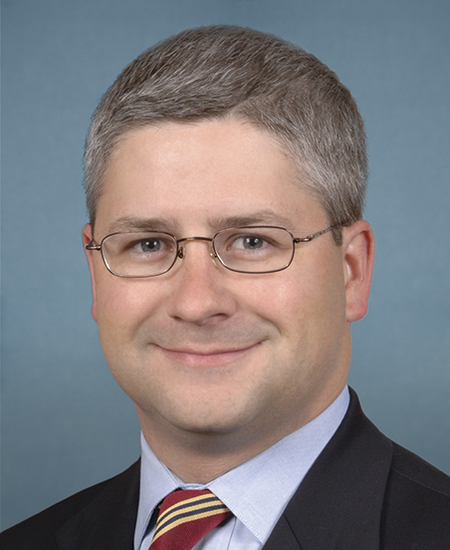
Rep. Patrick T. McHenry
Sponsored bills
Illegal Immigrant Payoff Prohibition Act This bill prohibits the payment of a settlement to an alien for a civil action brought against the United States in connection with the alien's inadmissibility to, or unlawful presence in, the United States.
This bill designates the facility of the United States Postal Service located at 3900 Crown Road Southwest in Atlanta, Georgia, as the John R. Lewis Post Office Building.
Educational Choice for Children Act This bill allows individuals and corporations a new tax credit after 2022 for charitable contributions to tax-exempt organizations that provide scholarships to elementary and secondary school students. Such students must be members of a household with incomes not greater 300% of the area median gross income and be eligible to enroll in a public elementary or secondary school. The bill excludes from the gross income of taxpayer dependents any scholarship amount for the elementary or secondary education expenses of eligible students. It also prohibits governmental control over scholarship granting organizations.
Maddy summaryHRES 1386 is a non-binding resolution designating the week of September 26-30, 2022, as "National Clean Energy Week." It expresses the House’s support for this designation and encourages individuals, organizations, and governments to promote clean energy solutions. The resolution highlights clean energy’s economic benefits (like supporting 7.8 million jobs in 2021) and urges investment in affordable, low-emission energy technologies. It does not create new laws, funding, or obligations - it is purely symbolic recognition of the clean energy sector’s role in the U.S. economy.
Promoting New and Diverse Depository Institutions Act This bill requires federal banking agencies to study and report on the challenges faced by entities attempting to become chartered depository institutions and to develop a strategic plan to assist in the application process. The strategic plan must (1) promote the chartering of minority depository institutions and entities that could be certified as community development financial institutions, and (2) describe actions to increase the number of depository institutions located in underserved areas. The bill also decreases, beginning September 30, 2022, the cap on the surplus funds of the Federal Reserve banks. (Amounts exceeding this cap are deposited in the general fund of the Treasury.)
Reduce Exacerbated Inflation Negatively Impacting the Nation Act This bill requires the Office of Management and Budget and the Council of Economic Advisers to provide an inflation estimate for each executive order that is projected to cause an annual gross budgetary effect of at least $1 billion. The estimate must determine whether the executive order will have no significant impact on inflation, a quantifiable inflationary impact on the consumer price index, or a significant impact on inflation that cannot be quantified at the time the estimate is prepared. The requirement does not apply to executive orders that (1) provide for emergency assistance or relief at the request of any state or local government or an official of the government, or (2) are necessary for national security or the ratification or implementation of international treaty obligations.
This joint resolution prospectively nullifies the rule proposed by the Securities and Exchange Commission titled The Enhancement and Standardization of Climate-Related Disclosures for Investors on April 11, 2022. The proposed rule requires registrants to disclose their climate-related risks.
Recovering America’s Wildlife Act of 2022 This bill provides funding for the conservation or restoration of wildlife and plant species of greatest conservation need, including endangered or threatened species, and establishes related requirements. TITLE I--WILDLIFE CONSERVATION AND RESTORATION (Sec. 101) This title establishes and funds a subaccount of the Wildlife Conservation and Restoration Account, which was established under the Pittman-Robertson Wildlife Restoration Act. The subaccount must be used to support efforts of states, territories, or the District of Columbia to recover and manage wildlife and plant species of greatest conservation need. The Department of the Interior must use a portion of the funding from the subaccount for grants to state fish and wildlife departments, the District of Columbia fish and wildlife department, fish and wildlife departments of territories, nonprofit organizations, or regional associations of fish and wildlife departments. The grants must be used for innovative recovery efforts for species of greatest conservation need, species listed as endangered or threatened species, or the habitats of such species. Funding for the subaccount must supplement existing funds available to the states from funds distributed under the Dingell-Johnson Sport Fish Restoration Act and the Wildlife Conservation and Restoration Account. Recipients of the funding from the subaccount must match federal funds as specified by the title. The Government Accountability Office must study and report on the progress of states, territories, the District of Columbia, and Indian tribes in protecting species of greatest conservation need, endangered species, and threatened species. TITLE II--TRIBAL WILDLIFE CONSERVATION AND RESTORATION (Sec. 201) This title establishes and funds a Tribal Wildlife Conservation and Restoration Account to support Indian tribes' efforts to recover and manage wildlife and plant species of greatest conservation need. Indian tribes are not required to provide matching funds. TITLE III--ENDANGERED SPECIES RECOVERY AND HABITAT CONSERVATION LEGACY FUND (Sec. 301) This title establishes and funds through FY2026 the Endangered Species Recovery and Habitat Conservation Legacy Fund. The U.S. Fish and Wildlife Service must use the fund to (1) implement an Endangered Species Recovery Grant Program; (2) address its interagency consultation responsibilities under the Endangered Species Act of 1973; (3) work with nonfederal entities to conserve wildlife habitat and at-risk species, threatened or endangered species, or species proposed to be listed as threatened or endangered species; or (4) address the development and permitting of voluntary conservation agreements under such act. Amounts made available under the fund must supplement other federal amounts made available to carry out such activities. The President must annually submit to Congress, together with the annual budget of the United States, a list of threatened species and endangered species for which recovery plans will be developed or implemented with amounts from the Endangered Species Recovery and Habitat Conservation Legacy Fund. TITLE IV--REPORT (Sec. 401) Interior must also report on information concerning the amount of grants and contracts that were awarded or are allocated under this bill to Historically Black Colleges and Universities, Hispanic-serving educational institutions, tribally controlled colleges and universities, minority-serving educational institutions, minority-owned business enterprises, women-owned business enterprises, and community-based organizations that are principally administered by, operated by, or serving minority communities.

Maddy summaryThe National Flood Insurance Program Extension Act of 2022 extends the federal flood insurance program until December 31, 2023, instead of ending on September 30, 2022. This directly affects homeowners, renters, and businesses in communities participating in the National Flood Insurance Program (NFIP), ensuring continued access to flood coverage. The bill amends two key sections of the 1968 law to update the program's expiration dates and includes a retroactive provision covering the period from September 30, 2022, through the new end date.