

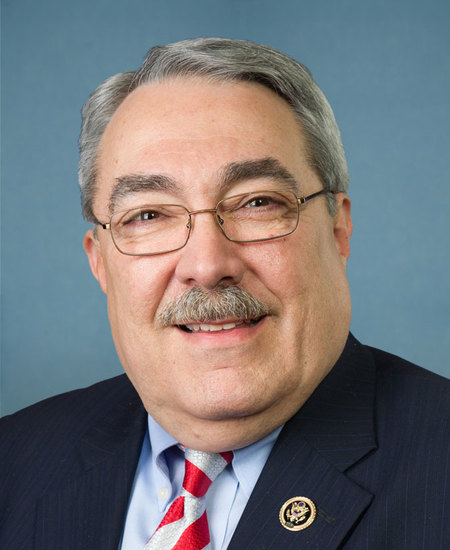
This resolution recognizes the contribution of the Greensboro Four to the civil rights movement and the significant role they played as a catalyst for the mobilization of college students coalescing in the formation of the Student Non-Violent Coordinating Committee. The resolution (1) recognizes that ethnic and racial diversity of the United States enriches and strengthens the nation, and (2) encourages states to include the history and contributions of the Greensboro Four in their educational curricula.
Rep. G. K. Butterfield
Sponsored bills
This resolution expresses the sense of the House of Representatives that the proposed constitutional amendment known as the Equal Rights Amendment has been duly proposed by Congress and ratified by the states and is therefore valid as the Twenty-Eighth Amendment to the Constitution. (The proposed amendment prohibits the United States or any state from denying or abridging equal rights under the law on account of sex.)
Maddy summaryHRES 588 (2021) is a House resolution honoring the Clinton 12 - 12 Black students who desegregated Clinton High School in Tennessee in 1956, facing violent threats from the KKK and community hostility. The resolution commemorates their bravery in pursuing equal education amid racial terror, including the 1958 bombing of their school, and references the Supreme Court’s Brown v. Board of Education ruling. It does not create new laws or policies but symbolically recognizes their legacy and calls for upholding the promise of equal educational opportunities.
Leading Against White Supremacy Act of 2022 This bill establishes a standard for determining whether a person engaged in a white supremacy inspired hate crime. The bill also sets forth the elements of related conspiracies. Specifically, the bill states that a person engaged in a white supremacy inspired hate crime when white supremacy ideology motivated the actions that constituted a crime or were undertaken in furtherance of activity that would have constituted a crime. Additionally, the bill sets forth the elements of an offense involving the conspiracy to engage in a white supremacy inspired hate crime. Finally, the bill authorizes the Department of Justice to investigate, prosecute, and maintain records of white supremacy inspired hate crimes and related conspiracies.
Maddy summaryThis bill grants a federal charter to National American Indian Veterans, Incorporated, a nonprofit organization serving American Indian veterans. It formalizes the group’s structure, requiring it to maintain tax-exempt status while advocating for veterans’ needs with specific prohibitions (e.g., no stock, dividends, or loans to members). The charter mandates annual reports to Congress detailing the organization’s activities but does not create new benefits or services for veterans. It directly affects the organization and the American Indian veterans it represents, ensuring its operations align with federal nonprofit standards.
Family Notification of Death, Injury, or Illness in Custody Act of 2021 This bill requires the Department of Justice (DOJ) to develop policies and procedures for notifying next-of-kin or other emergency contacts in the event of the death, or serious illness or serious injury, of an individual in custody. The bill requires DOJ to implement the policies and procedures at its detention agencies. Further, the bill requires DOJ to distribute model policies and procedures to state, territorial, tribal, and local detention agencies.
Protect Black Women and Girls Act of 2021 This bill establishes an Interagency Task Force to examine the conditions and experiences of Black women and girls to identify and assess the efficacy of policies and programs of federal, state, and local governments designed to improve outcomes for such individuals and to make recommendations to improve such policies and programs. The task force shall (1) cover issues involving Black women and girls in education, economic development, health care, justice and civil rights, and housing; and (2) submit recommendations at specified intervals to Congress, the President, and each state or local government on policies, practices, programs, and incentives that may be adopted to improve outcomes. The U.S. Commission on Civil Rights shall conduct a comprehensive study and collect data with respect to the effects on Black women and girls of a wide range of specified economic, health, criminal justice, and social services factors.
Repeal Existing Policies that Encourage and Allow Legal HIV Discrimination Act of 2022 or the REPEAL HIV Discrimination Act of 2022 This bill addresses federal and state laws, policies, and regulations that may burden people living with HIV/AIDS. Specifically, the bill directs the Department of Justice (DOJ), the Department of Health and Human Services (HHS), the Department of Defense (DOD), and the White House Office of National AIDS Policy to initiate a national review of federal (including military) and state laws, policies, regulations, and judicial precedents and decisions regarding criminal and related civil commitment cases involving people living with HIV/AIDS. DOJ must transmit to Congress and make publicly available the results of such review with related recommendations. The White House Office of National AIDS Policy must also develop and publicly release guidance to assist states with handling relevant cases. The office, DOJ, HHS, and DOD must transmit to the President and Congress any proposals necessary to implement adjustments to federal laws, policies, or regulations. This bill shall not be construed to discourage the prosecution of individuals who act with the intent to do harm to another individual by intentionally transmitting HIV.
Lifting Immigrant Families Through Benefits Access Restoration Act of 2021 or the LIFT the BAR Act of 2021 This bill repeals certain limits on the eligibility of noncitizens who lawfully reside in the United States for federal means-tested programs, including Medicaid, the Children's Health Insurance Program (CHIP), programs funded through Temporary Assistance for Needy Families (TANF) grants, Supplemental Security Income (SSI), and certain nutrition and housing programs.
District Court Judgeships Act of 2021 This bill requires the appointment of additional U.S. district court judges and converts certain temporary district court judgeships into permanent judgeships. Specifically, the bill requires the appointment of 203 district court judges in specified judicial districts in Arkansas, Arizona, California, Colorado, Delaware, Florida, Georgia, Idaho, Illinois, Indiana, Louisiana, Maryland, Michigan, Minnesota, Missouri, North Carolina, Nebraska, Nevada, New Jersey, New Mexico, New York, Ohio, Oregon, Pennsylvania, South Carolina, Tennessee, Texas, Utah, Virginia, Washington, Wisconsin, and West Virginia. Additionally, the bill converts certain temporary district court judgeships to permanent judgeships in specified judicial districts in Alabama, Arizona, California, Florida, Kansas, Missouri, New Mexico, North Carolina, and Texas.