

Maddy summaryHR 6211, the SAFE Act of 2023, prohibits U.S. immigration benefits for individuals holding passports issued by the Palestinian Authority. It blocks the issuance or renewal of visas, temporary protected status, asylum, refugee status, and parole for these individuals, and mandates the revocation of any such status granted on or after October 1, 2023. The bill also declares covered aliens inadmissible and requires immigration authorities to identify and remove Palestinians without lawful status who arrived after that date. This law directly affects Palestinian passport holders seeking to enter or remain in the United States through standard immigration pathways.
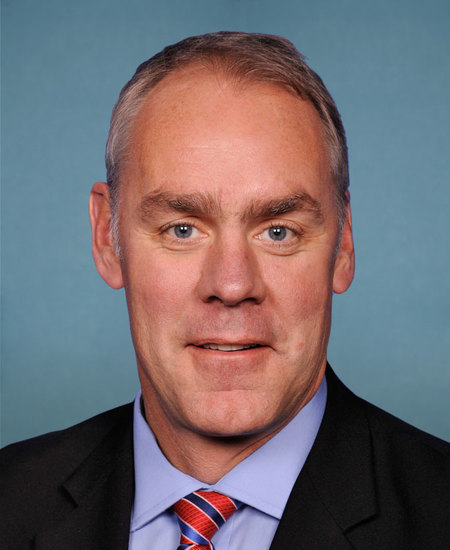
Rep. Ryan K. Zinke
Sponsored bills
Maddy summaryThe Combatting Fentanyl Poisonings Act of 2023 authorizes federal grants to state/local law enforcement and nonprofit organizations to address fentanyl-related harms. It provides funding for law enforcement to target social media platforms used for selling controlled substances (including education on counterfeit fentanyl risks) and for nonprofits to run public awareness campaigns about fentanyl dangers, including naloxone training and support for families affected by fentanyl deaths. Grants under section 509(a) are capped at $50,000 per nonprofit, with strict limits prohibiting funds for harm reduction supplies (except naloxone). The bill reserves $10 million for law enforcement grants and $2 million for public awareness grants under this act.
Maddy summaryThe Rape Kit Backlog Progress Act of 2023 requires states and local governments receiving federal crime-fighting grants to conduct comprehensive inventories of all sexual assault kits (both tested and untested) and report key details to the Attorney General. It mandates that jurisdictions document victim consent for testing, upload DNA results to the national CODIS database, establish electronic tracking systems for victims, and implement victim notification protocols. States must submit these reports annually to maintain eligibility for federal grants, with the Attorney General publishing a public annual report on backlog status and compliance. This law directly affects state/local law enforcement agencies and prosecutors handling sexual assault cases, aiming to improve transparency and accountability in processing evidence.
Maddy summaryHRES 774 is a symbolic resolution recognizing the influx of known or suspected terrorists along the U.S. northern border as a national security threat. It cites statistics showing 432 such encounters in fiscal year 2023 (up 38% from 2022), with a 1,889% increase in monthly encounters since President Biden took office in 2021. The resolution specifically demands Secretary of Homeland Security Mayorkas implement a plan to better secure the northern border. As a non-binding resolution, it does not create new law or policy but expresses congressional concern based on the cited data.
This resolution condemns the release of $6 billion in sanctioned Iranian funds and urges the immediate rescission of the waiver that allowed for the transfer of such assets. It also condemns potential violations of the Taylor Force Act, which prohibits U.S. foreign assistance from directly benefiting the Palestinian Authority except for certain humanitarian purposes.
Maddy summaryHRES 771 is a non-binding resolution expressing the U.S. House of Representatives' support for Israel following Hamas' October 7, 2023, attack. It condemns Hamas' actions, affirms Israel's right to self-defense, and calls for the immediate release of hostages. The resolution also urges enforcement of existing laws restricting aid to terrorists and sanctions against Iran for supporting Hamas. It does not create new policies or allocate funds, as it is a symbolic statement of congressional support.
Maddy summaryHRES 768 is a symbolic House Resolution expressing congressional support for Israel following Hamas' October 7, 2023 attacks. It condemns Hamas' actions, reaffirms Israel's right to self-defense, and calls for the immediate release of hostages. The resolution references the U.S. commitment to Israel's security through existing military aid programs, including the 2016 U.S.-Israel Memorandum of Understanding, and emphasizes enforcement of laws like the Taylor Force Act to prevent U.S. aid from reaching terrorist groups. As a symbolic resolution, it does not create new policy but serves as a statement of congressional support for Israel.
Drone Research and Innovation for Law Enforcement Act of 2023 This bill directs the Federal Aviation Administration (FAA) to study, and create an approval process for, nonlethal de-escalation unmanned aircraft (i.e., drones). Under the bill, nonlethal de-escalation unmanned aircraft means an unmanned aircraft that is equipped with one or more nonlethal weapons or devices and is used by law enforcement personnel in scenarios (1) that present significant risk to human life, and (2) in which the suspected criminal is in a position to potentially escalate the situation and expose human life to a high level of risk. Specifically, the FAA must initiate a pilot research program to study the potential use of nonlethal de-escalation unmanned aircraft by law enforcement agencies. As part of the study, the FAA must enter into interagency agreements with various federal, state, and local agencies. The FAA must submit a report on the results of the research program to Congress. The report must include a plan outlining a proposed FAA application process for law enforcement to seek permission to operate nonlethal de-escalation unmanned aircraft. Within 90 days of submitting the report, the FAA must initiate rulemaking to create a process through which the FAA may provide approval to operate these unmanned aircraft.
Maddy summaryHJRES 11 proposes a constitutional amendment that would limit Members of Congress to serving a maximum of three terms in the House of Representatives and two terms in the Senate. If passed and ratified, it would prevent any member who has already served the maximum terms from running for re-election, including time spent filling vacancies (for more than one year in the House or three years in the Senate). This amendment directly affects current and future members of Congress by changing eligibility rules for re-election. The proposal is currently a joint resolution in the House, requiring ratification by three-fourths of state legislatures to become part of the Constitution.
Maddy summaryHR 5791, the "Define the Mission Act," requires the President to submit a comprehensive strategy report to Congress within 30 days of the bill's enactment, detailing U.S. involvement in the Ukraine conflict. The report must define U.S. national interests in the conflict, set specific objectives with timelines, benchmarks, and resource estimates (including personnel and funding), list expected European NATO security contributions, and assess Russia’s natural gas market impact on resolving the conflict. It mandates the strategy must aim for a Russia-Ukraine cease-fire agreement and explicitly cannot depend on U.S. funding for Ukrainian reconstruction. The report must be unclassified but may include a classified annex for full transparency. This bill establishes a formal process for Congress to review and oversee U.S. policy toward Ukraine.