

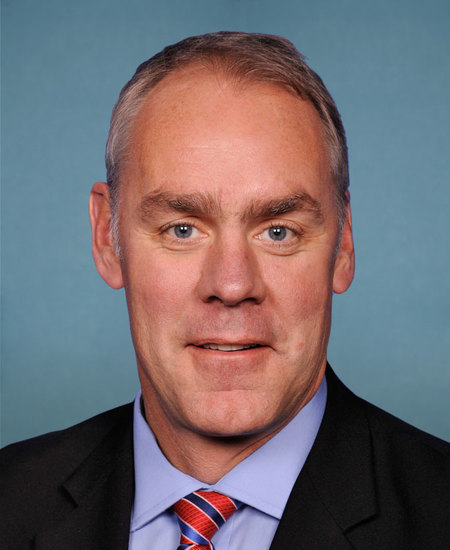
Photo of Ryan K. Zinke
R United States House · District 1 · Montana

Rep. Ryan K. Zinke

Compare
Total votes
1,879
all sessions
Attendance
97%
47 missed
Near the chamber average
With party
94%
of cast votes
Near the chamber average
Bipartisan score
3%
crosses aisle rarely
Near the chamber average
Sponsored
415
bills & resolutions
Lower than 84% of chamber peers
Committees
7
assignments
415 bills and resolutions

Sponsored bills

Total
415
Primary
31
Co-sponsor
384
This page
415
matching current filters
Co-sponsor HR 1097
Signed into law · United States House · Co-sponsor
Everett Alvarez, Jr. Congressional Gold Medal Act of 2023

Maddy summaryThis bill, HR 1097 (Everett Alvarez, Jr. Congressional Gold Medal Act of 2023), authorizes the award of a Congressional Gold Medal to Everett Alvarez, Jr., in recognition of his service as a U.S. Navy pilot and Vietnam War prisoner of war. It directly honors Alvarez, who was the first U.S. pilot shot down in the Vietnam War, spent over 8.5 years in captivity, and later served in the Peace Corps and Veterans Administration. The bill’s key mechanism is directing the U.S. Mint to strike a gold medal bearing his name and image, with bronze duplicates available for sale to cover costs. It does not create new policies or affect any group beyond the honoree.

Signed into law Dec 23, 2024 1 co-sponsor
Co-sponsor HR 8784
In committee · United States House · Co-sponsor
FREE Act

Maddy summaryHR 8784, the FREE Act, requires federal agencies to replace slow, discretionary permitting systems with a streamlined "permit by rule" process. Applicants would certify compliance with written requirements, and permits would automatically be approved within 30 days unless the agency proves non-compliance. Agencies must first report on all current permits and identify which could switch to this system, with a deadline of 240 days after enactment. This directly affects federal agencies managing permits and applicants seeking permits, aiming to reduce delays while maintaining enforcement for violations through audits and appeals.

In committee Dec 19, 2024 1 co-sponsor
Co-sponsor HR 7516
In committee · United States House · Co-sponsor
Purchased and Referred Care Improvement Act of 2024

Maddy summaryThis bill (HR 7516) updates the Indian Health Care Improvement Act to clarify and improve reimbursement for Native American patients who pay out-of-pocket for authorized "purchased/referred care" services through the Indian Health Service (IHS). It requires the IHS to establish procedures within 120 days to reimburse patients within 30 days of receiving documentation (electronically or in-person) for such care. The bill replaces outdated terms like "contract health care" with "purchased/referred care" throughout the law and clarifies that the IHS is not liable to debt collectors for these payments. It directly affects Native American patients who receive IHS-authorized care outside of regular IHS facilities.

In committee Dec 18, 2024 1 co-sponsor
Co-sponsor HR 7408
In committee · United States House · Co-sponsor
America’s Wildlife Habitat Conservation Act

Maddy summaryThe America's Wildlife Habitat Conservation Act creates new funding mechanisms to support wildlife habitat conservation across the United States. It establishes a $300 million annual subaccount for states, territories, and the District of Columbia to restore habitat for species listed as threatened or endangered under federal or state law, and to prevent species from needing such listings, with at least 15% of funds dedicated to endangered species recovery. The bill also creates a $20 million annual account specifically for tribal wildlife conservation programs. Funds must be used for habitat restoration, species conservation, invasive species management, and must be tracked through annual reporting requirements to demonstrate effectiveness.

In committee Dec 18, 2024 1 co-sponsor
Co-sponsor HR 5482
In committee · United States House · Co-sponsor
Energy Poverty Prevention and Accountability Act of 2024

Maddy summaryThis bill requires federal agencies to assess whether energy policies and rules disproportionately affect at-risk communities, including low-income, minority, rural, elderly, and Native American communities. Agencies must conduct studies before actions like leasing federal land or issuing new energy rules, and include an "energy poverty statement" certifying the policy won't cause energy poverty. Within one year, the Comptroller General and OMB must jointly report to Congress on how current policies impact these communities and recommend solutions to reduce energy poverty. The law aims to prevent energy poverty by mandating concrete evaluations of policy impacts on vulnerable groups.

In committee Dec 18, 2024 1 co-sponsor
Co-sponsor HR 4374
In committee · United States House · Co-sponsor
Energy Opportunities for All Act

Maddy summaryHR 4374, the Energy Opportunities for All Act, nullifies Public Land Order No. 7923, which had withdrawn public lands surrounding Chaco Culture National Historical Park in San Juan County, New Mexico. This bill directly affects land management decisions in that specific area by reversing a prior administrative withdrawal. The key provision is the explicit repeal of the order, restoring the lands to their previous management status under federal law. The bill does not create new energy policies or programs, despite its title. (Note: The title appears misleading as the bill addresses land withdrawal, not energy opportunities.)

In committee Dec 18, 2024 1 co-sponsor
Co-sponsor HR 3269
In committee · United States House · Co-sponsor
Law Enforcement Innovate to De-Escalate Act

Maddy summaryHR 3269, the Law Enforcement Innovate to De-Escalate Act, exempts specific less-than-lethal projectile devices from federal firearm taxes and National Firearms Act restrictions. The bill defines these devices as those firing projectiles at under 500 feet per second and designed not to cause death or serious injury. This directly affects law enforcement agencies using such devices and manufacturers producing them, by removing tax burdens and registration requirements. The key change is creating a clear legal exemption for these devices under federal law, streamlining their use for de-escalation purposes.

In committee Dec 18, 2024 1 co-sponsor
Co-sponsor HR 1419
In committee · United States House · Co-sponsor
Comprehensive Grizzly Bear Management Act of 2023

Maddy summaryThis bill directs the U.S. Fish and Wildlife Service to remove the Northern Continental Divide Ecosystem grizzly bear population from the federal endangered species list within 180 days of the bill's enactment. It directly affects grizzly bears in Montana and Idaho by ending their federal protected status. The key provision mandates the removal without regard to other legal requirements and explicitly prohibits judicial review of the decision. This would shift management authority to state agencies while ending federal protections for this specific bear population.

In committee Dec 18, 2024 1 co-sponsor
Primary HR 9717
In committee · United States House · Lead sponsor
Stop Russian Market Manipulation Act

Maddy summaryThis bill prohibits the import of eight specific minerals (including copper, nickel, palladium, and platinum) from Russia or Russian entities starting 90 days after enactment. It directly affects U.S. importers and businesses relying on these Russian-sourced minerals. The ban ends one year after the President certifies Russia has ceased hostilities against Ukraine, but resumes immediately if Russia restarts military action, with no presidential waivers allowed. The law remains in effect until a new certification confirms Russia's cessation of hostilities.

In committee Dec 17, 2024 0 co-sponsors
Co-sponsor HR 9096
In committee · United States House · Co-sponsor
Pharmacists Fight Back Act

Maddy summaryThe Pharmacists Fight Back Act (HR 9096) sets new rules for Pharmacy Benefits Managers (PBMs) working with federal health care programs like Medicare Part D and Medicaid. It requires PBMs to reimburse in-network pharmacies at a rate covering the drug's actual cost plus a small fee (capped at $25), and to reduce patient cost-sharing by at least 80% of rebates received from drug manufacturers. The bill bans PBMs from steering patients to specific pharmacies, charging patients more than pharmacies are paid, or using rebates to lower pharmacy payments after claims are processed. It also mandates public reporting of drug pricing data to improve transparency, ensuring patients and pharmacies receive fairer treatment under federal health programs.

In committee Dec 17, 2024 1 co-sponsor
Showing 171 to 180 of 415 bills
Previous 1 … 17 18 19 … 42 Next