This concurrent resolution celebrates the first anniversary of the signing of the Geneva Consensus Declaration on Promoting Women's Health and Strengthening the Family.
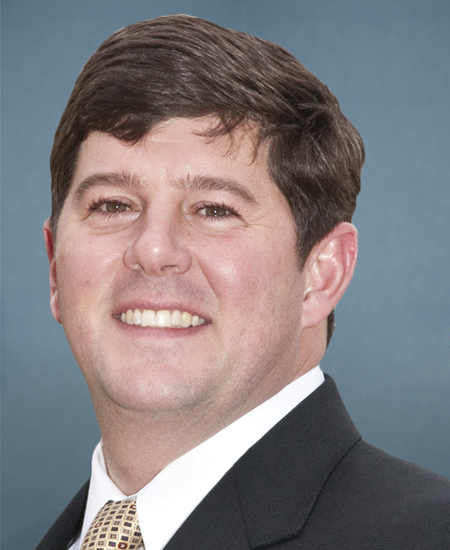
Rep. Steven M. Palazzo
Sponsored bills
Farmers Undertake Environmental Land Stewardship Act or the FUELS Act This bill increases thresholds for requiring a farm to have a plan to address oil spills. Currently, regulations require a farm to have an oil spill control and prevention plan that is certified by a professional engineer if the farm's aboveground oil storage capacity is above a certain threshold or if the farm has a reportable oil discharge history. A farm with lower aboveground storage capacity and no reportable history is either allowed to self-certify its plan or not required to have a plan at all, depending on the farm's storage capacity. Under the bill, the Environmental Protection Agency must require a farm to have a professionally certified plan if the farm has an aggregate aboveground oil storage capacity of 40,000 gallons or more, whereas the current threshold is 20,000 gallons. The bill also raises the aggregate capacity thresholds at which a farm with no reportable oil discharge history may self-certify its plan or is not required to have a plan. The bill also limits when a farm's aboveground oil storage containers on separate parcels shall count toward the farm's oil storage capacity for the purposes of these thresholds.
This resolution supports reopening the U.S. Capitol Building and House Office Buildings to visitors under the public visitation policies that were in place before the COVID-19 pandemic.
Ban IRS Biometrics Act This bill prohibits the Department of the Treasury from requiring taxpayers to provide biometric information as a condition of filing any tax return, receiving any service, or accessing taxpayer information. The bill defines biometric information as any information regarding any measurable physical characteristic or personal behavioral trait used to recognize the identity, or verify the claimed identity or location, of an individual, including facial images, fingerprints, and iris scans. Treasury must also develop a plan for the safe and secure destruction and disposal of any biometric information collected or used prior to the enactment of this bill.
Unmask Our Kids Act This bill prohibits a local educational agency (LEA) from receiving federal funds unless (1) in-person instruction is available to all students at each public elementary and secondary school under the jurisdiction of the LEA, and (2) a parent of a student at any school may opt out of a student face covering requirement.
Strengthening Enforcement and Criminalizing Unlawful Records Enabling Flights Act or the SECURE Flights Act This bill prohibits the use of warrants and other documents issued by U.S. Immigration and Customs Enforcement (ICE) as proof of identification at airport security checkpoints unless the individual is leaving the United States pursuant to immigration laws. If an individual uses prohibited documents as a proof of identification, the Transportation Security Administration (TSA) must (1) inform ICE and local law enforcement to determine whether the individual is in violation of any term of release, and (2) collect the individual's biometric information unless the TSA can verify the individual is a U.S. national. The TSA must also submit the biometric information to a national biometric identification system.
Child Tax Credit for Pregnant Moms Act of 2022 This bill allows a child tax credit for an unborn child who is born alive. It also allows the credit upon certification that a mother's pregnancy resulted in a miscarriage (the involuntary death of an unborn child who was carried in the womb for less than 20 weeks) or that the child was stillborn (the involuntary death of an unborn child who was carried in the womb for 20 weeks or more).
Inflation Prevention Act This bill establishes a point of order that, when the annualized rate of inflation exceeds 4.5%, prohibits the House and Senate from considering legislation that provides new budget authority and is estimated to result in an increase to the rate of inflation. The prohibition may be waived in the Senate by an affirmative vote of three-fifths of the Senate.
Maddy summaryThis resolution (HRES 883) is a symbolic gesture designating January 22 as "National Sanctity of Human Life Day" to recognize the value of human life at all stages. It contains statements opposing abortion and citing fetal development milestones, but the resolution itself has no legal effect or policy changes. It does not alter laws, allocate funding, or directly affect any individuals or groups. The bill solely encourages Americans to reflect on "the value of life" through a non-binding designation. As a procedural resolution, it has no binding provisions or concrete policy impact.
Freedom to Vote: John R. Lewis Act This bill addresses voter registration and voting access, election integrity and security, redistricting, campaign finance, and voting rights. Specifically, the bill expands voter registration (e.g., automatic and same-day registration) and voting access (e.g., vote-by-mail and early voting). It also limits removing voters from voter rolls. Next, the bill establishes Election Day as a federal holiday. The bill establishes certain federal criminal offenses related to voting. In particular, the bill establishes a new criminal offense for conduct (or attempted conduct) to corruptly hinder, interfere with, or prevent another person from registering to vote or helping someone register to vote. Additionally, the bill sets forth provisions related to election security, including by requiring states to conduct post-election audits for federal elections. The bill outlines criteria for congressional redistricting and generally prohibits mid-decade redistricting. The bill addresses campaign finance, including by expanding the prohibition on campaign spending by foreign nationals and establishing an alternative campaign funding system for certain federal offices. Next, the bill establishes new criteria for determining which states and political subdivisions must obtain preclearance before changes to voting practices may take effect. Preclearance is the process of receiving preapproval from the Department of Justice or the U.S. District Court for the District of Columbia before making legal changes that would affect voting rights. The bill also includes provisions related to federally protected activities at polling places and voting access on tribal lands.