

Maddy summaryHRES 410 is a non-binding House resolution requiring President Trump to comply with the Constitution’s Foreign Emoluments Clause regarding a $400 million Boeing 747-8 jet gift from Qatar’s royal family. It directs the President to immediately submit all plans for the aircraft to Congress and obtain explicit congressional consent before accepting it, as required by the Constitution. The resolution cites historical precedent where all prior presidents sought Congress’s approval for foreign gifts, including items like medals, horses, and the Statue of Liberty. It emphasizes that accepting the jet without consent would violate the Constitution and pose national security risks. The bill focuses solely on procedural compliance, not the merits of the gift itself.
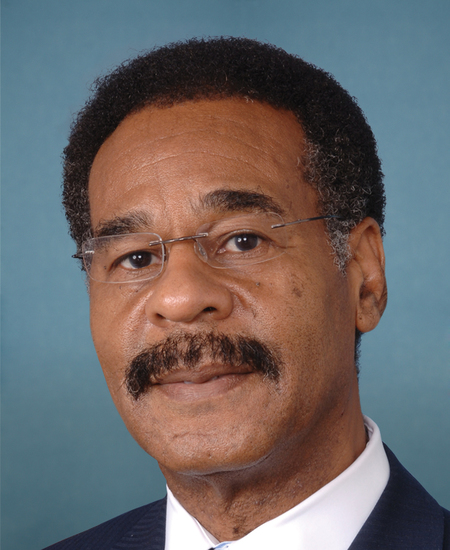
Rep. Emanuel Cleaver
Sponsored bills
Maddy summaryHR 3368, the "Born in the USA Act of 2025," prohibits federal funding for Executive Order 14160 (which aimed to restrict birthright citizenship for children born in the U.S.). The bill directly affects federal agencies that might implement the executive order by blocking their use of funds for that purpose. Its key provision is a funding ban targeting the executive order and any similar future policies, without changing citizenship law. The bill does not alter birthright citizenship rights but prevents federal resources from being used to enforce the controversial executive order. It is a procedural measure focused on funding, not a substantive policy change to citizenship rules.
Maddy summaryHR 3277, the Ensuring Lasting Smiles Act, requires group health plans and health insurance issuers to cover medically necessary outpatient and inpatient treatments for congenital anomalies or birth defects primarily affecting the eyes, ears, teeth, mouth, or jaw. This includes reconstructive procedures, dental/orthodontic support during treatment, and follow-up care, but excludes purely cosmetic surgery not tied to a medical diagnosis. Cost-sharing (like copays) for these services must not be stricter than for other medical benefits. The law takes effect for plan years beginning January 1, 2026, and mandates insurers to provide notice about this coverage to beneficiaries.
Maddy summaryHR 3306, the Truth in Tariffs Act, requires retailers selling goods to U.S. consumers to clearly display the portion of a product's price caused by applicable tariffs (called a "tariff surcharge"). This applies to most retailers but exempts small businesses as defined by the Small Business Act. The Federal Trade Commission (FTC) will enforce this rule, treating violations as unfair or deceptive practices under existing law, with penalties similar to those for other FTC violations. The law takes effect 30 days after enactment, covering tariffs imposed by the President after January 20, 2025.
Maddy summaryHR 3243, the Therapeutic Fraud Prevention Act of 2025, bans the provision of paid conversion therapy aimed at changing a person's sexual orientation or gender identity, and prohibits advertising such therapy as effective, safe, or without risk. It directly affects LGBTQ+ individuals and their families who might be targeted by these practices, as professionals have determined conversion therapy is ineffective and harmful. The law treats violations as deceptive acts under consumer protection laws, empowering the Federal Trade Commission and state attorneys general to enforce it through civil actions. It explicitly excludes legitimate gender transition support and non-discriminatory counseling from the ban.
Maddy summaryThe Housing Market Transparency Act (HR 3216) requires the Department of Housing and Urban Development (HUD) to collect standardized data on low-income housing tax credit projects. This includes development costs, ownership details, habitability standards, and reasons for property disposition (like sales or foreclosures), which states must submit annually to HUD. HUD will then compile and publicly release this data yearly, excluding certain sensitive details, and periodically publish market reports on multifamily housing. The law directly affects HUD, state housing agencies, and owners of properties receiving low-income housing tax credits under Section 42 of the Internal Revenue Code.
Maddy summaryHR 3184, the PFAS Alternatives Act, funds research to develop turnout gear (firefighter safety clothing) without harmful PFAS chemicals, directly affecting firefighters who wear this gear. It authorizes $25 million annually (2025-2029) for grants to eligible organizations to research and test PFAS-free gear, requiring partnerships with firefighting groups to translate findings into practice. The bill also allocates $2 million yearly (2027-2031) for training programs on safe gear use and decontamination. Its goal is to reduce firefighters' exposure to chemicals linked to occupational illnesses during operations.
Maddy summaryThe MEGOBARI Act (HR 36) is a U.S. legislative proposal that aims to strengthen Georgia's democratic development and Euro-Atlantic integration. It directs the U.S. Secretary of State to suspend the U.S.-Georgia Strategic Partnership Commission until Georgia meets specific democratic standards, including respecting citizens' democratic wishes and advancing EU/NATO membership. The bill establishes potential sanctions against Georgian officials who block Euro-Atlantic integration or undermine Georgia's sovereignty, requiring the President to determine if officials have engaged in significant corruption or actions against Georgia's territorial integrity. Additionally, it mandates reports on Russian intelligence assets in Georgia and a 5-year U.S. strategy for bilateral relations, with the Act set to sunset after 5 years from enactment.
Maddy summaryHRES 379 is a symbolic resolution recognizing the contributions of elementary and secondary school teachers to U.S. civic, cultural, and economic well-being. It specifically honors teachers during National Teacher Appreciation Week (May 5-9, 2025), urging students, parents, and officials to acknowledge their work. The resolution has no legal effect or policy changes - it simply expresses gratitude and promotes awareness of the teaching profession. It was introduced by Rep. Graves and co-sponsors and referred to the Education and Workforce Committee.
Maddy summaryHRES 378 is a non-binding House resolution urging the Department of Homeland Security to create a humanitarian parole program for Cameroonian immigrants fleeing violence and instability in Cameroon. It directly affects Cameroonian nationals currently in the U.S. or seeking entry who face risks like deportation to a country with ongoing armed conflicts, including the Anglophone Crisis and Boko Haram insurgency, which have displaced over 600,000 people internally and 70,000 externally. The resolution cites existing U.S. authority under Section 212(d)(5)(A) of the Immigration and Nationality Act to establish such a program, noting Cameroon’s TPS designation is set to expire. It emphasizes the need for humanitarian relief amid reports of severe human rights abuses against Cameroonian returnees and systemic discrimination against Black immigrants in U.S. immigration enforcement. The resolution does not create new law but formally requests DHS action.