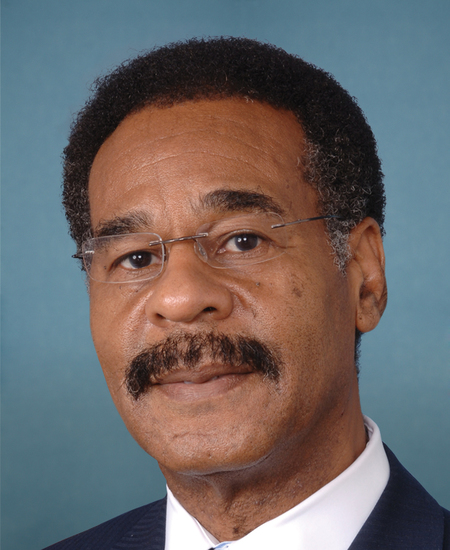
Photo of Emanuel Cleaver
D United States House · District 5 · Missouri On the 2026 ballot

Rep. Emanuel Cleaver

Compare
Total votes
2,837
all sessions
Attendance
91%
246 missed
Lower than 76% of chamber peers
With party
98%
of cast votes
Higher than 95% of chamber peers
Bipartisan score
1%
crosses aisle rarely
Lower than 95% of chamber peers
Sponsored
1,654
bills & resolutions
Higher than 82% of chamber peers
Committees
3
assignments
1,654 bills and resolutions

Sponsored bills

Total
1,654
Primary
79
Co-sponsor
1,575
This page
1,654
matching current filters
Co-sponsor HR 4716
In committee · United States House · Co-sponsor
Refuge From Cruel Trapping Act of 2021

Refuge From Cruel Trapping Act of 2021 This bill prohibits, with specified exceptions, the use or possession of body-gripping traps in the National Wildlife Refuge System. The bill imposes on persons who possess or use such traps in the system (1) for a first offense, a civil fine of up to $500 for each body-gripping trap possessed or used; and (2) for subsequent offenses, a civil fine of up to $1,000 for each body-gripping trap possessed or used, imprisonment for up to 180 days, or both such a civil fine and imprisonment. The bill makes any body-gripping traps that are possessed or used in violation of this bill, and any wildlife captured by the use of such traps, including the pelts and raw fur, subject to civil forfeiture. Persons found to be in violation of such prohibition shall pay all associated court costs.

In committee Jan 20, 2022 1 co-sponsor
Co-sponsor HR 4057
In committee · United States House · Co-sponsor
Albatross and Petrel Conservation Act

Albatross and Petrel Conservation Act This bill authorizes the United States Fish and Wildlife Service (USFWS) and the National Marine Fisheries Service (NMFS) to issue regulations to implement and enforce the Agreement on the Conservation of Albatrosses and Petrels, done at Cape Town, South Africa, on February 2, 2001. Specifically, the USFWS and the NMFS may take action to protect albatrosses and petrels and their habitats. The bill prohibits the taking of an albatross or petrel without a permit, authorization, or exemption. The FWS, in consultation with the NMFS, may authorize the taking of an albatross or petrel under exceptional circumstances or incidental to otherwise lawful activities. The bill gives the USFWS, the NMFS, and the Coast Guard authority to enforce this bill. Finally, the bill authorizes cooperation with other countries to achieve and maintain a favorable conservation status of albatrosses and petrels.

In committee Jan 20, 2022 1 co-sponsor
Co-sponsor HR 1848
In committee · United States House · Co-sponsor
LIFT America Act

Leading Infrastructure For Tomorrow’s America Act or the LIFT America Act This bill establishes several programs and incentives to modernize the nation's communications, drinking water, energy, transportation, health care, and other related infrastructure. For example, the bill provides incentives to make broadband internet more accessible and affordable. It also establishes grants to implement next generation 9-1-1 services. In addition, it supports drinking water programs, including the drinking water state revolving fund program. Further, it provides grants to treat perfluoroalkyl or polyfluoroalkyl substances (commonly referred to as PFAS) in drinking water and to replace lead service lines. The bill establishes a variety of programs to support clean energy infrastructure and address climate change, including efforts to (1) modernize the electric grid and make it more resilient, efficient, and secure; (2) increase energy efficiency in buildings; and (3) support renewable energy infrastructure. Further, it provides incentives for vehicle infrastructure, such as incentives to develop infrastructure for electric vehicles and grants to reduce air pollution at ports by electrifying port infrastructure. Additionally, the bill establishes grants and programs for health care infrastructure, including by providing support for the Centers for Disease Control and Prevention, laboratories, and state, local, tribal, and territorial health departments. Finally, the bill reauthorizes grant programs to remediate brownfield sites (i.e., sites contaminated with hazardous substances) through FY2026.

In committee Jan 20, 2022 1 co-sponsor
Co-sponsor HR 6396
In committee · United States House · Co-sponsor
Climate RESILIENCE Act

Climate Risk and Emergency Support In Livable Inclusive and Equitable Neighborhoods and Communities Everywhere Act or the Climate RESILIENCE Act This bill makes changes to the Robert T. Stafford Disaster Relief and Emergency Assistance Act to take into account climate change. The bill includes extreme temperature events, such as heat waves or freezes, within the scope of the act and defines resilience for purposes of disaster assistance and mitigation efforts. Federal and state preparedness and mitigation assistance may be used for reducing the impacts of extreme temperatures and improving air quality and mitigating against wildfire smoke.. The bill authorizes implementing predisaster hazard mitigation measures that will be cost-effective and equitable long-term and provide enhanced protection to the community. The Federal Emergency Management Agency (FEMA) must (1) provide technical assistance to underserved and disadvantaged communities for such measures; and (2) provide guidance to implement the latest published editions of relevant consensus-based codes, specifications, and standards that incorporate the latest hazard-resistant designs. The bill includes within the hazard mitigation program requirements the abatement of lead, mold, mildew, radon, asthma, and allergen triggers, or other pollutants and hazardous materials directly caused by a major disaster or emergency. FEMA must report to Congress regarding challenges posed by FEMA requirements for determining the cost-effectiveness of mitigation activities and how such requirements may disproportionately burden underserved or disadvantaged communities.

In committee Jan 14, 2022 1 co-sponsor
Co-sponsor HR 6398
In committee · United States House · Co-sponsor
FAIR Act

Federal Adjustment of Income Rates Act or the FAIR Act This bill modifies pay rates for federal employees in 2023. Specifically, the bill increases rates under the statutory pay systems and for prevailing rate employees by 4.1% and increases locality pay by 1%.

In committee Jan 13, 2022 1 co-sponsor
Co-sponsor HR 6381
In committee · United States House · Co-sponsor
CREATE Act of 2022

Comprehensive Resources for Entrepreneurs in the Arts to Transform the Economy Act of 2022 or the CREATE Act of 2022 This bill expands financial assistance for, and establishes measures to support, the creative economy and art entrepreneurs. Specifically, the bill requires (1) the Small Business Administration to develop loan criteria, evaluation procedures, and technical assistance programs for small business concerns that are owned by artists and support the creative economy; and (2) the Department of Commerce to ensure that traditional economic development tools, such as business incubators and grant programs, support the arts industry and creative economy.

In committee Jan 13, 2022 1 co-sponsor
Co-sponsor HR 6117
In committee · United States House · Co-sponsor
PrEP Access and Coverage Act

PrEP Access and Coverage Act This bill requires private health insurance plans to cover prescription drugs that prevent HIV, including related screenings, diagnostic procedures, administrative fees, and clinical follow-ups, without any cost-sharing obligation for the plan holder. Further, insurance plans must not impose any preauthorization requirement for this coverage. These coverage requirements also apply to public health insurance programs, including Medicare, Medicaid, and the Children's Health Insurance Program. Additionally, the bill prohibits denying, limiting, or qualifying coverage or increasing premiums for disability insurance, long-term care insurance, or life insurance policies based on an individual taking medication for HIV prevention. The bill further requires the Department of Health and Human Services to award grants to states, or directly to eligible local organizations, to provide uninsured individuals and underinsured individuals access to prescription drugs and related services that prevent HIV. The Centers for Disease Control and Prevention also must develop a public awareness campaign that focuses efforts in communities with a high need for HIV prevention treatment.

In committee Jan 6, 2022 1 co-sponsor
Co-sponsor HR 6272
In committee · United States House · Co-sponsor
College Student Hunger Act of 2021

College Student Hunger Act of 20 21 This bill modifies the eligibility requirements for the Supplemental Nutrition Assistance Program (SNAP) to make additional students at institutions of higher education eligible for benefits.

In committee Jan 4, 2022 1 co-sponsor
Co-sponsor HR 6000
In committee · United States House · Co-sponsor
Cures 2.0 Act

Cures 2.0 Act This bill addresses pandemic preparedness and public health issues, caregiver and patient engagement, drug development, insurance coverage, and biomedical research. The Department of Health and Human Services (HHS) must undertake research and other activities concerning COVID-19 and develop a strategy for future pandemics and declared emergencies. Additionally, the bill specifies actions to combat antimicrobial resistance. HHS may award grants for caregiver training. The bill also addresses diversity in clinical trials, collecting patient experience data during clinical trials, and coverage for care related to participation in specified clinical trials. The bill modifies the timeframe and requires additional guidance relating to expedited approval of certain breakthrough drugs, devices, or products. It also establishes two intercenter institutes within the Food and Drug Administration (FDA) focused on particular diseases that meet specified criteria. The bill also addresses (1) coverage in Medicare, Medicaid, and the Children's Health Insurance Program for telehealth, genetic and genomic testing, and other services; (2) electronic prescribing standards for Medicare drug benefits; and (3) access to Medicare and Medicaid claims data by certain registries. Furthermore, the bill prohibits the use of geographic tracking or biometrics in Medicaid electronic visit verification systems. The bill establishes the Advanced Research Projects Agency for Health (ARPA-H) within the National Institutes of Health to accelerate biomedical research and innovation through grants, contracts, cash prizes, and other means. The FDA may work with ARPA-H to expedite the development of medical products through specified activities.


In committee Jan 4, 2022 1 co-sponsor
Showing 1,301 to 1,310 of 1,654 bills