Ensuring Accurate Postal Rates Act This bill directs the Postal Regulatory Commission to review and potentially modify the market-dominant ratemaking system rules in light of the USPS Fairness Act, which canceled unpaid U.S. Postal Service obligations.
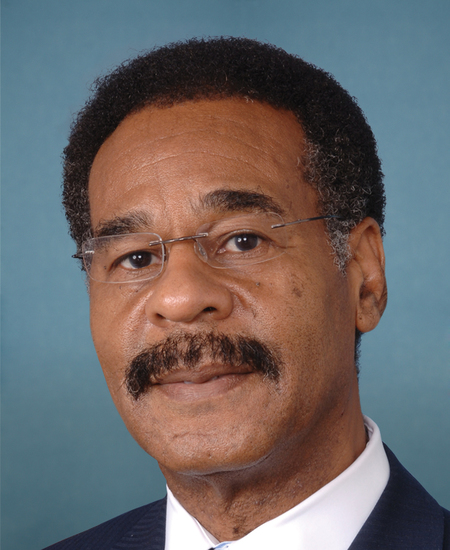
Rep. Emanuel Cleaver
Sponsored bills
Home Internet Accessibility Act This bill requires the Government Accountability Office (GAO) to report on broadband internet capacity in housing that is supported by the Department of Housing and Urban Development (HUD) or the Department of Agriculture. In its report, the GAO must identify such housing that lacks broadband capacity and estimate the costs and time frame necessary to provide broadband capacity in such housing. Additionally, HUD must develop a plan for retrofitting such housing to provide the capacity for broadband internet.
Reverend James Lawson, Jr. Congressional Gold Medal Act This bill provides for the award of a Congressional Gold Medal to Reverend James Morris Lawson Jr. in recognition of his contributions to the advancement of civil rights through nonviolent methods in the United States.
Harriet Tubman Bicentennial Commemorative Coin Act This bill directs the Department of the Treasury to mint and issue 50,000 $5 gold coins, 400,000 $1 silver coins, and 750,000 half-dollar clad coins emblematic of the legacy of Harriet Tubman as an abolitionist. The Secretary may issue coins under this bill only during the period of January 1, 2024, through December 31, 2024. All surcharges received by Treasury from the sale of such coins must be paid equally to the National Underground Railroad Freedom Center in Cincinnati, Ohio, and The Harriet Tubman Home, Inc. in Auburn, New York, for the purpose of accomplishing and advancing their missions.
Assault Weapons Ban of 2022 This bill makes it a crime to knowingly import, sell, manufacture, transfer, or possess a semiautomatic assault weapon (SAW) or large capacity ammunition feeding device (LCAFD). The prohibition does not apply to a firearm that is (1) manually operated by bolt, pump, lever, or slide action, except for certain shotguns; (2) permanently inoperable; (3) an antique; (4) only capable of firing rimfire ammunition; or (5) a rifle or shotgun specifically identified by make and model. The bill also exempts from the prohibition the following, with respect to a SAW or LCAFD: importation, sale, manufacture, transfer, or possession related to certain law enforcement efforts, or authorized tests or experiments; importation, sale, transfer, or possession related to securing nuclear materials; and possession by a retired law enforcement officer. The bill permits continued possession, sale, or transfer of a grandfathered SAW, which must be securely stored. A licensed gun dealer must conduct a background check prior to the sale or transfer of a grandfathered SAW between private parties. The bill permits continued possession of, but prohibits sale or transfer of, a grandfathered LCAFD. Newly manufactured LCAFDs must display serial number identification. Newly manufactured SAWs and LCAFDs must display the date of manufacture. The bill also allows a state or local government to use Edward Byrne Memorial Justice Assistance Grant Program funds to compensate individuals who surrender a SAW or LCAFD under a buy-back program.

This resolution supports the designation of Public Radio Music Day. It also expresses deep appreciation for the role of public radio music stations in serving listeners, musicians, and hundreds of communities in the United States.
VA Loan Informed Disclosure Act of 2022 or the VALID Act of 2022 The bill requires a Federal Housing Administration mortgage notice to a veteran to contain comparative rate and fee information about loans available under the Veterans Affairs home loan program.
Summer Meals Act of 2021 This bill revises provisions related to the Summer Food Service Program (SFSP) of the Department of Agriculture (USDA), which provides meals to children and teens in low-income areas during the summer months when school is not in session. The bill redefines areas in which poor economic conditions exist , where the SFSP may operate, as areas in which at least 40% (currently, 50%) of the children have been determined to be eligible for free or reduced price school meals under the school lunch and breakfast programs. The bill reimburses service institutions (other than school food authorities) for up to one meal and one snack per child each day during after-school hours, weekends, and school holidays during the regular school calendar. Currently, such institutions are reimbursed for meals and snacks served to children over the summer months or to children who are on vacation under a continuous school calendar. USDA may award competitive grants to service institutions to increase participation in the summer food service program for children at congregate feeding sites through innovative approaches to limited transportation and mobile meal trucks. Service institutions that are participating in the summer food service program for children may serve up to three meals, or two meals and one snack, during each day of operation. Currently, this option is reserved for camps and service institutions that serve meals primarily to migrant children.
Preserving Access to Home Health Act of 2022 This bill restricts the Centers for Medicare & Medicaid Services (CMS) from decreasing payments for Medicare home health services based on certain adjustments until 2026. Current law requires the CMS to make certain permanent and temporary payment adjustments under the Medicare prospective payment system for home health services based on behavioral assumptions for 2020 through 2026. The bill restricts the CMS from making adjustments that decrease payments until 2026; the CMS must also ensure that any such necessary decreases are made before 2032.
CDFI Bond Guarantee Program Improvement Act of 2022 This bill reauthorizes for four years and otherwise revises the Community Development Financial Institutions (CDFI) Bond Guarantee Program. Specifically, the bill (1) reduces the CDFI Bond Guarantee Program minimum issuance amount from $100 million to $25 million, and (2) revises the amount to be held in a CDFI's relending account. (CDFIs are financial institutions serving low-income communities. Designation as a CDFI allows an institution to participate in programs such as the CDFI Bond Guarantee Program. The program provides financing to CDFIs through federal credit subsidies that allow CDFIs to issue bonds.)