

Teleabortion Prevention Act of 2021 This bill restricts the use of telehealth for chemical abortions (also known as medication abortions). Specifically, it requires a provider who dispenses or prescribes medication for a chemical abortion to physically examine the patient, be physically present at the location of the chemical abortion, and schedule a follow-up visit. The bill provides an exception for a chemical abortion that is necessary to save the life of a mother whose life is endangered by a physical disorder, illness, injury, or condition. The bill establishes criminal penalties—a fine, a prison term of up to two years, or both—for a provider who does not comply with the requirements. A patient who undergoes a chemical abortion may not be prosecuted.
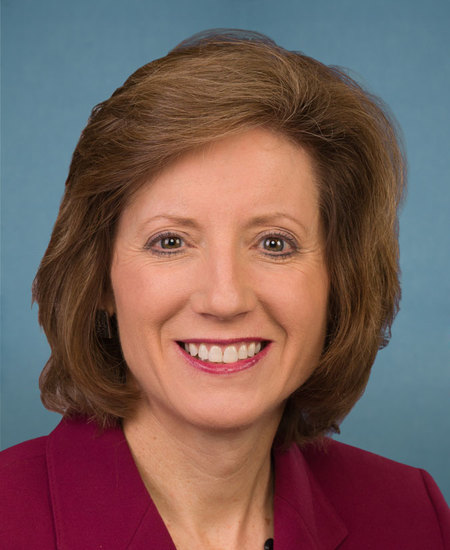
Rep. Vicky Hartzler
Sponsored bills
Exposing Agricultural Trade Suppression Act This bill restricts state and local governments from imposing certain standards or conditions on the production or manufacture of agricultural products sold or offered for sale in interstate commerce. Specifically, it prohibits the imposition of such standards or conditions if (1) the production or manufacture occurs in another state, and (2) the standard or condition adds to requirements applicable under federal law and the laws of the state or locality where the product is produced or manufactured. The bill also allows for a private right of action to challenge state or local regulations relating to agricultural goods sold in interstate commerce. A person may bring an action in (1) the U.S. district court for the judicial district in which the person is affected by a regulation or the person resides, operates, or does business; or (2) any other appropriate court with jurisdiction.
This bill bars individuals affiliated with the Chinese military from entering the United States on visas for students (F visa) or work-and-study exchange (J visa). The President shall publish a list identifying research, engineering, and scientific institutions affiliated with or funded by China's People's Liberation Army. Aliens who are or were previously employed, sponsored, or funded by any institution on the list shall be subject to the bar. When a Chinese national applies for an F or J visa for an academic field related to an item on the Commerce Control List (a list of items subject to export controls), the consular officer handling the application shall request a special background check on the applicant.
Empowering Law Enforcement To Fight Sex Trafficking Demand Act of 2021 This bill allows grants under the Edward Byrne Memorial Justice Assistance Grant program to be used for programs to combat human trafficking.
World Deserves To Know Act This bill requires sanctions on certain members of the Chinese Communist Party (CCP) and officials of Chinese health agencies. It also addresses related issues. The President must impose visa- and property-blocking sanctions on any foreign person who is a CCP official and who is knowingly responsible for or complicit in (1) the disappearances of whistleblowers and citizen journalists in China relating to COVID-19, or (2) limiting free speech and academic freedom in China relating to COVID-19. The President must also impose such sanctions on specified individuals who have leadership positions in China's Center for Disease Control and Prevention and China's National Health Commission (NHC). The authority to impose such sanctions shall end when the President certifies to Congress that an independent and unimpeded investigation into the potential origin of COVID-19 from the Wuhan Institute of Virology has taken place. The bill also bars federal funds and certain federal student assistance from going to institutions of higher education that enter into a contract with any element or China-based affiliate of the NHC. Federal funding to the National Academy of Sciences may not be used to enter into a contract with any element or China-based affiliate of the NHC. The Government Accountability Office must report to Congress a review of all funds that the National Institutes of Health have made available to the NHC since FY2010. This report must also be publicly available.
H-2B Returning Worker Exception Act of 2021 This bill modifies the H-2B (temporary nonagricultural workers) nonimmigrant visa program, including by exempting certain workers from an annual numerical limit on such visas and requiring civil penalties for program violations. Under this bill, if a worker seeking a H-2B visa has been counted toward the 66,000 annual cap on such visas in one of the three preceding fiscal years, that worker shall not be counted against the cap again. Furthermore, the Department of Homeland Security (DHS) must impose a civil monetary penalty on an employer for (1) failing to meet requirements related to an H-2B visa petition, or (2) making a willful misrepresentation of material fact in such a petition. DHS must also ensure the establishment of an electronic platform (1) for employers to submit and request approval of an H-2B petition, and (2) to act as a single point of access for applicants and the relevant government agencies. The Department of Labor must maintain a publicly available online database of all job orders by H-2B employers. Furthermore, Labor may take certain actions to enforce program requirements, such as imposing penalties and seeking injunctions. The bill provides statutory authority for the current practice of limiting the program to workers who are nationals of countries approved by DHS. DHS may make exceptions to this limitation in individual cases if it is in the U.S. interest to do so. DHS shall select approved countries based on various factors, such as the rate of overstay by H-2B visa holders from each country.
Stars and Stripes Act of 2021 This bill prohibits the Department of State from displaying any flag or banner at a diplomatic or consular post other than specified flags. Such flags are (1) the U.S. flag; (2) the flag of the country wherein the post is located; (3) the flag of a state, territory, or possession of the United States; (4) a departmental or secretarial flag; (5) the flag of an Armed Force; or (6) a flag to honor prisoners of war or those missing in action.
Preventing Anti-Semitic Hate Crimes Act This bill requires a designated officer or employee of the Department of Justice (DOJ) to facilitate the expedited review of anti-Semitic hate crimes and reports of anti-Semitic hate crimes. Further, the bill requires DOJ to issue guidance for state, local, and tribal law enforcement agencies on expanding public education campaigns to raise awareness of anti-Semitic hate crimes. Finally, the bill increases the statutory maximum prison term for an individual who is convicted of a federal hate crime offense after a prior conviction for a hate crime offense under federal law or a hate crime felony under state law.
Human-Animal Chimera Prohibition Act of 2021 This bill establishes new federal crimes related to conduct involving certain types of human-animal chimeras. The term human-animal chimera means an organism that, from an early stage of development, contains human and nonhuman parts. This bill makes is unlawful to create or attempt to create a prohibited human-animal chimera, transfer or attempt to transfer a human embryo into a nonhuman womb, transfer or attempt to transfer a nonhuman embryo into a human womb, or transport or receive for any purpose a prohibited human-animal chimera. A violator is subject to civil and criminal penalties.
Conrad State 30 and Physician Access Reauthorization Act This bill modifies the Conrad 30 Waiver program, which incentivizes qualified foreign physicians to serve in underserved communities. It also extends statutory authority for the program for three years from this bill's enactment. Aliens coming to the United States under a J-1 nonimmigrant visa to receive medical training typically must leave the country and reside for two years abroad before being eligible to apply for an immigrant visa or permanent residence. The Conrad program waives this requirement for individuals who meet certain qualifications, including serving for a number of years at a health care facility in an underserved area. The bill increases the number of waivers that a state may obtain each fiscal year from 30 to 35 if a certain number of waivers were used the previous year, and provides for further adjustments depending on demand. An alien physician may be employed at an academic medical center to meet the Conrad program's employment requirements if the alien's work is in the public interest, even if the medical center is not in an underserved area. Employment contracts for alien physicians under the Conrad program shall contain certain information, such as the maximum number of on-call hours per week the physician shall have to work. Certain alien physicians (along with the physician's spouse and children) shall be exempt from the direct annual numerical limits on immigration, including those physicians that have met certain requirements related to visas for physicians to serve in underserved areas.