This resolution expresses support for the designation of Journeyman Lineworkers Recognition Day. (A journeyman lineworker is a person who builds and maintains electrical power systems.)
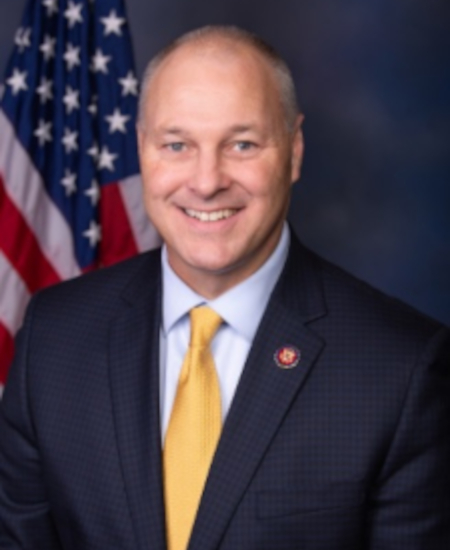
Rep. Pete Stauber
Sponsored bills
Tax Emergency Adjustment for Mileage Volunteers Act or the TEAM Volunteers Act This bill increases the rate of the tax deduction for the charitable use of a passenger automobile to equal the standard business rate (i.e., 58.5 cents per mile in the first half of 2022, then 62.5 cents per mile for the rest of that year) for taxable years beginning after 2021 and before 2024. It then provides for a permanent 24 cents per mile rate, adjusted annually for inflation, for taxable years beginning after 2023.
Small Business Payment for Performance Act of 20 22 This bill allows a small business that is awarded a construction contract by a federal agency to request an equitable adjustment if the agency's contracting officer directs a change in the contract's performance without the agreement of the small business. The agency must provide the small business with an interim partial payment to cover additional costs resulting from such a change, and the small business must pay a first tier subcontractor or supplier the portion of the partial payment that is attributable to additional costs incurred due to the change.
Mining Schools Act of 2022 This bill establishes a grant program for mining schools to recruit and educate mining engineers and other qualified professionals.
Maddy summaryThis bill amends the Endangered Species Act to require the Secretary of the Interior to issue protective regulations for endangered species, changing the current "may" to "shall" for this action. It clarifies that such regulations can prohibit activities listed in Section 9 (like harming species or their habitats) but only apply in states that haven't adopted equivalent rules through cooperative agreements. The bill also updates Section 9 to reference these new regulations. This change directly affects how federal protections are implemented for species listed as endangered, ensuring consistent conservation measures nationwide unless states adopt their own rules.
Promoting Cross-b order Energy Infrastructure Act This bill establishes a new process for approving the construction and operation of energy infrastructure across an international border of the United States and replaces the existing process established under specified executive orders. Specifically, this bill requires a person to obtain a certificate of crossing before constructing, connecting, operating, or maintaining a border-crossing facility for the import or export of oil, natural gas, or electricity across an international border. A certificate must be obtained from the Federal Energy Regulatory Commission (FERC) for a facility consisting of oil or natural gas pipelines or the Department of Energy (DOE) for an electric transmission facility. As a condition of issuing a certificate, DOE must require that an electric transmission facility be constructed, connected, operated, or maintained consistent with specified policies and standards. FERC and DOE must meet a deadline for issuing a certificate as set forth by this bill. The bill also requires FERC to meet a deadline for approving applications to import or export natural gas to or from Canada or Mexico.

Military Spouse Hiring Act This bill expands the Work Opportunity Tax Credit (WOTC) to include the hiring of a qualified military spouse. (The WOTC permits employers who hire individuals who are members of a targeted group such as qualified veterans, ex-felons, or long-term unemployment recipients to claim a tax credit equal to a portion of the wages paid to those individuals.) A qualified military spouse is any individual who is certified by the designated local agency as being (as of the hiring date) a spouse of a member of the Armed Forces.
Federal Columbia River Power System Certainty Act This bill requires Federal Columbia River Power System (FCRPS) operations to be consistent with a specified decision. The system includes dams in the Columbia and Snake rivers in the Pacific Northwest. Specifically, the Bureau of Reclamation, the Bonneville Power Administration, and the U.S. Army Corps of Engineers must operate the FCRPS consistent with the Columbia River System Operations Environmental Impact Statement Record of Decision dated September 2020. The preferred alternative outlined in that decision would allow specified dams in the lower Snake River to remain in place. The decision may be amended if each agency determines that (1) changes are necessary for public safety or electrical grid reliability, or (2) certain requirements in the decision are no longer necessary. Further, the bill requires statutory authorization for any structural modification, action, study, or engineering plan that (1) restricts FCRPS hydroelectric dam generation; or (2) limits navigation on the Snake River in Washington, Oregon, or Idaho.
Strengthening Subcontracting for Small Businesses Act of 2022 This bill requires federal agencies to consider when evaluating offers for contracts the extent to which, in a subcontracting plan, the offeror proposes to use small businesses as subcontractors in the performance of the contract.
Deterring Enemy Forces and Enabling National Defenses Act of 2022 or the DEFEND Act of 2022 This bill requires the Department of Defense to seek to cooperate with Middle East allies and partners (i.e., countries of the Gulf Cooperation Council, Iraq, Israel, Jordan, Egypt, and other countries in the region as appropriate) to identify and develop an approach for such allies and partners to implement an integrated air and missile defense capability to protect against attacks from Iran and groups linked to Iran.