

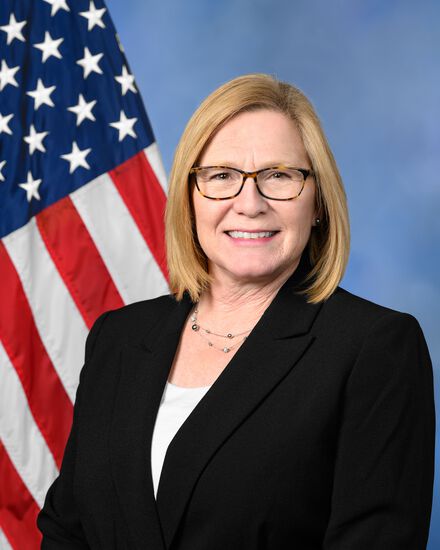
Photo of Michelle Fischbach
R United States House · District 7 · Minnesota On the 2026 ballot

Rep. Michelle Fischbach

Compare
Total votes
2,837
all sessions
Attendance
100%
9 missed
Higher than 85% of chamber peers
With party
96%
of cast votes
Higher than 79% of chamber peers
Bipartisan score
2%
crosses aisle rarely
Lower than 80% of chamber peers
Sponsored
619
bills & resolutions
Lower than 78% of chamber peers
Committees
5
assignments
619 bills and resolutions

Sponsored bills

Total
619
Primary
71
Co-sponsor
548
This page
619
matching current filters
Primary HCONRES 1
Passed · United States House · Lead sponsor
Regarding consent to assemble outside the seat of government.

Maddy summaryHCONRES 1 is a procedural resolution that allows the House Speaker and Senate Majority Leader (or their designees) to direct congressional members to assemble outside Washington, D.C., after consulting with minority leaders, if they determine it serves the public interest. It establishes a specific process requiring joint notification to both chambers before holding sessions elsewhere during the 119th Congress. The resolution does not create new laws or alter policy but changes how Congress organizes its meetings. It directly affects congressional operations by providing a formal mechanism for relocating sessions outside the District of Columbia.

Passed Jan 6, 2025 0 co-sponsors
Co-sponsor HJRES 12
In committee · United States House · Co-sponsor
Proposing an amendment to the Constitution of the United States to limit the number of terms that a Member of Congress may serve.

Maddy summaryThis proposed constitutional amendment would limit Members of Congress to serving a maximum of three terms in the House of Representatives or two terms in the Senate. It directly affects current and future members by preventing those who have already served the maximum terms from seeking re-election. Key provisions include counting vacancies filled for more than a year (House) or three years (Senate) as a full term toward the limit, while excluding terms served before ratification from the count. As a constitutional amendment proposal, it requires approval by three-fourths of state legislatures to become law.

In committee Jan 6, 2025 1 co-sponsor
Co-sponsor HR 82
Signed into law · United States House · Co-sponsor
Social Security Fairness Act of 2023

Maddy summaryHR 82, the Social Security Fairness Act of 2023, repeals two provisions that reduce Social Security benefits for certain government workers. It eliminates the Government Pension Offset (GPO), which cuts spousal or survivor benefits for people with pensions from jobs not covered by Social Security (like federal or state government roles), and the Windfall Elimination Provision (WEP), which lowers retirement benefits for those with similar pensions. The law takes effect for benefits paid after December 2023, requiring the Social Security Administration to adjust benefit calculations to remove these reductions. This change directly affects public-sector employees who previously had their Social Security benefits reduced due to their government pensions.

Signed into law Jan 5, 2025 1 co-sponsor
Co-sponsor HR 9076
Signed into law · United States House · Co-sponsor
Supporting America’s Children and Families Act

Maddy summaryThe Supporting America's Children and Families Act reauthorizes federal child welfare programs through 2029, with new provisions to improve services for children in foster care and families. It directly affects states, tribes, child welfare agencies, foster youth, and families through requirements to address poverty-related neglect, expand family preservation services, strengthen kinship care support, and improve court technology for remote hearings. Key mechanisms include new funding for regional partnerships addressing parental substance use, streamlined administrative processes, and demonstration projects for maintaining relationships between incarcerated parents and their children in foster care. The bill also strengthens tribal child support enforcement and improves implementation of the Indian Child Welfare Act, aiming to reduce bureaucracy while improving outcomes for children and families.

Signed into law Jan 4, 2025 1 co-sponsor
Primary HR 8841
Signed into law · United States House · Lead sponsor
To designate the facility of the United States Postal Service located at 114 Center Street East in Roseau, Minnesota, as the "Floyd B. Olson Post Office".

Maddy summaryThis bill renames a United States Postal Service facility at 114 Center Street East in Roseau, Minnesota, as the "Floyd B. Olson Post Office." It directly affects the physical post office location and all official references to it in government documents. The key provision updates all federal records, maps, and communications to use the new name, ensuring consistency in official correspondence and signage. This is a ceremonial designation with no changes to postal services, funding, or policy.

Signed into law Jan 4, 2025 0 co-sponsors
Co-sponsor HR 4563
In committee · United States House · Co-sponsor
ACE Act

Maddy summary# Summary of Proposed Legislation This comprehensive legislative proposal contains multiple sections addressing election integrity, campaign finance reform, cybersecurity, census operations, and related government functions. Key provisions include: 1. **Campaign Finance Reforms**: - Increased thresholds for political committee reporting requirements - Repeal of requirements for political committees to report donor identification - Exemption of uncompensated internet communications from contribution/expenditure treatment - Protection of donor privacy for tax-exempt organizations through the "Speech Privacy Act of 2023" 2. **Election Security**: - Establishment of a process for testing and monitoring cybersecurity vulnerabilities in election equipment - Requirements for the Secretary of Homeland Security to notify state officials about election cybersecurity incidents - Exclusive authority for the Election Assistance Commission regarding guidelines for voting system certification 3. **Census and Redistricting**: - Establishment of a permanent Census Monitoring Board with bipartisan composition to review census operations - Clarification of state authority over congressional redistricting maps - Provisions regarding the Speaker of the House's authority to join civil actions related to apportionment 4. **Other Key Provisions**: - Termination of the Disinformation Governance Board and prohibition on funding similar entities - Amendments to the Federal Election Campaign Act to increase reporting thresholds and exempt certain communications - Various technical corrections to existing campaign finance law The legislation appears to focus on enhancing election security, reducing regulatory burdens on political organizations, protecting donor privacy, and strengthening oversight of census operations while maintaining constitutional boundaries between federal and state authority.

In committee Jan 3, 2025 1 co-sponsor
Co-sponsor HJRES 10
In committee · United States House · Co-sponsor
Proposing a balanced budget amendment to the Constitution of the United States.

This joint resolution proposes a constitutional amendment prohibiting total outlays for a fiscal year from exceeding total receipts for that fiscal year unless Congress authorizes the excess by a three-fifths roll call vote of each chamber. The prohibition excludes outlays for repayment of debt principal and receipts derived from borrowing. The amendment requires a three-fifths roll call vote of each chamber to increase the public debt limit. It prohibits a bill to increase revenue from becoming law unless it has been approved by a majority roll call vote of each chamber. The amendment also requires the President to submit an annual budget in which total outlays do not exceed total receipts. Congress may waive these requirements due to a declaration of war or a military conflict that causes an imminent and serious military threat to national security.

In committee Jan 3, 2025 1 co-sponsor
Primary HRES 6
Passed · United States House · Lead sponsor
Fixing the daily hour of meeting of the First Session of the One Hundred Nineteenth Congress.

Maddy summaryThis procedural resolution (HRES 6) sets the standard daily meeting times for the U.S. House of Representatives during the first session of the 119th Congress. It specifies that the House will meet at 2 p.m. on Mondays, noon on Tuesdays (or 2 p.m. if no business occurred Monday), noon on Wednesdays and Thursdays, and 9 a.m. on other days. The resolution directly affects how the House schedules its daily sessions. It does not change substantive policy but establishes a fixed operational schedule for House proceedings.

Passed Jan 3, 2025 0 co-sponsors
Primary HRES 5
Passed · United States House · Lead sponsor
Adopting the Rules of the House of Representatives for the One Hundred Nineteenth Congress, and for other purposes.

Maddy summaryHRES 5 is a procedural resolution that adopts the rules of the House of Representatives for the 119th Congress, with several technical amendments to standing rules. It establishes the operational framework for the House, including changes to committee names (such as renaming "Oversight and Accountability" to "Oversight and Government Reform"), voting procedures, and committee work periods. The resolution directly affects how the House will function during the 119th Congress, setting rules for committee operations, voting, and legislative procedures. This is a procedural bill that does not create new policy but rather formalizes the House's governing rules.

Passed Jan 3, 2025 0 co-sponsors
Co-sponsor HR 45
In committee · United States House · Co-sponsor
FIND Act

Maddy summaryHR 45 (FIND Act) requires federal government contractors to certify they do not discriminate against firearm businesses (including manufacturers, dealers, and trade associations) in their policies or practices. The bill mandates that contractors and subcontractors (for contracts over 10% of the prime contract value) certify they have no discriminatory policies and will not adopt them during the contract term. Violations could lead to contract termination and potential debarment. This applies to all federal procurement contracts awarded after the bill's enactment, excluding sole-source contracts. The law aims to ensure firearm businesses are treated equally in government contracting without restricting legitimate business criteria like creditworthiness or legal compliance.

In committee Jan 3, 2025 1 co-sponsor
Showing 191 to 200 of 619 bills
Previous 1 … 19 20 21 … 62 Next