

Maddy summaryHR 3022 is a procedural bill that adds "Workers’ Memorial Day" to the list of official federal holidays observed by the U.S. government. It amends Title 5 of the U.S. Code to insert "Workers’ Memorial Day" after "Washington’s Birthday" in the federal holiday schedule. This bill does not create new policies, programs, or funding; it solely recognizes April 28th as a day for honoring workers who have died in workplace incidents. The change affects only the federal government's calendar, not private citizens or businesses.
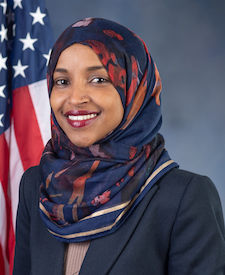
Rep. Ilhan Omar
Sponsored bills
Maddy summaryHR 2904, the Anti-Racism in Public Health Act of 2023, establishes a National Center on Antiracism and Health within the CDC. The center will declare racism a public health crisis, conduct research on how structural racism affects health outcomes, and develop data systems to track health disparities across race, ethnicity, gender, and other factors. It will fund regional centers in minority communities, create public health interventions, and require CDC to report annually on antiracist efforts. This bill directly affects public health agencies, researchers, and communities of color by mandating systemic analysis of racial inequities in healthcare and public health policy.
Maddy summaryThis bill requires the Pentagon to obtain a clean audit of its finances. If the Department of Defense fails to get an unqualified audit (a "clean" opinion) for a department or agency, it triggers automatic spending cuts: 0.5% in the first year of failure and 1.0% in subsequent years. These cuts apply broadly across programs but exclude military personnel, National Guard, reserve forces, and the Defense Health Program. The President may temporarily waive cuts for national security reasons, but must justify the waiver to Congress. The goal is to link defense spending to financial accountability, using existing audit standards.
Forced Arbitration Injustice Repeal Act of 2023 or the FAIR Act of 2023 This bill prohibits a predispute arbitration agreement from being valid or enforceable if it requires arbitration of an employment, consumer, antitrust, or civil rights dispute.
Maddy summaryHR 2974 establishes the United States Interagency Council on Housing Affordability and Preservation, a new federal body composed of heads from 21 agencies (including HUD, Treasury, and Justice) to coordinate efforts on affordable housing. The Council’s key duties include developing a national strategic plan for affordable housing within 12 months, reviewing federal housing programs, providing regional support to states and localities to access federal resources, and requiring annual agency reports on housing barriers. It mandates $4.8 million annually for operations (2024-2028) and encourages states to create their own housing councils to align with federal goals. The bill directly affects federal agencies, state/local governments, and low-income renters by improving coordination and access to housing programs, without directly changing housing subsidies or tenant protections.
Water Infrastructure Sustainability and Efficiency Act or the WISE Act This bill requires each state to use a certain percentage of funds it receives for capitalization of its clean water state revolving fund for projects to address green infrastructure, water or energy efficiency improvements, or other environmentally innovative activities.
Performing Artist Tax Parity Act of 2023 This bill modifies the above-the-line tax deduction for the expenses of performing artists (including commissions paid to managers or agents) to provide for a phaseout of such deduction for taxpayers whose adjusted gross income exceeds $100,000 ($200,000 for joint return filers). The $100,000 phaseout threshold is adjusted for inflation annually for taxable years beginning after 2023.
Maddy summaryThis bill prohibits the use of federal funds to develop or deploy autonomous weapons systems that lack meaningful human control for nuclear weapon launches or target selection. It directly affects federal agencies, particularly the Department of Defense, by banning spending on such systems for nuclear purposes. The key provision requires human oversight over target selection and launch decisions, aligning with existing U.S. policy and international law requiring human control in nuclear command. The bill does not ban autonomous systems generally but specifically restricts their use in nuclear contexts where human judgment is mandated.
Maddy summaryHR 2848, the Freedom to Move Act, provides $5 billion annually (2024-2028) in federal grants to cities, counties, and transit agencies to implement and improve fare-free public transportation systems. Eligible entities must apply with detailed plans addressing equity gaps, community consultation, and replacing fare enforcement with safety improvements like bus stop accessibility and safer routes. The bill requires grantees to prioritize underserved communities (low-income areas and communities of color) by expanding service frequency, reducing commute times, and improving connectivity to critical services. Grants cover lost fare revenue and costs for operational upgrades, network redesigns, and staff training over a 5-year period. This directly affects local transit systems and their riders, particularly low-income residents, seniors, people with disabilities, and foster care youth.
Maddy summaryHR 2825, the Prison Libraries Act of 2023, establishes a federal grant program to fund library services in state and territorial correctional facilities. It directly affects incarcerated individuals by providing access to books, digital resources, educational programs, and staff support, with funds requiring states to submit detailed plans demonstrating need and measurable goals like improving literacy or job skills. Key provisions include funding for modern library infrastructure, hiring qualified librarians, and programming such as job training, digital literacy, restorative justice, and cultural activities - all while prohibiting use for food, general prison operations, or unrelated staff costs. The program authorizes $10 million annually for six years (2024-2029), prioritizing grants that align with library standards, prioritize post-secondary education, and show clear impact on reducing recidivism.