

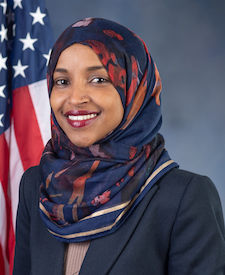
Photo of Ilhan Omar
D United States House · District 5 · Minnesota On the 2026 ballot

Rep. Ilhan Omar

Compare
Total votes
2,837
all sessions
Attendance
98%
43 missed
Near the chamber average
With party
94%
of cast votes
Lower than 77% of chamber peers
Bipartisan score
3%
crosses aisle rarely
Higher than 76% of chamber peers
Sponsored
1,670
bills & resolutions
Higher than 80% of chamber peers
Committees
4
assignments
1,670 bills and resolutions

Sponsored bills

Total
1,670
Primary
79
Co-sponsor
1,591
This page
1,670
matching current filters
Co-sponsor HR 1954
In committee · United States House · Co-sponsor
Do No Harm Act

Maddy summaryHR 1954, the "Do No Harm Act," amends the Religious Freedom Restoration Act (RFRA) to clarify that RFRA does not override specific federal laws protecting against harm. It explicitly exempts provisions related to anti-discrimination (like the Civil Rights Act), workplace protections (wages, leave, collective activity), child safety, and healthcare access from RFRA's requirements. The bill ensures RFRA cannot be used to challenge government programs or contracts that provide these essential protections. It also clarifies that RFRA applies only to disputes involving government as a party, not private disputes between individuals. This change preserves existing legal safeguards while modifying RFRA's scope.

In committee Mar 6, 2025 1 co-sponsor
Co-sponsor HRES 192
In committee · United States House · Co-sponsor
Recognizing the commencement of Ramadan, the Muslim holy month of fasting and spiritual renewal, and commending Muslims in the United States and throughout the world for their faith.

Maddy summaryHRES 192 is a ceremonial resolution recognizing the start of Ramadan, the Muslim holy month of fasting and spiritual renewal, and commending Muslims in the U.S. and globally. It acknowledges that approximately 4.5 million Muslims live in the United States and highlights Ramadan’s significance as the ninth month of the Islamic calendar, observed from February 28, 2025. The resolution notes American Muslims’ contributions to society through charitable work, diverse professions, and community leadership, while referencing historical U.S. government recognition of Ramadan, including presidential iftars since 1996. As a symbolic gesture, it has no legal effect or direct impact on any group, policy, or funding.

In committee Mar 5, 2025 1 co-sponsor
Co-sponsor HR 1888
In committee · United States House · Co-sponsor
Nuclear Weapons Abolition and Conversion Act of 2025

Maddy summaryThis bill would redirect U.S. nuclear weapons funding to clean energy and social programs, but only after the President certifies all nuclear-armed nations have begun verifiable global elimination under the Treaty on the Prohibition of Nuclear Weapons. It requires converting nuclear weapons industry facilities and retraining workers for clean energy development. Funds would support climate initiatives, healthcare, housing, education, and environmental restoration. The bill's implementation is contingent on international progress toward nuclear disarmament, as it does not mandate immediate action.

In committee Mar 5, 2025 1 co-sponsor
Co-sponsor HR 14
In committee · United States House · Co-sponsor
John R. Lewis Voting Rights Advancement Act of 2025

Maddy summaryThis bill strengthens the Voting Rights Act of 1965 by clarifying how to prove voting discrimination and expanding requirements for preclearance of voting changes. It establishes new standards for determining when voting practices dilute minority voting strength or deny/abridge voting rights, requiring plaintiffs to show specific conditions for vote dilution claims and including factors like historical discrimination and racial polarization in court analyses. The bill modifies the criteria for determining which states and political subdivisions must seek preclearance for voting changes, and adds new transparency requirements for jurisdictions to publicly disclose changes to voting qualifications, polling locations, and election districts. It directly affects states and local governments that implement voting policies, particularly those with a history of voting rights violations or that make changes to voting qualifications, procedures, or district boundaries. The bill aims to prevent discriminatory voting practices by providing clearer standards for courts and requiring greater transparency in voting rule changes.

In committee Mar 5, 2025 1 co-sponsor
Co-sponsor HR 20
In committee · United States House · Co-sponsor
Richard L. Trumka Protecting the Right to Organize Act of 2025

Maddy summaryThe Richard L. Trumka Protecting the Right to Organize Act of 2025 strengthens workers' organizing rights by making it an unfair labor practice for employers to threaten permanent replacement of striking workers, discriminate against workers who support unions, or require employees to attend employer campaigns unrelated to their job duties. It expands the definition of "employee" to make it harder for companies to classify workers as independent contractors and requires employers to post notices about workers' rights in conspicuous locations. The bill establishes a new electronic voting system for union elections, creates a 90-day bargaining period before mediation can be requested, and increases penalties for violations of labor laws. These changes are intended to make it easier for workers to form unions and negotiate better wages and working conditions.

In committee Mar 5, 2025 1 co-sponsor
Co-sponsor HR 1841
In committee · United States House · Co-sponsor
Peace on the Korean Peninsula Act

Maddy summaryThis bill directs the State Department to review restrictions on U.S. citizens traveling to North Korea, particularly focusing on humanitarian visits for Americans with relatives there (estimated at 100,000 people). It requires the Secretary of State to submit a report within 180 days detailing how the U.S. will pursue a formal end to the Korean War through diplomatic negotiations with North and South Korea. The bill also mandates a separate report outlining a clear roadmap for achieving a binding peace agreement, including necessary negotiation steps and key stakeholders. These provisions aim to address the ongoing state of war, which the bill states prevents formal U.S.-North Korea relations and family reunifications.

In committee Mar 4, 2025 1 co-sponsor
Co-sponsor HR 660
In committee · United States House · Co-sponsor
WISER Act of 2025

Maddy summaryThe WISER Act of 2025 provides automatic discharge status upgrades and a $25,000 one-time payment to eligible female veterans involuntarily separated from military service between April 1951 and February 1976 under Executive Order 10240. It directly affects women veterans who served during that period and were separated due to pregnancy, childbirth, or childcare responsibilities. The bill establishes two programs: one to upgrade discharge status (treating veterans as if they completed their service) and another to pay $25,000 to eligible veterans or their surviving spouses if the veteran dies after enactment. Eligibility is automatic for those separated under Executive Order 10240, with additional consideration for veterans who had childbirth-related events within 10 months of separation.

In committee Mar 4, 2025 1 co-sponsor
Co-sponsor HJRES 70
In committee · United States House · Co-sponsor
Providing for congressional disapproval of the proposed license amendment for the export to Israel of certain defense articles and services.

Maddy summaryHJRES 70 is a joint resolution seeking congressional disapproval of a proposed license amendment to export specific U.S. defense equipment to Israel. It directly targets a planned transfer of 15,500 additional JDAM tail kits and 615 Small Diameter Bombs (SDBs) to the Israeli Ministry of Defense, as outlined in Transmittal No. DDTC 24-052. The bill would prohibit the issuance of this license amendment, effectively blocking the additional weapons exports. This resolution focuses on halting a specific authorization under the Arms Export Control Act, affecting only the designated defense articles and their intended end-use by Israel's military.

In committee Mar 3, 2025 1 co-sponsor
Co-sponsor HJRES 69
In committee · United States House · Co-sponsor
Providing for congressional disapproval of the proposed foreign military sale to Israel of certain defense articles and services.

Maddy summaryHJRES 69 is a joint resolution that would prohibit a specific proposed U.S. military sale to Israel. It blocks the transfer of 2,166 GBU-39 bombs, thousands of bomb components and guidance kits, and related support services detailed in a February 2025 arms sale notification. The bill directly affects Israel by preventing the acquisition of these defense articles under the proposed transaction. It uses the statutory process for congressional disapproval under the Arms Export Control Act to stop this particular sale. The resolution does not alter broader U.S. policy toward Israel but targets this specific military equipment transfer.

In committee Mar 3, 2025 1 co-sponsor
Co-sponsor HJRES 68
In committee · United States House · Co-sponsor
Providing for congressional disapproval of the proposed foreign military sale to Israel of certain defense articles and services.

Maddy summaryHJRES 68 is a congressional resolution seeking to block a specific proposed U.S. military sale to Israel. It targets defense articles and services detailed in Transmittal No. 24-16, including 10,000 additional M107/M795 155mm artillery shells and related support like technical documentation and engineering services. The resolution would prohibit this sale by invoking Congress's disapproval authority under the Arms Export Control Act. It directly affects the U.S. government's ability to proceed with this particular foreign military sale to Israel. The measure focuses solely on stopping this specific transaction, not broader policy changes.

In committee Mar 3, 2025 1 co-sponsor
Showing 401 to 410 of 1,670 bills
Previous 1 … 40 41 42 … 167 Next