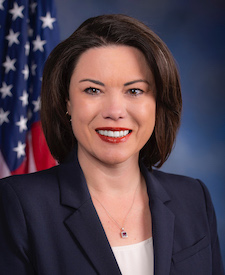
Photo of Angie Craig
D United States House · District 2 · Minnesota

Rep. Angie Craig

Compare
Total votes
2,837
all sessions
Attendance
98%
60 missed
Near the chamber average
With party
93%
of cast votes
Near the chamber average
Bipartisan score
4%
crosses aisle rarely
Near the chamber average
Sponsored
1,830
bills & resolutions
Higher than 95% of chamber peers
Committees
1
assignment
1,830 bills and resolutions

Sponsored bills

Total
1,830
Primary
87
Co-sponsor
1,743
This page
1,830
matching current filters
Co-sponsor HR 2828
In committee · United States House · Co-sponsor
DAIRY PRIDE Act

Defending Against Imitations and Replacements of Yogurt, milk, and cheese to Promote Regular Intake of Dairy Everyday Act or the DAIRY PRIDE Act This bill prohibits the sale of any food that uses the market name of a dairy product (such as milk , yogurt , or cream cheese ) unless the food (1) is the milk of a hooved animal, (2) is derived from such milk, or (3) contains such milk as a primary ingredient.

In committee Apr 23, 2021 1 co-sponsor
Co-sponsor HR 959
In committee · United States House · Co-sponsor
Black Maternal Health Momnibus Act of 2021

Black Maternal Health Momnibus Act of 2021 This bill directs multi-agency efforts to improve maternal health, particularly among racial and ethnic minority groups, veterans, and other vulnerable populations. It also addresses maternal health issues related to COVID-19 (i.e., coronavirus disease 2019). The Department of Health and Human Services (HHS) and other specified departments must address the social determinants of maternal health, which include child care, housing, food security, transportation, and environmental conditions. The bill also extends to 24 months postpartum eligibility for the Special Supplemental Nutrition Program for Woman, Infants, and Children. Additionally, HHS and other agencies must take actions to grow and diversify the maternal health workforce. To increase access to maternity care, HHS and other agencies must (1) award specified grants; (2) test an alternative payment model for perinatal care under Medicaid and the Children's Health Insurance Program (CHIP); and (3) support training, technology, and telehealth initiatives. The bill also increases research and data collection on maternal morbidity and mortality, particularly among tribal populations and minority groups. The Bureau of Prisons and the Department of Justice must establish programs to improve maternity care for incarcerated populations. The Medicaid and CHIP Payment and Access Commission must also report on the impact of Medicaid ineligibility for pregnant and postpartum prisoners. Additionally, as a condition for certain grants, states and territories must have laws limiting the use of restraints on pregnant individuals in prisons. The bill also directs activities to mitigate adverse maternal health outcomes associated with climate change and to improve maternal vaccination rates.

In committee Apr 23, 2021 1 co-sponsor
Co-sponsor HR 2820
In committee · United States House · Co-sponsor
Growing Climate Solutions Act of 2021

Growing Climate Solutions Act of 2021 This bill authorizes the Department of Agriculture (USDA) to establish a voluntary Greenhouse Gas Technical Assistance Provider and Third-Party Verifier Certification Program to help reduce entry barriers into voluntary environmental credit markets for farmers, ranchers, and private forest landowners. A voluntary environmental credit market is a market through which agriculture and forestry credits may be bought or sold. Entities eligible to participate in the program are (1) providers of technical assistance to farmers, ranchers, or private forest landowners in carrying out sustainable land use management practices that prevent, reduce, or mitigate greenhouse gas emissions, or sequester carbon; or (2) third-party verifiers that conduct the verification of the processes described in the protocols for voluntary environmental credit markets. Among other requirements, USDA must publish (1) a list of protocols and qualifications for eligible entities; (2) information describing how entities may self-certify under the program; (3) information describing how entities may obtain the expertise to meet the protocols and qualifications; and (4) instructions and suggestions to assist farmers, ranchers, and private forest landowners in facilitating the development of agriculture or forestry credits and accessing voluntary environmental credit markets. USDA must also establish an advisory council to make recommendations regarding the list of protocols and qualifications, best practices, and voluntary environmental credit markets. The bill also rescinds certain funds provided in the American Rescue Plan Act of 2021 and makes the funds available for the certification program.

In committee Apr 22, 2021 1 co-sponsor
Co-sponsor HR 51
Passed · United States House · Co-sponsor
Washington, D.C. Admission Act

Washington, D.C. Admission Act This bill provides for admission into the United States of the state of Washington, Douglass Commonwealth, composed of most of the territory of the District of Columbia. The commonwealth shall be admitted to the Union on an equal footing with the other states. The Mayor of the District of Columbia shall issue a proclamation for the first elections to Congress of two Senators and one Representative of the commonwealth. The bill applies current District laws to the commonwealth and continues pending judicial proceedings. The commonwealth (1) shall consist of all District territory, with specified exclusions for federal buildings and monuments, including the principal federal monuments, the White House, the Capitol Building, the U.S. Supreme Court Building, and the federal executive, legislative, and judicial office buildings located adjacent to the Mall and the Capitol Building; and (2) may not impose taxes on federal property except as Congress permits. District territory excluded from the commonwealth shall be known as the Capital and shall be the seat of the federal government. The bill maintains the federal government's authority over military lands and specified other property. The bill provides for expedited consideration of a joint resolution repealing the Twenty-third Amendment to the Constitution, which provides for the appointment of electors of the President and Vice President. The bill continues certain federal authorities and responsibilities, including regarding employee benefits, agencies, courts, and college tuition assistance, until the commonwealth certifies that it is prepared to take over the authorities and responsibilities. The bill establishes the Statehood Transition Commission to advise the President, Congress, and District and commonwealth leaders on the transition.


Passed Apr 22, 2021 1 co-sponsor
Co-sponsor HR 2654
In committee · United States House · Co-sponsor
Chiropractic Medicare Coverage Modernization Act of 2021

Chiropractic Medicare Coverage Modernization Act of 2021 This bill expands Medicare coverage of chiropractic services to include all services provided by chiropractors, rather than only subluxation corrections through manual manipulation of the spine.

In committee Apr 20, 2021 1 co-sponsor
Co-sponsor HR 1996
Passed · United States House · Co-sponsor
SAFE Banking Act of 2021

Secure and Fair Enforcement Banking Act of 2021 or the SAFE Banking Act of 2021 This bill generally prohibits a federal banking regulator from penalizing a depository institution for providing banking services to a legitimate cannabis-related business. Prohibited penalties include terminating or limiting the deposit insurance or share insurance of a depository institution solely because the institution provides financial services to a legitimate cannabis-related business and prohibiting or otherwise discouraging a depository institution from offering financial services to such a business. Additionally, proceeds from a transaction involving activities of a legitimate cannabis-related business are not considered proceeds from unlawful activity. Proceeds from unlawful activity are subject to anti-money laundering laws. Furthermore, a depository institution is not, under federal law, liable or subject to asset forfeiture for providing a loan or other financial services to a legitimate cannabis-related business. The bill also provides that a federal banking agency may not request or order a depository institution to terminate a customer account unless (1) the agency has a valid reason for doing so, and (2) that reason is not based solely on reputation risk. Valid reasons for terminating an account include threats to national security and involvement in terrorist financing, including state sponsorship of terrorism. Finally, the bill decreases the cap on the surplus funds of the Federal Reserve banks. (Amounts exceeding this cap are deposited in the general fund of the Treasury.)

Passed Apr 20, 2021 1 co-sponsor
Co-sponsor HR 1482
Passed · United States House · Co-sponsor
504 Credit Risk Management Improvement Act of 2021

504 Credit Risk Management Improvement Act of 2021 This bill revises the duties of the Office of Credit Risk Management to include oversight of a certified development company (CDC) that participates in the 504 Loan Program of the Small Business Administration (SBA), and it requires the SBA to issue rules related to certain environmental requirements. The 504 Loan Program provides a small business with SBA financing—through a CDC intermediary—for expansion or modernization. Specifically, the bill requires the office to oversee any CDC that participates in the program and to conduct file reviews with respect to loan closings under the program. Further, the bill authorizes the office to take formal and informal enforcement actions against a CDC for specified violations and to charge each CDC a fee. The SBA must issue rules to clarify the procedures necessary for an eligible CDC to comply with certain environmental requirements.

Passed Apr 19, 2021 1 co-sponsor
Primary HR 1490
Passed · United States House · Lead sponsor
504 Modernization and Small Manufacturer Enhancement Act of 2021

504 Modernization and Small Manufacturer Enhancement Act of 2021 This bill modifies the Small Business Administration (SBA) 504 Loan Program, which provides a small business with SBA financing—through a certified development company (CDC) intermediary—for expansion or modernization. Specifically, the bill adds policy goals, at least one of which a CDC must demonstrate to be eligible for assistance. These include (1) enhancing the ability of a small business to reduce costs by using energy efficient products and generating renewable energy, and (2) aiding the revitalization of any area for which a disaster has been declared or determined. The bill also authorizes a CDC to take specified actions to facilitate the closing of a 504 loan, such as correcting borrower or lender information on loan documents or reallocating up to 10% of the cost of a project. For small manufacturers, the bill (1) increases the maximum loan amount from $5.5 million to $6.5 million, (2) reduces the amount that they must contribute to project costs, (3) increases job retention requirements, and (4) revises collateral requirements and debt refinancing considerations. Further, each SBA district office must partner with a resource partner to provide certain training for small manufacturers.

Passed Apr 19, 2021 0 co-sponsors
Co-sponsor HR 1195
Passed · United States House · Co-sponsor
Workplace Violence Prevention for Health Care and Social Service Workers Act

Workplace Violence Prevention for Health Care and Social Service Workers Act This bill requires the Department of Labor to address workplace violence in health care, social service, and other sectors. Specifically, Labor must issue an interim occupational safety and health standard that requires certain employers to take actions to protect workers and other personnel from workplace violence. The standard applies to employers in the health care sector, in the social service sector, and in sectors that conduct activities similar to those in the health care and social service sectors. In addition, Labor must promulgate a final standard within a specified time line.

Passed Apr 19, 2021 1 co-sponsor
Co-sponsor HR 2615
In committee · United States House · Co-sponsor
PPP Second Draw Fairness Act of 2021

PPP Second Draw Fairness Act of 2021 This bill allows applicants for second draw loans under the Paycheck Protection Program, established to support small businesses in response to COVID-19 (i.e., coronavirus disease 2019), to select any consecutive 90-day period in 2020 from which to demonstrate a qualifying loss in revenue that makes them eligible for such loans. Currently, this qualification period must align with a corresponding calendar quarter from the previous year.

In committee Apr 16, 2021 1 co-sponsor
Showing 1,671 to 1,680 of 1,830 bills