American Made Pharmaceuticals Act of 2022 This bill requires the Centers for Medicare & Medicaid Services to conduct a demonstration program that gives preference to domestically manufactured drugs under Medicare, Medicaid, and the Children's Health Insurance Program (CHIP). The program must be conducted in at least eight states and for at least seven years. Applicable drugs include critical drugs that are needed to respond to a public health emergency and that have a vulnerable global supply chain. Preference may take the form of reduced cost-sharing, preferential treatment on formularies, bonus payments, and other specified methods.
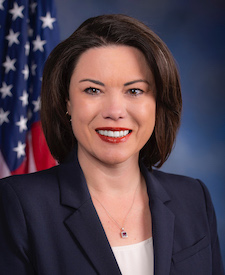
Rep. Angie Craig
Sponsored bills
Postal Service Reform Act of 202 2 This bill addresses the finances and operations of the U.S. Postal Service (USPS). The bill requires the Office of Personnel Management (OPM) to establish the Postal Service Health Benefits Program within the Federal Employees Health Benefits Program under which OPM may contract with carriers to offer health benefits plans for USPS employees and retirees. The bill provides for coordinated enrollment of retirees under this program and Medicare. The bill repeals the requirement that the USPS annually prepay future retirement health benefits. Additionally, the USPS may establish a program to enter into agreements with an agency of any state government, local government, or tribal government, and with other government agencies, to provide certain nonpostal products and services that reasonably contribute to the costs of the USPS and meet other specified criteria. The USPS must develop and maintain a publicly available dashboard to track service performance and must report regularly on its operations and financial condition. The Postal Regulatory Commission must annually submit to the USPS a budget of its expenses. It must also conduct a study to identify the causes and effects of postal inefficiencies relating to flats (e.g., large envelopes). The USPS Office of Inspector General shall perform oversight of the Postal Regulatory Commission.
Modernizing Therapeutic Equivalence Rating Determination Act This bill requires the Food and Drug Administration (FDA) to provide a therapeutic equivalence rating for certain new drug applications if the applicant requests such a rating. Upon request in the application, the FDA must provide such a rating for a new drug application that relies on information from studies not conducted by the applicant and that the applicant does not have a right to reference or use (commonly referred to as a 505(b)(2) application). The FDA must provide the rating no later than 30 days after the application's approval. (A drug is a therapeutic equivalent of another if they produce the same clinical effect and have the same safety profile. Typically, for certain generic drugs, the FDA rates the therapeutic equivalence of that generic drug to another drug, such as the brand name version. Currently, an applicant seeking approval of a drug through a 505(b)(2) application typically only receives an equivalence rating by requesting one from the FDA in a separate petition.)
Ensuring Lasting Smiles Act This bill requires private health insurance plans to cover diagnosis and treatment of congenital anomalies and birth defects, such as reconstructive services and items. Coverage must include services and items that functionally improve, repair, or restore any body part that is medically necessary for normal bodily functions or appearance, as determined by the treating physician. Coverage limits and cost-sharing requirements for such services and items may not be more restrictive than those applicable to all medical and surgical benefits under the plan.
Supply Chain Disruptions Relief Act This bill modifies the treatment of liquidations of new motor vehicle inventory as qualified LIFO (last in first out accounting method) inventory. It allows new motor vehicle dealers to elect to wait until the end of 2025 to replace their inventory for purposes of determining income attributable to the sale of such inventory during 2020 and 2021.
Home Front Energy Independence Act This bill prohibits the importation of petroleum and petroleum products from Russia until Russia recognizes the sovereignty and territorial integrity of Ukraine. The bill allows a new tax credit for the sale or blending of ethanol fuels. It also extends through 2025 the income tax credit for biodiesel and renewable diesel used as fuel. The bill modifies requirements relating to the waiver of ethanol reid vapor pressure limitations and E15 labeling. The bill requires the Department of Agriculture to award grants to certain governmental entities for expanding the biofuel infrastructure and agriculture product market.
Marijuana Opportunity Reinvestment and Expungement Act or the MORE Act This bill decriminalizes marijuana. Specifically, it removes marijuana from the list of scheduled substances under the Controlled Substances Act and eliminates criminal penalties for an individual who manufactures, distributes, or possesses marijuana. The bill also makes other changes, including the following: replaces statutory references to marijuana and marihuana with cannabis , requires the Bureau of Labor Statistics to regularly publish demographic data on cannabis business owners and employees, establishes a trust fund to support various programs and services for individuals and businesses in communities impacted by the war on drugs, imposes an excise tax on cannabis products produced in or imported into the United States and an occupational tax on cannabis production facilities and export warehouses, makes Small Business Administration loans and services available to entities that are cannabis-related legitimate businesses or service providers, prohibits the denial of federal public benefits to a person on the basis of certain cannabis-related conduct or convictions, prohibits the denial of benefits and protections under immigration laws on the basis of a cannabis-related event (e.g., conduct or a conviction), establishes a process to expunge convictions and conduct sentencing review hearings related to federal cannabis offenses, directs the Government Accountability Office to study the societal impact of state legalization of recreational cannabis, directs the National Highway Traffic Safety Administration to study methods for determining whether a driver is impaired by marijuana, directs the National Institute for Occupational Safety and Health to study the impact of state legalization of recreational cannabis on the workplace, and directs the Department of Education to study the impact of state legalization of recreational cannabis on schools and school-aged children.

This resolution expresses support for the designation of Dr. John E. Fryer Day and encourages governmental support for the teaching of lesbian, gay, bisexual, transgender, and queer history.
Securing a Strong Retirement Act of 2022 This bill makes various changes with respect to employer-sponsored retirement plans, including providing for the automatic enrollment of employees in certain plans and increasing the age at which participants are required to begin receiving mandatory distributions.
Reauthorizing Evidence-based And Crisis Help Initiatives Needed to Generate Improved Mental Health Outcomes for Patients Act of 2022 or the REACHING Improved Mental Health Outcomes for Patients Act of 2022 This bill reauthorizes through FY2027 various activities related to mental health services and resources. It also establishes grants for assisted outpatient treatment programs. Specifically, the bill reauthorizes a policy laboratory housed within the Substance Abuse and Mental Health Services Administration (SAMHSA) that promotes evidence-based practices and service delivery models. Additionally, the bill reauthorizes grants and similar assistance for projects and programs to address priority mental health needs of regional and national significance, integrated primary care and behavioral health care at the community level, community-based systems to respond to behavioral health crises, programs to raise awareness about mental health services and resources in communities and train community members about how to respond appropriately and safely to individuals with mental disorders, suicide prevention and intervention programs for individuals over age 25 who are at risk of suicide, and assertive community treatment programs for individuals with the most severe functional impairments associated with mental illness. The bill also requires the Center for Mental Health Services within SAMHSA to award grants to localities, mental health systems, mental health courts, or other entities for assisted outpatient treatment programs (i.e., medically prescribed mental health treatment that is lawfully ordered by a state or local court and that a patient receives while living in a community).