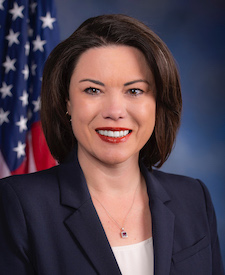
Photo of Angie Craig
D United States House · District 2 · Minnesota

Rep. Angie Craig

Compare
Total votes
2,837
all sessions
Attendance
98%
60 missed
Near the chamber average
With party
93%
of cast votes
Near the chamber average
Bipartisan score
4%
crosses aisle rarely
Near the chamber average
Sponsored
1,831
bills & resolutions
Higher than 95% of chamber peers
Committees
1
assignment
1,831 bills and resolutions

Sponsored bills

Total
1,831
Primary
87
Co-sponsor
1,744
This page
1,831
matching current filters
Co-sponsor HRES 891
In committee · United States House · Co-sponsor
Expressing the sense of the House of Representatives that the article of amendment (commonly known as the "Equal Rights Amendment") to the Constitution is valid.

This resolution expresses the sense of the House of Representatives that the proposed constitutional amendment known as the Equal Rights Amendment has been duly proposed by Congress and ratified by the states and is therefore valid as the Twenty-Eighth Amendment to the Constitution. (The proposed amendment prohibits the United States or any state from denying or abridging equal rights under the law on account of sex.)

In committee Nov 1, 2022 1 co-sponsor
Co-sponsor HRES 507
In committee · United States House · Co-sponsor
Condemning the rise in hate against the transgender and nonbinary community.

Maddy summaryHRES 507 is a non-binding House resolution condemning legislative actions and violence targeting transgender and nonbinary individuals. It references 2021 state bills restricting transgender youth access to gender-affirming medical care, sports participation, and public facilities, alongside statistics on rising violence (44 transgender killings in 2020) and mental health impacts. The resolution formally condemns discriminatory legislation and violence, remembers victims of transphobic hate, and commits to advocating for the community’s safety. As a symbolic resolution - not a law - it expresses congressional disapproval but does not create new policies or alter existing laws.

In committee Nov 1, 2022 1 co-sponsor
Co-sponsor HR 8736
In committee · United States House · Co-sponsor
GUARD VA Benefits Act

Governing Unaccredited Representatives Defrauding VA Benefits Act or the GUARD VA Benefits Act This bill imposes criminal penalties and/or fines on individuals for directly or indirectly soliciting, contracting for, charging, or receiving any unauthorized fee or compensation with respect to the preparation, presentation, or prosecution of any claim for Department of Veterans Affairs benefits. The attempted commission of such offenses is also punishable by fine or imprisonment.

In committee Nov 1, 2022 1 co-sponsor
Co-sponsor HR 8685
In committee · United States House · Co-sponsor
Afghan Adjustment Act

Afghan Adjustment Act This bill expands eligibility for special immigrant visas to certain Afghan nationals (and accompanying spouse and children) and addresses related issues. The Department of Homeland Security may provide such visas to Afghan nationals who provided qualifying service as a member of the Afghan Air Force or other specified entities and meet eligibility requirements, such as passing a background check. Currently, special immigrant visas for Afghan nationals are generally only available to those who were employed by or on behalf of the U.S. government in Afghanistan. Such visas shall also be available to an Afghan national who is a qualifying relative of a veteran or member of the U.S. Armed Forces. The bill also modifies procedures for providing lawful permanent resident status to certain classes of Afghan nationals, such as by (1) providing a streamlined process with specified vetting requirements for certain individuals, including those who provided support to the U.S. government in Afghanistan; and (2) preserving the eligibility of certain battered spouses whose eligibility for such status stemmed from a marriage that has terminated. Furthermore, the Department of State (1) must respond to inquiries from Members of Congress about specific applications from Afghan nationals seeking special immigrant or refugee status; and (2) establish an office in Afghanistan to perform certain tasks, such as issuing visas, if no U.S. embassies are operational in Afghanistan. The President must establish a task force to develop and implement a strategy to assist Afghan nationals who qualify for admission to the United States.

In committee Nov 1, 2022 1 co-sponsor
Co-sponsor HR 8209
In committee · United States House · Co-sponsor
SOBER Act of 2022

Supporting Opportunities to Build Everyday Responsibility Act of 2022 or the SOBER Act of 2022 This bill directs the Department of Justice to establish a grant program to provide funding for 24-7 sobriety programs. It also directs the National Institute of Justice to evaluate the policies and procedures used by grant recipients to reduce crime, recidivism, and incarceration attributed to use of alcohol or controlled substances.

In committee Nov 1, 2022 1 co-sponsor
Co-sponsor HR 7826
In committee · United States House · Co-sponsor
Pathways to Policing Act

Pathways to Policing Act This bill authorizes the Office of Community Oriented Policing Services within the Department of Justice to award grants to states, local governments, and law enforcement agencies to support recruitment of law enforcement officers. In particular, these grants may be used for (1) marketing and recruitment campaigns to encourage candidates to seek careers in law enforcement; and (2) developing, operating, or expanding Pathways to Policing programs (e.g., programs that facilitate entry into full-time law enforcement positions for certain candidates).

In committee Nov 1, 2022 1 co-sponsor
Primary HR 7782
In committee · United States House · Lead sponsor
Closing the Congressional Revolving Door Act

Closing the Congressional Revolving Door Act This bill places limits on certain activities of Members and elected officers of Congress. The bill imposes a permanent ban on lobbying contacts by a former Senator (currently, a two-year ban), a former Member of the House of Representatives (currently, a one-year ban), or a former elected officer of the House or Senate (currently, a one-year ban). Additionally, certain benefits and services are eliminated for former Members of the House (e.g., access to the House chamber, the Member's Dining Room, or parking spaces) unless the benefits or services are made available to the public.

In committee Nov 1, 2022 0 co-sponsors
Co-sponsor HR 6946
In committee · United States House · Co-sponsor
SAFE Act of 2022

Save Americans from the Fentanyl Emergency Act of 2022 or the SAFE Act of 2022 This bill permanently places fentanyl-related substances as a class into schedule I of the Controlled Substances Act. A schedule I controlled substance is a drug, substance, or chemical that has a high potential for abuse; has no currently accepted medical value; and is subject to regulatory controls and administrative, civil, and criminal penalties under the Controlled Substances Act. It limits the application of mandatory minimum penalties for certain offenses involving fentanyl-related substances, establishes a process to deschedule or remove certain fentanyl-related substances that have a low potential for abuse, and allows a federal court to vacate or reduce the sentence for convictions of offenses involving a fentanyl-related substance that is descheduled or moved to a schedule other than schedule I or II. The bill establishes a new, alternative registration process for schedule I research. It also makes other changes to registration requirements for conducting research with controlled substances, including permitting a single registration for related research sites in certain circumstances, waiving the requirement for a new inspection in certain situations, and allowing a registered researcher to perform certain manufacturing activities with small quantities of a substance without obtaining a manufacturing registration. Finally, the bill requires the Government Accountability Office to analyze the implementation and impact of permanently placing fentanyl-related substances into schedule I of the Controlled Substances Act.

In committee Nov 1, 2022 1 co-sponsor
Co-sponsor HR 6860
In committee · United States House · Co-sponsor
Latonya Reeves Freedom Act of 2022

Latonya Reeves Freedom Act of 2022 This bill prohibits government entities and insurance providers from denying community-based services to individuals with disabilities that require long-term service or support that would enable such individuals to live in the community and lead an independent life. Specifically, these entities may not discriminate against such individuals in the provision of community-based services by such actions as imposing prohibited eligibility criteria, cost caps, or waiting lists or failing to provide a specific community-based service. Additionally, community-based services must be offered to individuals with such disabilities prior to institutionalization. Institutionalized individuals must be notified regularly of community-based alternatives. The bill requires the Department of Justice to issue regulations requiring government entities and insurance providers to offer community-based long-term services to individuals with such disabilities who would otherwise qualify for institutional placement. Government entities must ensure sufficient availability of affordable, accessible, and integrated housing that is not a disability-specific residential setting or a setting where services are tied to tenancy. Regulations shall also (1) require government entities and insurance providers to perform self-evaluation on current services, policies, and practices and concerning compliance with requirements of this bill; and (2) require government entities to submit a transition plan. The bill provides funds for FY2022 for the Department of Health and Human Services to provide technical assistance with respect to transition plans. The bill allows civil actions by individuals subjected to, or about to be subjected to, a violation of its requirements.


In committee Nov 1, 2022 1 co-sponsor
Co-sponsor HR 6853
In committee · United States House · Co-sponsor
Russian Travel Sanctions for a Democratic Ukraine Act

Russian Travel Sanctions for a Democratic Ukraine Act This bill imposes visa-blocking sanctions on certain citizens of Russia. Specifically, the President must impose such sanctions on citizens of Russia who are (1) Russian oligarchs, (2) employees of Russia's government, or (3) employees of companies that are owned by or receive funding from Russia's government. The President must also impose the sanctions on family members of such individuals. The President must coordinate with allies, including NATO member states, on the imposition of such sanctions. The President may waive the application of such sanctions in certain instances.

In committee Nov 1, 2022 1 co-sponsor
Showing 1,321 to 1,330 of 1,831 bills