Harlem Hellfighters Congressional Gold Medal Act This bill provides for the award of a Congressional Gold Medal to the 369th Infantry Regiment, commonly known as the Harlem Hellfighters, in recognition of their bravery and outstanding service during World War I.
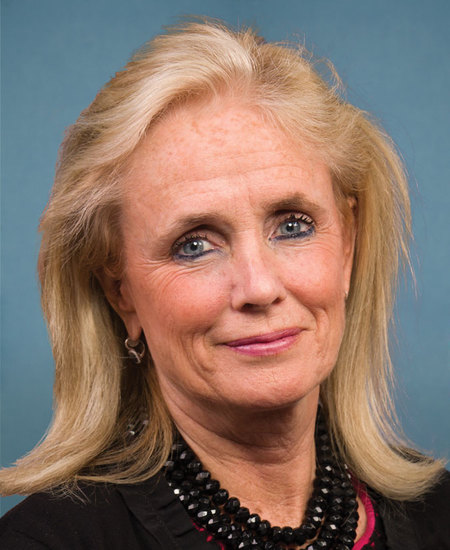
Rep. Debbie Dingell
Sponsored bills
Puppies Assisting Wounded Servicemembers for Veterans Therapy Act or the PAWS for Veterans Therapy Act This bill implements a program and a policy related to service dog therapy for veterans. Specifically, the bill requires the Department of Veterans Affairs (VA) to implement a five-year pilot program to provide canine training to eligible veterans diagnosed with post-traumatic stress disorder as an element of a complementary and integrative health program. Eligible veterans are those who are enrolled in the VA health care system and have been recommended for participation by a qualified mental health care provider or clinical team. The VA must seek to enter agreements containing specified elements with accredited nongovernmental entities that have demonstrated ability to provide canine training. Veterans who participate in the program are authorized to adopt the dog they assisted in training if their health provider determines it is in the best interest of the veteran. The VA must establish processes to document and track the progress of participating veterans with respect to health benefits and improvements. The Government Accountability Office must brief Congress and submit a report on the program. The bill also authorizes the VA to provide service dogs to veterans with mental illnesses, regardless of whether they have a mobility impairment.
Beaches Environmental Assessment and Coastal Health Act of 2021 or the BEACH Act of 2021 This bill reauthorizes through FY2026 and expands a program that awards grants to state and local governments to monitor the water quality at beaches and notify the public when water is not safe for recreational activities. The bill expands the program to allow the Environmental Protection Agency to award grants for researching and identifying specific sources of contamination at certain coastal recreation waters and taking actions to mitigate those sources.
Preserving Patient Access to Home Infusion Act This bill specifically includes pharmacy services as part of covered home infusion therapy under Medicare, and specifies that certain payment components still apply regardless of whether or not a qualified supplier is physically present in the beneficiary's home. The bill also allows nurses and physician assistants to establish and review the plan of care for home infusion therapy.
Preserving the MotorCities Heritage Act This bill extends through FY2036 the authority of the Department of the Interior to make grants or furnish technical assistance for the MotorCities National Heritage Area in Michigan. The bill also increases the maximum amount of funding that may be appropriated for the heritage area. Finally, the bill waives, for FY2022-FY2023, the matching funds requirement for the heritage area.
Information Sharing And Advanced Communication Alerting Act or the ISAAC Alerting Act This bill requires the Technological Advisory Council of the Federal Communications Commission, in consultation with relevant stakeholders, to submit a report that identifies measures, barriers, and recommendations for implementing a 9–1–1 disability alerting system. The alerting system must allow an individual to register and create a profile associated with an individual who has a disability that includes information such as whether the individual is a wandering risk, nonverbal, or physically limited. The alerting system then transmits such information to public safety answering points to be conveyed to first responders.
Migratory Bird Protection Act of 2021 This bill prohibits the incidental taking (e.g., capturing or killing) of migratory birds by commercial activities unless the activity is authorized under a permit or is identified as posing de minimis risk to migratory birds. The U.S. Fish and Wildlife Service (USFWS) must regulate such incidental taking, including by (1) issuing general permits for certain industries, (2) creating a mitigation fee for any incidental taking of migratory birds, and (3) identifying categories of de minimis risk activities that are exempt from liability for the taking of migratory birds. In addition, the USFWS must establish and maintain a research program (1) to evaluate the impacts of commercial activities on birds, (2) to evaluate the effectiveness of best management practices and technologies to avoid or minimize such impacts, and (3) to develop new or improved best management practices and technologies.
Refuge System Protection Act This bill authorizes the Department of Justice (DOJ), at the request of the Department of the Interior, to bring in a district court a civil action against any individual or entity that destroys, causes the loss of, causes Interior to make risk mitigation efforts with respect to, or injures any resource that is within the boundaries any land or water that is managed by the U.S. Fish and Wildlife Service. The bill also authorizes DOJ, at the request of Interior, to bring in a district court an in rem action against any instrumentality (e.g., a vessel, vehicle, or aircraft) that destroys, causes the loss of, causes Interior to make risk mitigation efforts with respect to, or injures any such system resource. Among others, it shall be an affirmative defense in either type of action that the destruction of, loss of, risk mitigation regarding, or injury to a system resource was caused by an otherwise legal act or omission that occurred outside the boundaries of the resource. In either type of action, the court may award response costs and damages.

Twenty-First Century Dams Act This bill addresses dam infrastructure and safety. First, the bill provides resources for programs related to state dam safety, the rehabilitation of high hazard potential dams, and the inspection of dams. In particular, the bill reauthorizes through FY2026 the National Dam Safety Program. In addition, the bill reauthorizes through FY2026 a program related to the rehabilitation of structural measures and a program related to water infrastructure. Next, the bill allows a new tax credit for maintaining and enhancing hydroelectric dams that is equal to 30% of the basis of any qualified dam safety, environmental, and grid resilience enhancement property placed in service in a taxable year. It also allows a 30% credit for qualified obsolete river obstruction removal expenditures for demolishing and removing certain nonpowered or hydroelectric dams. The bill directs the Department of the Army to establish a program to carry out dam removal projects. Further, the bill establishes the Dam Removal Council to (1) coordinate with participating federal agencies to annually notify all known dam owners of the availability of dam removal funding and provide guidance on the existing programs of participating agencies; (2) evaluate and submit to Army recommendations for dam removal projects, technical assistance programs, and funding allocations; and (3) develop a dam removal strategy. The bill requires certain dam assessments, including a joint assessment by the U.S. Geological Survey and the Department of Energy. The bill also authorizes specified federal agencies to undertake certain activities related to federal dam infrastructure.
This resolution establishes a House Permanent Select Committee on Aging.