

Harriet Tubman Bicentennial Commemorative Coin Act This bill directs the Department of the Treasury to mint and issue 50,000 $5 gold coins, 400,000 $1 silver coins, and 750,000 half-dollar clad coins emblematic of the legacy of Harriet Tubman as an abolitionist. The Secretary may issue coins under this bill only during the period of January 1, 2024, through December 31, 2024. All surcharges received by Treasury from the sale of such coins must be paid equally to the National Underground Railroad Freedom Center in Cincinnati, Ohio, and The Harriet Tubman Home, Inc. in Auburn, New York, for the purpose of accomplishing and advancing their missions.
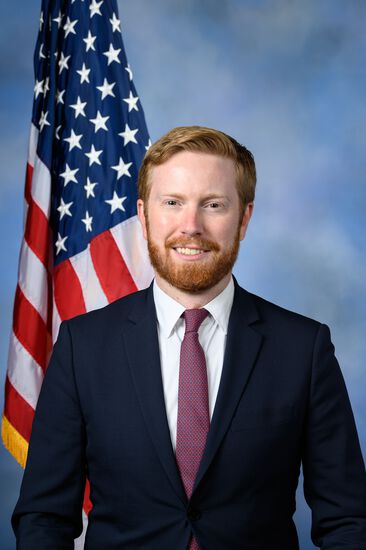
Rep. Peter Meijer
Sponsored bills
National World War II Memorial Commemorative Coin Act This bill directs the Department of the Treasury to mint and issue up to 50,000 $5 coins, 400,000 $1 silver coins, and 750,000 half-dollar clad coins in commemoration of the National World War II Memorial in the District of Columbia. The design of the coins shall be emblematic of the memorial and the service and sacrifice of American soldiers and civilians during World War II. All surcharges received from the sale of such coins shall be paid to the Friends of the National World War II Memorial to support the National Park Service in maintaining and repairing the memorial, and for educational and commemorative programs.
Banning Oil Exports to Foreign Adversaries Act This bill requires the Department of Energy (DOE) to prohibit the export or sale of petroleum products (e.g., crude oil) from the Strategic Petroleum Reserve to (1) China, North Korea, Russia, and Iran; (2) any other country the government of which is subject to sanctions imposed by the United States; and (3) any entity owned, controlled, or influenced by such countries or the Chinese Communist Party. However, DOE may issue a waiver of the prohibition if the export or sale of petroleum products is in the national security interests of the United States.
This resolution condemns the assassination of former Japanese Prime Minister Shinzo Abe, extends condolences to the family of former Prime Minister Abe and the people of Japan, honors the life and legacy of former Prime Minister Abe, and calls for a renewed commitment to the U.S.-Japan alliance.
Will to Fight Act of 2022 This bill requires the Office of the Director of National Intelligence to submit a report to Congress examining the extent to which analyses of the military will to fight and the national will to fight informed broader analyses of the intelligence community. The bill specifies that the report consider analyses of how the armed forces and governments of Ukraine, Afghanistan, and Iraq would perform at key junctures.
National Weather Service Communications Improvement Act This bill directs the National Weather Service (NWS) to improve the instant messaging service used by NWS personnel by implementing a commercial, off-the-shelf communications solution hosted on the public cloud to serve as a replacement for the communications system in use, commonly referred to as NWSChat.
Prosper Africa Act This bill requires actions to promote trade, investment, and strategic partnerships between the United States and countries in Africa. The President must establish the Prosper Africa Initiative to prioritize and coordinate U.S. government activities and diplomatic efforts aimed at increasing two-way trade and investment between the United States and Africa. The President must also establish (1) the Prosper Africa Directorate to perform various functions to support the initiative, including by developing and implementing policies to promote such trade and investment; (2) an interagency leadership committee to provide strategic guidance to the initiative and coordinate federal agency efforts; and (3) an advisory council to advise the President on the extent to which the directorate and federal agencies are meeting the objectives established in this bill. Designated staff in U.S. embassies located in Africa shall also support the initiative to the extent practicable. The President must seek to convene a meeting every two years between the U.S. government and the heads of state of African countries to advance shared priorities and strengthen partnerships. The bill also requires the President to (1) report to Congress and make publicly available a government-wide strategy to achieve this bill's objectives, and (2) annually report to Congress on matters related to U.S. government efforts to achieve this bill's objectives.
This resolution expresses support for U.S. Border Patrol agents, denounces the politicization and falsification of claims against agents in Del Rio, Texas, and calls on the Biden administration to support front line agents.
Commission on Reform and Modernization of the Department of State Act This bill establishes in the legislative branch a commission to examine the changing nature of diplomacy in the 21st century and ways the Department of State and its personnel can modernize to advance U.S. interests. The commission must offer recommendations related to topics such as (1) the State Department's organizational structure and infrastructure, (2) the link between diplomacy and other core U.S. interests such as defense, and (3) the core legislation that authorizes U.S. diplomacy. The commission must also periodically brief Congress on its work. Within 18 months of this bill's enactment, the commission must provide to Congress and the President its final report of findings, conclusions, and recommendations. The report must also examine all substantive aspects of State Department personnel, management, and operations. The commission shall terminate 180 days after the submission of the final report.
Federal PFAS Research Evaluation Act This bill requires the Environmental Protection Agency (EPA) to enter into an agreement with the National Academies of Sciences, Engineering, and Medicine (NASEM) to complete various studies and reports related to perfluoroalkyl and polyfluoroalkyl substances, commonly referred to as PFAS. PFAS are man-made and may have adverse human health effects. A variety of products contain the compounds, such as nonstick cookware or weatherproof clothing. Specifically, the bill requires the EPA to enter into an agreement with NASEM to (1) study and report on research and knowledge gaps identified by the Federal Government Human Health PFAS Research Workshop (October 26 and 27, 2020); and (2) identify research and development needed to identify, categorize, evaluate, and address individual or total PFAS. Additionally, the EPA and other relevant federal agencies must enter into an agreement with NASEM to submit a study and report to better understand the research and development needed to better understand the extent and implications of human and environmental contamination by PFAS and any management and treatment options. After NASEM submits the required reports, the White House Office of Science and Technology Policy must submit an implementation plan to Congress for increased collaboration and coordination of federal PFAS research, development, and demonstration activities.