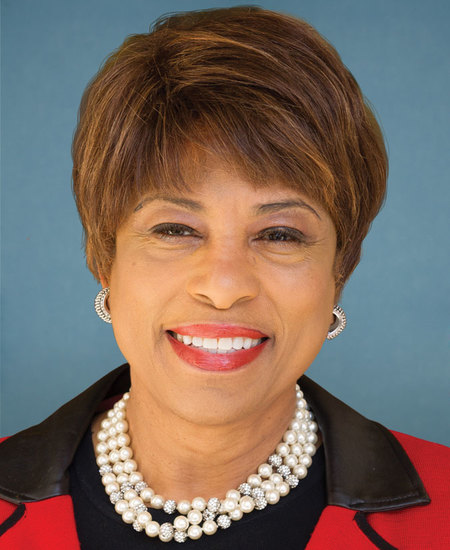
Photo of Brenda L. Lawrence
D United States House · District 14 · Michigan

Rep. Brenda L. Lawrence

Compare
Total votes
958
all sessions
Attendance
100%
4 missed
Higher than 77% of chamber peers
With party
98%
of cast votes
Higher than 79% of chamber peers
Bipartisan score
1%
crosses aisle rarely
Lower than 80% of chamber peers
Sponsored
445
bills & resolutions
Near the chamber average
Committees
0
assignments
445 bills and resolutions

Sponsored bills

Total
445
Primary
14
Co-sponsor
431
This page
445
matching current filters
Co-sponsor HJRES 87
In committee · United States House · Co-sponsor
Directing the removal of United States Armed Forces from hostilities in the Republic of Yemen that have not been authorized by Congress.

This joint resolution directs the President to remove U.S. Armed Forces from hostilities against the Houthis in Yemen within 30 days of the enactment of this joint resolution unless Congress authorizes a later withdrawal date, issues a declaration of war, or specifically authorizes the use of the Armed Forces. Prohibited activities include sharing intelligence or providing logistical support to enable offensive strikes by the coalition led by Saudi Arabia. This joint resolution shall not affect any military operations directed at Al Qaeda or associated forces.

In committee May 31, 2022 1 co-sponsor
Co-sponsor HR 7894
In committee · United States House · Co-sponsor
Affordability is Access Act

Affordability is Access Act This bill establishes several requirements relating to health insurance coverage of, and access to, over-the-counter contraceptives. Specifically, the bill requires the Department of Health and Human Services, the Department of Labor, and the Department of the Treasury to specify that private health insurance plans must cover over-the-counter contraceptives that are approved by the Food and Drug Administration (FDA), even without a prescription. Under current law, private health insurance plans (with some exceptions) must cover FDA-approved prescription contraceptives, without cost-sharing requirements. The bill also prohibits retailers from interfering with an individual's access to oral contraceptives that are meant for routine, daily use and are FDA-approved for use without a prescription.

In committee May 27, 2022 1 co-sponsor
Co-sponsor HR 350
Passed · United States House · Co-sponsor
Domestic Terrorism Prevention Act of 2022

Domestic Terrorism Prevention Act of 2022 This bill establishes new requirements to expand the availability of information on domestic terrorism, as well as the relationship between domestic terrorism and hate crimes. It authorizes domestic terrorism components within the Department of Homeland Security (DHS), the Department of Justice (DOJ), and the Federal Bureau of Investigation (FBI) to monitor, analyze, investigate, and prosecute domestic terrorism. The domestic terrorism components of DHS, DOJ, and the FBI must jointly report on domestic terrorism, including white-supremacist-related incidents or attempted incidents. DHS, DOJ, and the FBI must review the anti-terrorism training and resource programs of their agencies that are provided to federal, state, local, and tribal law enforcement agencies. Additionally, DOJ must make training on prosecuting domestic terrorism available to its prosecutors and to assistant U.S. attorneys. It creates an interagency task force to analyze and combat white supremacist and neo-Nazi infiltration of the uniformed services and federal law enforcement agencies. Finally, it directs the FBI to assign a special agent or hate crimes liaison to each field office to investigate hate crimes incidents with a nexus to domestic terrorism.

Passed May 26, 2022 1 co-sponsor
Co-sponsor HR 3807
Passed · United States House · Co-sponsor
Restaurant Revitalization Fund Replenishment Act of 2021

Relief for Restaurants and other Hard Hit Small Businesses Act of 2022 This bill addresses support for restaurants, arts and entertainment venues, and small businesses impacted by the COVID-19 pandemic. The bill provides an additional $42 billion in FY2021 for the Restaurant Revitalization Fund and gives priority to previous applicants who have not received a grant. The Small Business Administration (SBA) must provide to applicants an explanation for denied applications, establish a reconsideration process for denied applications, and institute an audit and oversight plan with respect to grant recipients. Additionally, the bill establishes the Hard Hit Industries Award Program for small businesses that suffered a pandemic-related revenue loss of 40% or more. Aggregate grant amounts are capped at $1 million. Funds may be used for expenses including mortgage, rent, and utility payments and payroll. SBA must prioritize entities that have experienced significant pandemic-related revenue loss, with first priority going to those that experienced a loss of at least 80%, and second priority going to those that experienced a loss of at least 60%. Finally, the bill extends to March 11, 2023 (or a later date as determined by the SBA), the time frame during which Shuttered Venue Operators Grant recipients may use grant funds to cover their expenses.

Passed May 25, 2022 1 co-sponsor
Co-sponsor HR 8
Passed · United States House · Co-sponsor
Bipartisan Background Checks Act of 2021

Bipartisan Background Checks Act of 2021 This bill establishes new background check requirements for firearm transfers between private parties (i.e., unlicensed individuals). Specifically, it prohibits a firearm transfer between private parties unless a licensed gun dealer, manufacturer, or importer first takes possession of the firearm to conduct a background check. The prohibition does not apply to certain firearm transfers or exchanges, such as a gift between spouses in good faith.

Passed May 25, 2022 1 co-sponsor
Co-sponsor HR 1446
Passed · United States House · Co-sponsor
Enhanced Background Checks Act of 2021

Enhanced Background Checks Act of 2021 (Sec. 2) This bill revises background check requirements applicable to proposed firearm transfers from a federal firearms licensee (e.g., a licensed gun dealer) to an unlicensed person. Specifically, it increases the amount of time, from 3 business days to a minimum of 10 business days, that a federal firearms licensee must wait to receive a completed background check prior to transferring a firearm to an unlicensed person. (This type of transaction is often referred to as a default proceed transaction.) If a submitted background check remains incomplete after 10 business days, then the prospective purchaser may submit a petition for a final firearms eligibility determination. If an additional 10 days elapse without a final determination, then the federal firearms licensee may transfer the firearm to the prospective purchaser. (Sec. 3) The Government Accountability Office must report on the extent to which the changes have prevented firearms transfers to prohibited persons. (Sec. 4) The Federal Bureau of Investigation must report on the number of petitions it receives for final federal firearms determinations. (Sec. 5) The Department of Justice, in consultation with the National Resource Center on Domestic Violence and Firearms, must report on further amendments to the background check process that would likely reduce the risk of death or great bodily harm to victims of domestic violence, domestic abuse, dating partner violence, sexual assault, and stalking.

Passed May 25, 2022 1 co-sponsor
Co-sponsor HRES 1137
In committee · United States House · Co-sponsor
Expressing concern for the drought and endemic food insecurity plaguing the Horn of Africa and calling for greater humanitarian and agricultural assistance to the region.

This resolution expresses that the House of Representatives is deeply concerned for the latest years-long drought in the Horn of Africa and the ensuing food security crisis and severe socioeconomic disturbances it caused; acknowledges the role that climate change plays in increasing the frequency of extreme weather events like droughts, and pledges to take coordinated, international action to adapt to and avert further global warming; reaffirms the effectiveness and instrumentality of U.S. international food assistance for meeting humanitarian obligations, cultivating enduring self-reliance in developing nations, ensuring the stability of global financial markets, and mitigating the likelihood of conflict in accordance with our national security interests; and emphasizes the importance of funding urgently needed humanitarian assistance for hunger-stricken regions of the world, supporting the development of sustainable agricultural sectors in developing nations, and assisting with the international resettlement of refugees escaping droughts and extreme hunger.

In committee May 24, 2022 1 co-sponsor
Co-sponsor HR 1620
Passed · United States House · Co-sponsor
Violence Against Women Act Reauthorization Act of 2021

Violence Against Women Reauthorization Act of 2021 This bill modifies and reauthorizes through FY2026 programs and activities under the Violence Against Women Act that seek to prevent and respond to domestic violence, sexual assault, dating violence, and stalking. The bill also authorizes new programs, makes changes to federal firearms laws, and establishes new protections to promote housing stability and economic security for victims of domestic violence, sexual assault, dating violence, and stalking.

Passed May 24, 2022 1 co-sponsor
Co-sponsor HR 7791
Signed into law · United States House · Co-sponsor
Access to Baby Formula Act of 2022

Access to Baby Formula Act of 2022 This bill authorizes the Department of Agriculture (USDA) to take certain actions to address emergencies, disasters, and supply chain disruptions (particularly the shortage of infant formula in the United States) affecting participants of the Special Supplemental Nutrition Program for Women, Infants, and Children (WIC). The bill directs USDA to require each infant formula cost containment contract to include remedies in the event of an infant formula recall, including how an infant formula manufacturer would protect against disruption to WIC participants in the state. USDA must, within 30 days, ensure there is a memorandum of understanding with the Department of Health and Human Services that includes procedures for coordination and information sharing regarding any supply chain disruption, including a supplemental food recall. The bill also authorizes USDA to waive or modify any WIC qualified administrative requirement during emergencies, disasters, and supply chain disruptions. Specifically, USDA may waive or modify such a requirement for one or more state agencies if (1) the requirement cannot be met by state agencies during the emergency, disaster, or disruption; and (2) the modification or waiver is necessary to provide assistance to WIC participants and does not substantially weaken the nutritional quality of supplemental foods. For example, USDA may waive the maximum monthly allowance for infant formula. The bill establishes notification requirements for USDA and state agencies related to supply chain disruptions.


Signed into law May 21, 2022 1 co-sponsor
Co-sponsor HRES 1133
In committee · United States House · Co-sponsor
Recognizing National Foster Care Month as an opportunity to raise awareness about the challenges of children in the foster care system and encouraging Congress to implement policy to improve the lives of children in, or at risk of entering, the foster care system.

Maddy summaryHRES 1133 is a symbolic resolution recognizing May as National Foster Care Month. It raises awareness about challenges faced by children in foster care, such as instability, educational disruptions, and the high number aging out without permanent connections. The resolution encourages Congress to implement policies improving outcomes for these children and acknowledges the work of foster parents, social workers, and advocates. It does not create new laws but urges legislative action aligned with existing programs under the Social Security Act focused on prevention, reunification, and support for youth transitioning to adulthood.

In committee May 19, 2022 1 co-sponsor
Showing 121 to 130 of 445 bills
Previous 1 … 12 13 14 … 45 Next