

Maddy summaryHRES 227 is a non-binding resolution expressing the House of Representatives' support for designating March 18, 2025, as "National Agriculture Day" to honor agriculture's role as a vital U.S. industry. It does not create new laws, allocate funds, or impose requirements on any group. The resolution serves as a symbolic gesture to highlight agriculture's economic impact and contributions to the nation. As a procedural resolution, it has no direct policy effect beyond raising awareness.
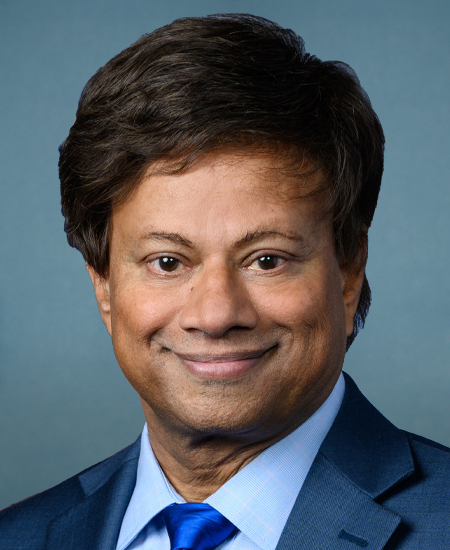
Rep. Shri Thanedar
Sponsored bills
Maddy summaryThis bill creates a tax credit for cable, satellite, and internet-based video distributors (like streaming services) that carry content from independent video producers. Distributors can claim a credit equal to the lesser of their actual license fees paid for carrying independent programming or $0.10 per average monthly subscriber, with a maximum of $0.30 per subscriber. It also requires the Federal Communications Commission to submit biennial reports to Congress on how many independent programmers are being carried and for how long, to help assess the program's effectiveness. The credit applies to agreements where distributors carry independent content to at least 40% of their subscribers, targeting small, non-corporate video producers who aren't owned by major networks or distributors.
Maddy summaryThis bill (HR 2199) prevents private health insurance plans from discriminating against patients with end-stage kidney disease (ESRD) who require dialysis. It amends the Social Security Act to prohibit plans from treating dialysis coverage differently than other medical services or applying network restrictions that disproportionately harm ESRD patients. The law clarifies that plans cannot deny or limit benefits for dialysis based on a patient’s diagnosis, while preserving a plan’s right to choose which dialysis providers are in their network. It directly affects ESRD patients and their private health insurance coverage, ensuring dialysis is treated equally with other covered medical services. The bill does not require plans to include specific dialysis providers but stops them from unfairly restricting access to necessary care.
Maddy summaryThis bill delays two Medicare billing deadlines for ground ambulance services from 2025 to 2028. It amends the Social Security Act to extend the timeline for implementing specific billing rules under Section 1834(l). The change directly affects Medicare ambulance providers by postponing compliance deadlines for billing requirements. No new services or funding are created - only a technical extension of existing timelines.
Maddy summaryThis bill prohibits pharmacy benefit managers (PBMs) from receiving payments tied to prescription drug prices or rebates starting January 1, 2027. Instead, PBMs may only charge flat, itemized fees for actual services performed (e.g., claim processing), not based on drug costs or discounts. It directly affects PBMs and health insurance plans by requiring compensation to be decoupled from drug pricing, while allowing rebates to be passed through to lower net drug costs. The law aims to reduce conflicts of interest in PBM operations without changing drug pricing itself.
Maddy summaryHR 2222, the "Lowering Egg Prices Act of 2025," modifies federal egg regulations to allow surplus broiler hatching eggs (used to hatch chicks for meat production) to be sold to egg breakers (facilities that process whole eggs into liquid products). The bill directs the FDA and USDA to create new rules within 180 days permitting these eggs to be stored under conditions compatible with hatching while also being sold for processing into liquid egg products. This change aims to increase the supply of eggs available for processing by making it easier to redirect surplus hatching eggs to egg breakers. The bill directly affects broiler hatcheries, egg breakers, and the broader egg processing industry by altering how certain surplus eggs can be handled and sold.
Maddy summaryThis resolution (HRES 223) is a ceremonial measure honoring Selfridge Air National Guard Base in Michigan on its 108th anniversary. It commends the base’s historical contributions - such as hosting the Tuskegee Airmen, supporting post-9/11 security, and hosting KC-46A aircraft - and acknowledges its current role in national defense, economic impact (supporting over 4,500 jobs and generating hundreds of millions in local revenue), and community partnerships. The resolution does not create new policy or funding but formally recognizes the base’s significance to military history and regional security. As a procedural resolution, it has no direct effect on legislation or affected parties beyond symbolic recognition.
Maddy summaryHRES 226 is a ceremonial resolution commemorating Delta Air Lines' 100th anniversary, marking the centennial of its founding on March 2, 1925. It recognizes Delta's history as the first U.S. airline to reach 100 years (originally as Huff Daland Dusters, an aerial crop-dusting company) and highlights its current scale, including 100,000 employees, 5,000 daily flights, and global connectivity. The resolution contains no policy changes or binding provisions - it simply expresses the House's recognition of Delta's milestone and its role in connecting people and supporting communities. As a commemorative resolution, it does not affect any individuals, businesses, or regulations.
Maddy summaryHR 2103, the Protect Postal Performance Act, requires the U.S. Postal Service to hold public hearings and wait 180 days before closing or consolidating any post office, ensuring community input and transparency. It directly affects communities by preventing closures if a post office is the only one within 15 miles or serves 15,000+ residents, and blocks closures of processing centers that would leave entire non-contiguous state regions (with over 100,000 residents) without service. The bill also mandates that the Postal Regulatory Commission review proposed facility changes before implementation and prohibits reducing mail pickup/drop-off frequency through transportation optimization plans without prior approval. These provisions aim to stabilize postal services and maintain access for residents in underserved areas.
Maddy summaryHR 2095, the Postal Police Reform Act of 2025, amends existing law to clarify the roles of USPS police officers and their authority over property. It explicitly includes "Postal Service police officers" alongside Postal Inspectors in Section 3061 of Title 18, U.S. Code, and gives the Postmaster General new authority to create rules for protecting USPS-owned or controlled property. These rules can include fines or up to 30 days in jail for violations, with penalties clearly defined under the law. The bill directly affects USPS police officers and individuals on USPS property by standardizing their regulatory framework.