

Maddy summaryThis bill creates two new tax credits to support homebuyers. It provides a first-time homebuyer credit of up to $50,000 for down payments on primary residences, with income limits ($150,000 single filers, $225,000 head of household, $300,000 joint filers). A separate starter home construction credit offers 15% (30% for first-time buyers) of costs for new homes under 1,200 square feet priced at or below 80% of local median home prices. The credits require repayment if the home is sold or no longer used as a primary residence within five years, with exceptions for new purchases, death, divorce, or military service.
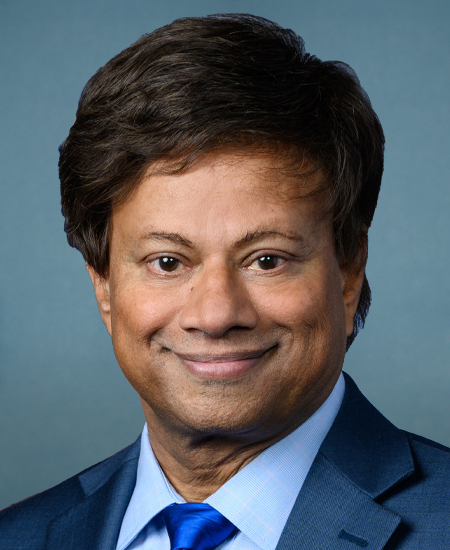
Rep. Shri Thanedar
Sponsored bills
Stronger Communities through Better Transit Act This bill requires the Department of Transportation (DOT) to establish a grant program to support operating projects for public transportation and related service improvements, particularly in underserved communities and areas of persistent poverty. Specifically, the bill requires DOT to allocate funding under the program for urbanized areas, states, and Indian tribes that are recipients of funds under either the Federal Transit Administration's (FTA's) Urbanized Area Formula Funding program or Formula Grants for Rural Areas program. Eligible recipients may use funding for operating costs associated with projects that improve public transportation service for transit-dependent populations and support increased transit ridership (e.g., service expansion, information technology enhancements, and workforce development). DOT must apportion the funding so that recipients receive funds that are proportional to their share of operating costs. The bill also provides for an increased federal cost share for operating assistance for projects or programs carried out in areas of persistent poverty or underserved communities. DOT must set up a multimodal access measurement interface for public agencies to aid transit agencies in determining and reporting on access to jobs and essential services. A grant recipient must (1) report specific information to the FTA for inclusion in the National Transit Database, and (2) survey transit riders and non-riding residents regarding transit service improvements. Further, the bill expands the purposes of the public transportation programs to include supporting public transportation's role in combating climate change through growing/retaining transit ridership.
Maddy summaryHRES 414 is a symbolic resolution recognizing the U.S. government's moral and legal obligation to provide reparations for the harms of slavery and its lasting impacts on Black Americans. It acknowledges the historical and ongoing effects of chattel slavery, systemic racism, and discriminatory policies on Black communities, including economic disparities, environmental racism, and the criminal justice system. The resolution encourages support for H.R. 40, which would establish a commission to study reparations proposals, and calls for formal acknowledgment of slavery's legacy through congressional apologies. This resolution does not create new legal obligations or provide reparations itself, but serves as a statement of recognition and a call to action for further policy development.
Maddy summaryThis resolution (HRES 415) formally impeaches former President Donald Trump, alleging he violated his constitutional duty to "preserve, protect, and defend the Constitution" by undermining judicial independence and violating court orders. It specifically cites his public denigration of judges (including calling for the impeachment of Judge Boasberg after a court ordered the return of detained immigrant Kilmar Abrego Garcia), condoning the U.S. government's refusal to comply with a Supreme Court order to facilitate Garcia's release, and ignoring due process protections. The resolution claims these actions caused "the devolution of democracy within the United States into authoritarianism" by flouting separation of powers and the Fifth Amendment. If passed, it would send impeachment articles to the Senate for trial.
Maddy summaryThis bill restores a tax deduction for personal losses caused by disasters, crimes, or scams (like stolen property or damage from hurricanes). It directly affects taxpayers who filed returns before 2025 but couldn’t claim this deduction due to a prior suspension. The bill reinstates the deduction and extends the deadline to file refund claims for these losses until the tax filing deadline for the year the bill becomes law. This allows eligible individuals to claim refunds they were previously barred from receiving.
Maddy summaryHR 3459, the Empty Lots to Housing Act, allows local transportation agencies to transfer unused government-owned land (acquired with federal transportation funds) to develop affordable housing near transit. The bill requires that 40% of units built on this land must be affordable for households earning ≤60% of the area median income, with at least 20% reserved for those earning ≤30% of the median income. Transfers to third parties are permitted only if local entities can't take the land and the deal offers greater public benefit than government sale. This directly affects low- and moderate-income families by creating new affordable housing opportunities on previously underutilized public land.
SNAP Administrator Retention Act of 2025 This bill directs the Food and Nutrition Service (FNS) to pay Supplemental Nutrition Assistance Program (SNAP) state agencies for 100% of SNAP administrative personnel costs. The bill also requires that state SNAP agency administrators be paid at least the same amount as federal employees. (Under current law, FNS generally pays 50% of a state's administrative costs for SNAP.) Specifically, FNS must pay a state agency for 100% of all SNAP administrative personnel costs that are part of an FNS-approved state agency personnel wage plan. This must include all costs associated with hiring and training new employees, maintaining those personnel costs, and complying with wage standards. The state agency must use these funds (1) to supplement, not supplant, nonfederal funds used for existing administrative personnel costs; and (2) for existing or additional full-time positions that are above the number of positions that were held in FY2024. The bill also requires that the wage standards for SNAP state agency administrators be (1) at least the same amount as the General Schedule (GS) pay rate for federal employees; and (2) updated annually based on any increase in the GS pay rate, including locality adjustments.
Maddy summaryHRES 413 is a non-binding House resolution condemning Hamas for its October 7, 2023, attacks on Israel, which killed over 1,200 people and took more than 250 hostages. It specifically demands that Hamas immediately release the 58 remaining hostages (including four U.S. citizens: Edan Alexander, Itay Chen, Omer Neutra, Judi Weinstein, and Gad Haggai) and return them to safety. The resolution also recognizes that hostage-taking violates international law and calls on the White House to continue efforts to secure all hostages' release. As a symbolic resolution, it does not create new laws or policies but formally expresses the House's stance.
Maddy summaryHRES 410 is a non-binding House resolution requiring President Trump to comply with the Constitution’s Foreign Emoluments Clause regarding a $400 million Boeing 747-8 jet gift from Qatar’s royal family. It directs the President to immediately submit all plans for the aircraft to Congress and obtain explicit congressional consent before accepting it, as required by the Constitution. The resolution cites historical precedent where all prior presidents sought Congress’s approval for foreign gifts, including items like medals, horses, and the Statue of Liberty. It emphasizes that accepting the jet without consent would violate the Constitution and pose national security risks. The bill focuses solely on procedural compliance, not the merits of the gift itself.
Maddy summaryHR 3418, the Historic Preservation Fund Reauthorization Act, extends the federal Historic Preservation Fund through 2035 and increases its annual funding from $150 million to $250 million. This bill directly affects historic preservation programs nationwide, including state and local grants for protecting historic sites and buildings. The key provision updates the funding levels and duration in existing law (54 U.S. Code § 303102), ensuring continued support for preservation efforts. The change maintains current program operations without creating new requirements or altering eligibility.