

Maddy summaryThe AI Talent Act (HR 6573) creates specialized hiring teams within federal agencies to streamline recruitment for technology and artificial intelligence positions. It establishes agency-level "AI talent teams" to improve job announcements, assessments, and hiring for tech roles, while the Office of Personnel Management (OPM) will lead a central team to coordinate cross-agency hiring efforts, share technical assessments, and develop an online platform for standardized skills evaluations. The bill directly affects federal agencies hiring for AI and tech roles and applicants seeking those positions by changing how technical skills are assessed - requiring job-specific evaluations (like coding tests or structured interviews) instead of relying solely on self-assessments after 5 years. Key provisions include sharing assessment tools between agencies, allowing customization of evaluations, and mandating that assessments be based on job analysis to measure relevant skills. The law aims to modernize federal hiring for high-demand tech talent without altering pay or creating new government programs.
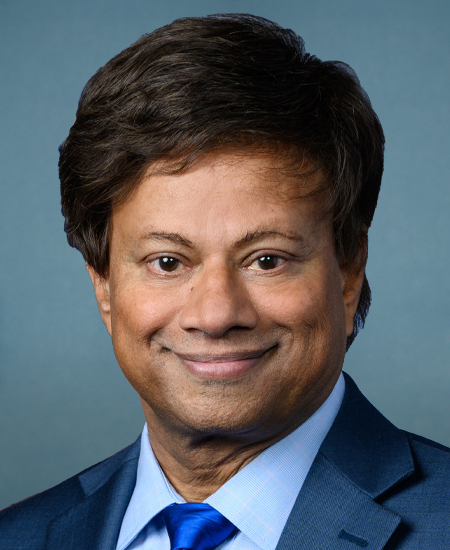
Rep. Shri Thanedar
Sponsored bills
Maddy summaryThis bill increases federal student loan limits for graduate and professional students. Starting July 1, 2026, it sets a $50,000 annual limit and a $200,000 total aggregate limit (beyond undergraduate borrowing) for unsubsidized Federal Direct Stafford loans. These changes directly affect graduate and professional students pursuing advanced degrees who rely on federal loans for education costs. The provisions aim to provide higher borrowing capacity for these students' educational expenses under the Higher Education Act.
Maddy summaryHR 6565, the Reuniting Families Act, would significantly reform family-based immigration by reclassifying spouses, permanent partners, and minor children of legal permanent residents as "immediate relatives," eliminating current visa backlogs for these family members. The bill creates a new legal definition of "permanent partner" to provide equal treatment for same-sex partners in immigration processes, expanding eligibility for family-based visas. It increases the worldwide level of family-sponsored immigrant visas and adjusts allocation numbers to reduce processing delays, while also providing specific relief for orphans, widows, widowers, and certain Filipino veterans. The bill also expands refugee family reunification provisions and increases diversity visa numbers from 55,000 to 80,000. These changes would directly affect family members seeking to reunite with U.S. citizens or legal permanent residents through family-based immigration pathways.
Maddy summaryHR 6589, the Ranked Choice Voting Act, would require all states to implement ranked choice voting for elections of U.S. Senators and Representatives, including primaries and general elections. Under this system, voters would rank candidates in order of preference, with ballots tabulated by eliminating the least preferred candidate in successive rounds until a candidate achieves a majority. The bill prohibits separate runoff elections for these offices and provides federal funding to states to cover implementation costs, with payments due by June 1, 2026. The law would apply to federal elections held on or after January 1, 2030, and would not affect state or local elections.
Maddy summaryHR 6579, the Justice for Breonna Taylor Act, requires federal, state, and local law enforcement officers to provide notice of their authority and purpose before entering a premises with a warrant. This applies to all officers serving warrants, including those at the federal level and state/local agencies receiving Department of Justice funding. The law mandates this notice requirement starting in the first fiscal year after enactment, directly affecting law enforcement agencies that receive federal funding for policing. It changes the process for executing warrants by eliminating the ability to conduct no-knock entries without first informing occupants.
Maddy summaryThis House resolution (HRES 935) proposes impeaching Secretary of Defense Peter B. Hegseth for alleged "high crimes and misdemeanors." It outlines two articles: Article I alleges Hegseth ordered lethal military strikes against a Caribbean boat carrying 11 people (described as potentially migrants, not drug smugglers) and later directed a second strike to kill survivors, violating murder laws and the Law of War. Article II alleges Hegseth recklessly mishandled classified information by discussing sensitive military operations in a private Signal chat with high-level officials and a journalist, breaching federal laws governing classified data. The resolution asserts these actions warrant impeachment, removal from office, and disqualification from future federal positions. As a proposed impeachment resolution, it does not enact law but initiates a formal process against Hegseth.
Maddy summaryThis bill creates a new tax deduction for first-time homebuyers who save for down payments in specially designated accounts. It allows a deduction of up to $10,000 ($20,000 for joint filers) for cash contributions to these accounts, with the deduction phasing out for single filers earning over $150,000 or joint filers over $236,000. Contributions must be used exclusively for down payments or closing costs on a first home, and withdrawals not used for this purpose incur a 20% tax penalty. The deduction applies to taxable years beginning after December 31, 2025.
Maddy summaryHR 5995, the "Have You Served Act," provides grants to states and tribes with veteran suicide prevention plans to fund "Ask the Question Campaigns." These campaigns train human services professionals, local governments, and community providers to respectfully ask clients if they or a loved one served in the military, then connect them to VA resources. The bill authorizes $6 million annually (2026-2030) for up to 25 grants of $200,000 each to support this training and outreach. It directly affects veterans and their families by improving access to VA services through community-based referrals, without changing eligibility for benefits.
Maddy summaryHRES 927 is a symbolic House resolution declaring support for "Design for Recycling" (DFR) initiatives. It encourages manufacturers to design products with the maximum number of recyclable components, aiming to reduce waste sent to landfills and promote circular economy practices. The resolution does not create new laws or requirements but formally endorses efforts to make products easier to recycle, which would directly affect manufacturers across industries like packaging, electronics, and textiles. It highlights the economic and environmental benefits of recycling, such as job creation and reduced raw material use, based on data from industry reports.
Right to Read Act of 2025 This bill expands access to school libraries and literacy skills support for elementary and secondary school students. It also outlines certain constitutional rights and liability protections related to school libraries. Specifically, the bill reauthorizes through FY2030 (1) the Comprehensive Literacy State Development Program, which provides grants to ensure high-quality instruction and effective strategies in reading and writing for children through 12th grade; and (2) the Innovative Approaches to Literacy Program, which provides grants to support the development of literacy skills in low-income communities. Additionally, the bill allows Supporting Effective Instruction State Grants to be used to assist local educational agencies (LEAs) and schools in recruiting, hiring, and retaining state-certified school librarians. Further, the bill authorizes states and LEAs to use Student Support and Academic Enrichment grants for programs and activities that promote the development of digital literacy and information literacy skills. The Department of Education (ED) must direct the National Center for Education Statistics to biennially collect data on school libraries. ED must require an assurance from each state and LEA receiving certain funds confirming that it will (1) protect the First Amendment rights of students in school libraries, and (2) provide equal protection in the conduct of school libraries in compliance with the requirements of the Fourteenth Amendment and nondiscrimination laws. The bill also provides liability protection to teachers, school librarians, school leaders, paraprofessionals, and other staff for actions that conform with state or local policies regarding the right to read.