

Maddy summaryHR 7634, the Plastic Pellet Free Waters Act, prohibits plastic pellets and pre-production plastic materials from being discharged into water through wastewater, spills, or runoff from specific facilities. It directly affects plastic polymer production facilities, plastic molding and forming facilities, and any point source (like packaging or transport operations) handling plastic pellets. The bill requires the EPA to issue a final rule within 60 days of enactment banning these discharges and updating all relevant wastewater, stormwater, and performance standards in permits and regulations. This creates a legal requirement for facilities to prevent plastic pellet pollution in waterways, targeting a major source of ocean plastic pollution.
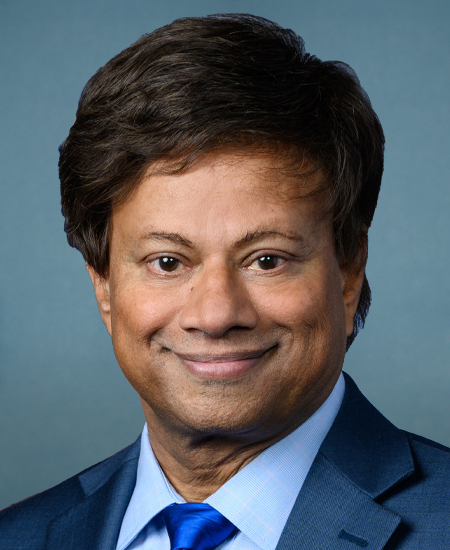
Rep. Shri Thanedar
Sponsored bills
Maddy summaryThis concurrent resolution (HCONRES 97) recognizes the gender wage gap, noting that women working full-time earn 84 cents for every dollar earned by men. It highlights racial disparities (e.g., Latinas earn 57 cents, Black women 69 cents) and the economic impact of the gap, including $965 billion in annual lost wages for women. As a symbolic resolution, it does not create new laws or policies but formally acknowledges the issue and reaffirms Congress’s commitment to addressing wage inequality.
Maddy summaryHR 7629, the Protect Our Letter Carriers Act of 2024, allocates $1.4 billion annually (2025-2029) to the U.S. Postal Service for high-security collection boxes and replacing physical universal mailbox keys with electronic versions, directly affecting USPS operations and letter carriers. It requires the Attorney General to appoint specialized prosecutors in each district to coordinate investigations and prosecutions of postal-related crimes, such as assaults on carriers or mail theft. The bill also mandates the U.S. Sentencing Commission to adjust guidelines so that assaults or robberies against postal employees are treated with the same severity as assaults against law enforcement officers. These provisions aim to enhance safety through infrastructure upgrades, improved prosecution, and stricter sentencing for crimes targeting postal workers.
Maddy summaryThe American High-Speed Rail Act authorizes $35 billion annually for high-speed rail corridor development (with $3 billion for corridor planning), requiring at least 20% of project costs to come from non-Federal sources. It defines "high-speed rail" as services reaching 186+ mph and "higher-speed rail" as 110-186 mph, with no more than 20% of funds allocated to higher-speed rail projects. Key provisions include allowing advance acquisition of rail corridors before environmental reviews, creating tax exclusions for rail carriers selling property to high-speed rail projects, and requiring consideration of equity, sustainability, and economic development impacts in planning. The bill affects federal agencies, state and local governments, rail carriers, and communities along proposed rail corridors.
Young Adult Tax Credit Act This bill allows a refundable young adult tax credit and a monthly advance payment of such credit. The bill defines young adult as an individual who is at least age 18, but not yet 25, and is either a citizen, national, or resident of the United States. The amount of such credit is the sum of $500 for each taxpayer or taxpayer dependent who is a young adult in any calendar month.
Maddy summaryThe Increasing Access to Mental Health in Schools Act creates a federal grant program to increase mental health staff in low-income schools. It provides funding for partnerships between low-income schools (where at least 20% of students are from families below the poverty line) and graduate programs in school counseling, psychology, and social work. Grant funds can cover training costs, salary support for new mental health providers, recruitment of underrepresented students, and student loan repayment for mental health staff working in qualifying schools. The bill sets target ratios for staff-to-student ratios (like 1 counselor per 250 students) and requires annual reporting on program outcomes. The program is authorized for $200 million annually to address mental health staffing shortages in schools serving high-poverty communities.
Maddy summaryHR 6591, the Encouraging Success Act, requires the Small Business Administration (SBA) to regularly update the asset and net worth limits for individuals qualifying as "economically disadvantaged" under the SBA's 8(a) business development program. This affects small business owners seeking eligibility for the 8(a) program, which provides federal contracting opportunities. The bill mandates the SBA reassess these thresholds annually after enactment and every four years thereafter, adjusting for inflation and economic changes through a standard rulemaking process with public comment. The SBA must use existing funding to implement these updates without requiring new appropriations.
Maddy summaryHR 4669, the DOE and SBA Research Act, requires the Department of Energy (DOE), Small Business Administration (SBA), and National Laboratories to create formal agreements for joint research and development projects. It mandates that these collaborations actively include small businesses and use existing agency funding without requiring new appropriations. The bill also requires the agencies to report to Congress within two years on their coordination, research achievements, and future opportunities for collaboration. This legislation establishes a structured framework for interagency cooperation but does not create new programs or funding.
Maddy summaryThis bill requires federal agencies that haven't met their annual goal for awarding contracts to service-disabled veteran-owned small businesses to provide staff training on improving those contracts. Within 180 days of enactment, the Small Business Administration must issue guidance to these agencies on best practices for increasing such contracts. Agencies must also report annually to Congress listing those that missed the goal, the number of training sessions provided, and the training content. The law directly affects federal agencies failing to meet the existing contracting target, aiming to improve their performance through structured training and transparency.
Maddy summaryHR 7473, the *Funding Small Businesses During Shutdown Act*, ensures small business loan programs continue during government shutdowns by appropriating specific funds from the Treasury. It allocates $500,000 for Section 7(m) loans, $2.917 billion for Section 7(a) loans, $1.25 billion for SBA investment programs, and $13.775 million for administrative costs during any 30-day lapse in SBA funding. This directly affects small businesses relying on these SBA loans, preventing program disruptions during shutdowns. The bill provides concrete, immediate funding to maintain loan servicing without creating new programs.