

Maddy summaryThe HAVEN Act (HR 3133) makes several key changes to federal housing assistance programs. It reduces the percentage used to calculate rental payments from 30% to 20% for several housing programs, increasing assistance for recipients. The bill expands the Housing Choice Voucher Program by adding 500,000 vouchers in 2026 and increasing by 500,000 each year through 2029. It also creates housing navigation grants to help families find housing, expands anti-discrimination protections to include "lawful source of income," and requires zip code-based fair market rents for housing vouchers starting in 2026.
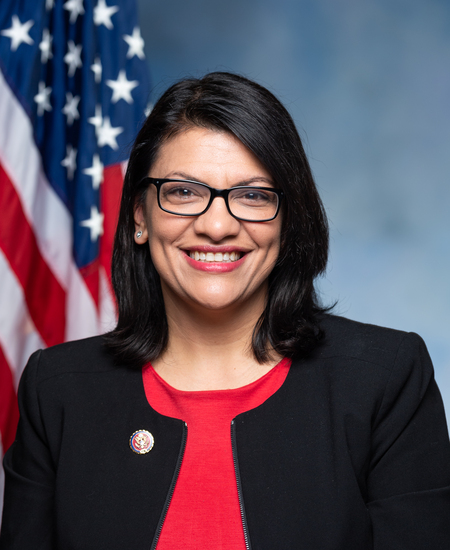
Rep. Rashida Tlaib
Sponsored bills
Maddy summaryThis resolution requests the President to provide unredacted documents within 14 days about government use of electronic communication platforms like Signal, WhatsApp, and Slack for official communications. It specifically seeks information on how the administration preserves national security communications sent via these platforms and ensures compliance with federal recordkeeping laws. The resolution targets communications containing highly sensitive national security information, whether sent on government or personal devices. It does not change policy but seeks transparency regarding current practices.
Maddy summaryHRES 286 is a non-binding House resolution (not a law) requesting the President to provide specific documents about a fictional "United States DOGE Service" and its AI use. It asks for records related to AI deployments at federal agencies since January 2025, including data sources, personnel involved in decisions, and analyses of potential program cuts, all framed around alleged violations of privacy laws and transparency requirements. The resolution specifically targets documents concerning "Elon Musk or an individual associated with the United States DOGE Service," which does not exist as a government entity. This is a procedural request for information, not a policy change, and references fictional elements (e.g., "Trump Administration" in 2025).
Maddy summaryThis resolution (HRES 264) requests the President to provide the House of Representatives with unredacted documents about security clearances held by specific individuals, including Elon Musk and six others (Akash Bobba, Edward Coristine, Ethan Shaotran, Luke Farritor, Gautier Cole Killian, and Gavin Kliger). It specifically targets documents related to security clearances for people associated with the "United States Department of Government Efficiency Service" (referred to as "DOGE" in the bill). The request requires the President to submit all relevant communications and background investigations within 14 days of the resolution's adoption. This is a procedural inquiry resolution, not a policy bill, and references fictional government entities (DOGE is not a real agency).
Maddy summaryHR 3112, the Better CARE for Animals Act of 2025, strengthens enforcement of the federal Animal Welfare Act by requiring dealers and exhibitors to hold valid licenses for animal sales or transport (Section 4). It expands enforcement authority by allowing the Attorney General to sue violators for up to $10,000 per day, seize animals, and seek injunctions (Section 20), while clarifying that courts can address violations of related rules and regulations. The bill directly affects animal dealers, exhibitors, the USDA, and the Department of Justice, creating clearer pathways for holding violators accountable. Key provisions include updating definitions, broadening inspection powers to cover all regulations, and directing penalty funds toward temporary animal care costs during legal proceedings.
Maddy summaryHR 3128, the Improving Diaper Affordability Act of 2025, makes diapers eligible as qualified medical expenses under tax-advantaged health accounts (like HSAs and health flexible spending arrangements) and prohibits states or localities from imposing sales taxes on diaper purchases. This directly affects families with young children - particularly low-income households, where 46% report struggling to afford diapers - who currently spend hundreds annually on diapers. The bill changes existing tax rules so families can use pre-tax dollars from health savings accounts to cover diaper costs, and bans sales taxes on diaper purchases starting in 2025. It does not create new government assistance programs but adjusts tax treatment to reduce out-of-pocket costs for diapers.
Maddy summaryHR 3094, the PREP Act, shortens probationary periods for new federal employees. It reduces the standard 1-year probation to 6 months for individuals who previously worked in the executive branch civil service, and to 12 months for all other new hires. This applies to competitive service positions (most federal jobs), excepted service roles, and the Senior Executive Service. The bill directly affects new federal employees by accelerating their transition to permanent status based on prior federal experience. It makes no changes to current employees or existing probationary terms.
Assault Weapons Ban of 2025 This bill makes it a crime to knowingly import, sell, manufacture, transfer, or possess a semiautomatic assault weapon (SAW) or large capacity ammunition feeding device (LCAFD). The prohibition does not apply to a firearm that is (1) manually operated by bolt, pump, lever, or slide action, except for certain shotguns; (2) permanently inoperable; (3) an antique; (4) only capable of firing rimfire ammunition; or (5) a rifle or shotgun specifically identified by make and model. The bill also exempts from the prohibition the following, with respect to a SAW or LCAFD: importation, sale, manufacture, transfer, or possession related to certain law enforcement efforts, or authorized tests or experiments; importation, sale, transfer, or possession related to securing nuclear materials; and possession by a retired law enforcement officer. The bill permits continued possession, sale, or transfer of a grandfathered SAW, which must be securely stored. A licensed gun dealer must conduct a background check prior to the sale or transfer of a grandfathered SAW between private parties. The bill permits continued possession of, but prohibits sale or transfer of, a grandfathered LCAFD. Newly manufactured LCAFDs must display serial number identification. Newly manufactured SAWs and LCAFDs must display the date of manufacture. The bill also allows a state or local government to use Edward Byrne Memorial Justice Assistance Grant Program funds to compensate individuals who surrender a SAW or LCAFD under a buy-back program.
Fairness to Freedom Act of 2025 This bill establishes a right to legal representation in certain immigration proceedings (e.g., removal and immigration bond hearings) at the government's expense for individuals who cannot afford representation. The bill also establishes various entities to facilitate such legal representation. Currently, individuals in these immigration proceedings may be represented by counsel but not at government expense. The bill addresses various issues related to such legal representation, including (1) the scope of the representation, (2) criteria for determining whether the individual is financially unable to afford representation, and (3) requirements relating to allowing the individual to meet with their lawyer and receiving relevant documents. Immigration proceedings may not commence until counsel has been appointed. The bill also establishes the Office of Immigration Representation to ensure that qualified individuals who cannot afford legal representation receive the representation as required by this bill. The office's duties shall include establishing (1) administrative regions throughout the United States, and (2) a local immigration representation board for each region. The local boards must, subject to the office's approval, develop and implement plans for providing legal representation under this bill. To provide such legal representation, the local boards may (1) establish one or more immigrant public defender organizations, (2) contract with existing community defender organizations, and (3) establish a panel attorney system. The bill establishes minimum funding requirements for the office.
Maddy summaryThis bill, the REHIRE Act (HR 3093), creates a hiring preference for certain federal employees who were involuntarily separated between January 1, 2025, and January 1, 2027. It directly affects career federal employees removed during that period who were not in political positions or separated for misconduct or poor performance. The key provision gives these employees 5 additional points in their hiring rating (under 5 U.S.C. §3309) and deems them "preference eligible" for competitive service positions. The preference expires 5 years after the bill becomes law and does not apply to political appointees, those fired for misconduct, or those with documented poor performance reviews.