

This resolution strongly disapproves of the escalation of political tensions between the government of Ethiopia and the Tigray People's Liberation Front into armed conflict, and it calls for the immediate cessation of hostilities in the Tigray region as well as an end to violence throughout Ethiopia. Further, the resolution urges all parties to work to protect human rights, and it calls on relevant U.S. agencies to take specified actions that encourage an end to the conflict and that provide humanitarian support.
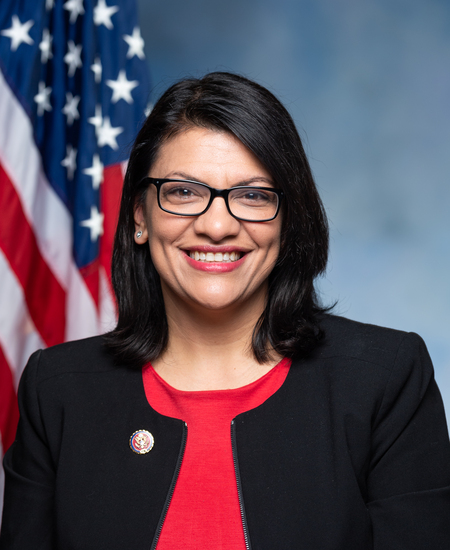
Rep. Rashida Tlaib
Sponsored bills
Caring for Survivors Act of 2021 This bill increases the monthly rate of dependency and indemnity compensation payable to surviving spouses through the Department of Veterans Affairs. The bill also adjusts the amount payable to surviving spouses and children of veterans who were rated as totally disabled for a period of less than 10 years before their death.
Maddy summaryThis resolution (HRES 356) expresses the U.S. House of Representatives' condemnation of police brutality worldwide, including excessive force, extrajudicial killings, and disproportionate harm to racial minorities, women, migrants, and LGBTQIA+ communities. It urges the U.S. government to stop arms sales to countries with documented police brutality, end militarized policing tactics domestically and abroad, and redirect funds toward community programs. As a symbolic resolution, it does not create new laws but calls for specific policy actions from the executive branch and businesses.
This resolution calls for the creation of a Green New Deal with the goals of achieving greenhouse gas and toxic emissions reductions needed to stay under 1.5 degrees Celsius of warming; establishing millions of high-wage union jobs and ensuring economic security for all; investing in infrastructure and industry; securing clean air and water, climate and community resiliency, healthy food, access to nature, and a sustainable environment for all; and promoting justice and equality. The resolution calls for accomplishment of these goals through a 10-year national mobilization effort. The resolution also enumerates the goals and projects of the mobilization effort, including building smart power grids (i.e., power grids that enable customers to reduce their power use during peak demand periods); upgrading all existing buildings and constructing new buildings to achieve maximum energy and water efficiency; removing pollution and greenhouse gas emissions from the transportation and agricultural sectors; cleaning up existing hazardous waste and abandoned sites; ensuring businesspersons are free from unfair competition; and providing higher education, high-quality health care, and affordable, safe, and adequate housing to all.
This resolution recognizes the opportunity for Black Maternal Health Week to raise national awareness of the state of Black maternal health in the United States.
This resolution rejects the Supreme Court's decisions in the Insular Cases (a series of cases regarding the application of constitutional rights in U.S. territories) and recognizes that constitutional and democratic principles apply throughout the states and territories of the United States.
Families Belong Together Act This bill provides various immigration benefits for eligible alien parents (or legal guardians) and minor children who were separated by the Department of Homeland Security (DHS) between January 20, 2017, and January 20, 2021. Generally, to be an eligible parent or minor child under this bill, the alien must not be inadmissible for certain crime- or security-related grounds, though DHS may waive certain grounds for humanitarian or public interest reasons. Furthermore, an eligible child who was separated as a minor remains eligible for the immigration benefits after reaching majority. DHS must grant humanitarian parole into the United States to an eligible alien who requests such parole, regardless of whether the alien is physically present in the United States. An eligible alien in the United States may apply for lawful permanent resident status. U.S. Citizenship and Immigration Services shall grant a qualifying alien's lawful permanent resident status within 30 days of receiving the alien's application. An alien who receives lawful permanent resident status under this bill shall be eligible for benefits and services that are available to an alien who is admitted as a refugee. Certain annual numerical limitations shall not apply to aliens who receive lawful permanent resident status under this bill. If an alien seeks judicial review of a denial of an application for lawful permanent resident status under this bill, the Department of Justice shall appoint counsel to represent that alien upon request.
PFAS Accountability Act of 2021 This bill provides a cause of action under the Toxic Substances Control Act for individuals or classes of individuals who were significantly exposed to perfluoroalkyl or polyfluoroalkyl substances, commonly referred to as PFAS. These substances are man-made and may have adverse human health effects. A variety of products contain the compounds, such as nonstick cookware or weatherproof clothing. Specifically, the bill provides a cause of action those who were significantly exposed to PFAS (or have reasonable grounds to believe they were exposed) against persons who engaged in any portion of a manufacturing process that created the PFAS and foresaw (or reasonably should have foreseen) the creation or use of PFAS would result in human exposure. The bill authorizes a court to award medical monitoring to claimants if (1) they have been significantly exposed to PFAS, (2) they have an increased risk of developing a disease associated with such exposure, (3) the increased risk provides a reasonable basis to conclude that periodic diagnostic medical examinations is necessary, and (4) the medical examinations are effective in detecting a disease associated with PFAS exposure. The bill establishes a presumption of significant exposure to PFAS if the claimant (1) provides medical results proving the presence of PFAS in the body, or (2) demonstrates the defendant's manufacturing process created the PFAS to which the claimant was exposed and the PFAS were released into one or more areas where the claimant would have been exposed for at least one year.
Honduras Human Rights and Anti-Corruption Act of 2021 This bill temporarily imposes sanctions and other penalties on Honduran president Juan Orlando Hernandez and the government of Honduras for systemic corruption and human rights violations, with particular focus on the Honduran police and military. Specifically, the President must impose asset- and visa-blocking sanctions on Juan Orlando Hernandez due to his corrupt practices, including the use of the state apparatus to protect and facilitate drug trafficking. Additionally, the President must prohibit, within 30 days, the issuance of licenses to export defense articles and services and specified munitions to the Honduran police or military. The bill also (1) makes Honduras ineligible for security assistance to equip and train police and military, and (2) requires U.S. representatives at multilateral development banks to oppose any loans for Honduran police or military. Furthermore, the Department of the Treasury must instruct U.S. leadership of international financial institutions and the U.S. International Development Finance Corporation to promote human rights due diligence and risk management in any loan, grant, policy, or strategy related to Honduras. The sanctions and other penalties put in place under this bill terminate in five years but may be lifted earlier if specified conditions are met.
Green New Deals for Cities Act of 2021 This bill authorizes the Department of Housing and Urban Development to provide funding to states, local governments, or Native American nations to carry out Green New Deal projects, such as projects to clean up pollution, climate adaptation measures, or conservation projects on family farms. In order to receive such funding, a state, local government, or Native American nation must have a local Green New Deal program proposal and meet other requirements as specified by the bill. A proposal must contain certain commitments, including a commitment to zero greenhouse gas emissions by 2030 through a fair and just transition for all communities and workers.