

Maddy summaryThe Justice for Black Farmers Act of 2023 addresses historical discrimination against Black farmers by the USDA through several key provisions. It establishes an Equity Commission to study discrimination and recommend solutions, creates an independent Civil Rights Oversight Board to review discrimination complaints, and provides land grants of up to 160 acres to eligible Black farmers at no cost. The bill also improves access to credit for socially disadvantaged farmers, requires the USDA to collect and publish data on racial disparities in its programs, and includes protections against discriminatory practices in the livestock industry. These measures aim to increase land ownership and economic opportunity for Black farmers while addressing systemic barriers they've faced for decades.
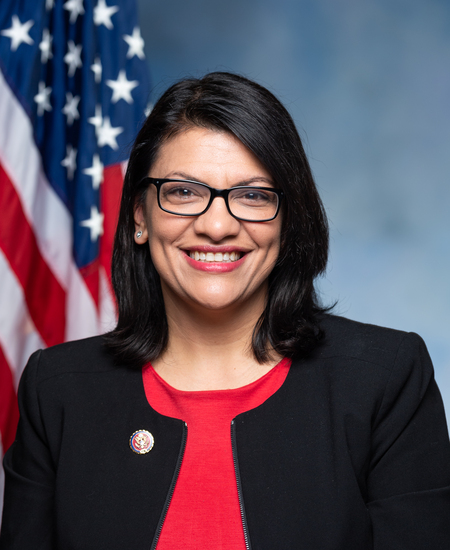
Rep. Rashida Tlaib
Sponsored bills
Maddy summaryHRES 150 is a ceremonial House resolution honoring the late civil rights leader John Robert Lewis (1940-2020). It formally recognizes his lifelong commitment to nonviolent activism, including his leadership in the Civil Rights Movement, the 1965 Selma voting rights march ("Bloody Sunday"), and his 30+ years serving as a U.S. Representative from Georgia. The resolution specifically commends his "towering achievements in the nonviolent struggle for civil rights" and his dedication to building the "Beloved Community" through justice and equality. As a commemorative resolution, it has no policy impact but serves as an official tribute to Lewis's legacy for the public and Congress.
Maddy summaryHR 1124, the Federal Death Penalty Abolition Act of 2023, would eliminate the federal death penalty by repealing provisions in over 30 sections of U.S. Code that currently allow for capital punishment in various criminal offenses. The bill would affect anyone convicted of a federal crime that currently carries the death penalty, including murder during drug trafficking, terrorism, and other violent crimes. It would remove the death penalty as a sentencing option for these offenses and require resentencing for those already under a death sentence. The bill also makes related changes to military justice procedures that currently permit capital punishment.
Maddy summaryHR 1134, the People Over Pentagon Act of 2023, would reduce the U.S. Department of Defense's 2024 budget by $100 billion. It directly affects the Pentagon's funding, though it specifically preserves spending for the Defense Health Program, military personnel, and civil service pay and benefits. The bill mandates this cut while directing the Secretary of Defense to consider a 2021 Congressional Budget Office report on managing a smaller defense budget. It does not specify where the savings would be redirected, only requiring reallocation to address non-military national security priorities.
Maddy summaryThe Department of Peacebuilding Act of 2023 would establish a new Cabinet-level Department of Peacebuilding within the executive branch of the U.S. government. The department would include multiple offices focused on domestic and international peacebuilding, violence prevention, peace education, and conflict resolution, with specific offices dedicated to areas like peace education, domestic activities, international activities, technology, arms control, and human rights. It would create a Secretary of Peacebuilding position and require the department to develop policies addressing root causes of violence, promote nonviolent conflict resolution, and collaborate with existing federal agencies. The bill would mandate annual reports on progress toward peace in the United States and require consultation with other departments on matters related to conflict prevention and peacebuilding.
Maddy summaryHR 724, the Arctic Refuge Protection Act, repeals the existing oil and gas program for the Arctic National Wildlife Refuge in Alaska and designates approximately 1.56 million acres of the refuge's coastal plain as federal wilderness. This bill directly affects the Arctic Refuge by permanently prohibiting oil and gas leasing and development in that specific area. The key mechanism is adding the designated land to the National Wilderness Preservation System under the Wilderness Act, requiring it to be managed for its natural conditions. This change legally protects the area from future fossil fuel extraction activities.
Boundary Waters Wilderness Protection and Pollution Prevention Act This bill withdraws approximately 234,328 acres of federal land and waters in a specified area in the Rainy River Watershed of Superior National Forest in Minnesota from entry, appropriation, and disposal under the public land laws; location, entry, and patent under the mining laws; and operation of the mineral leasing, mineral materials, and geothermal leasing laws. The area is adjacent to the Boundary Waters Canoe Area Wilderness and the Boundary Waters Canoe Area Wilderness Mining Protection Area. Land or interest in land within such area that is acquired by the United States shall be immediately withdrawn in accordance with this bill. The Forest Service is authorized to permit the removal of sand, granite, iron ore, and taconite from national forest system lands within such area if the removal is not detrimental to the water quality, air quality, and health of forest habitat within the Rainy River Watershed.
This resolution expresses the sense of the House of Representatives that Marcus Garvey should be recognized as a leader in the struggle for human rights and that the President should take measures to exonerate him of charges brought against him.
Maddy summaryThis bill directs the Joint Committee of Congress on the Library to obtain a statue of Shirley Chisholm and place it permanently in the U.S. Capitol within two years of enactment. It authorizes the Architect of the Capitol to handle the agreement for the statue under the Committee's terms, with necessary funding approved as needed. The bill does not change laws or affect specific people or groups; it is a procedural measure to honor Shirley Chisholm, the first Black woman elected to Congress, through a permanent Capitol display.
Maddy summaryHR 1088, the Shirley Chisholm Congressional Gold Medal Act, authorizes a posthumous Congressional Gold Medal to honor Congresswoman Shirley Chisholm, the first African-American woman elected to Congress (1968) and the first Black candidate for a major party's presidential nomination (1972). The bill directs the Treasury Secretary to design and strike a gold medal featuring Chisholm's image, which will be presented by Congress and then permanently displayed at the Smithsonian Institution. Duplicate bronze medals may be sold to the public to cover production costs, with proceeds deposited into the U.S. Mint fund. This bill commemorates Chisholm's legacy and achievements without creating new laws or affecting any current policies.