

Maddy summaryHR 1404, the Facial Recognition and Biometric Technology Moratorium Act of 2023, bans U.S. federal agencies and officials from using facial recognition, voice recognition, or other remote biometric surveillance systems (like gait analysis) for law enforcement or surveillance in the United States. It directly affects federal law enforcement agencies and state/local governments receiving Byrne grant funding, which they would lose if they don’t adopt similar bans. Key provisions prohibit federal acquisition or use of these systems (except for narrowly defined congressional authorizations), ban federal funding for such systems, and make illegally obtained biometric data inadmissible in court. The bill also allows individuals to sue the federal government for violations and requires states receiving federal funds to implement comparable restrictions.
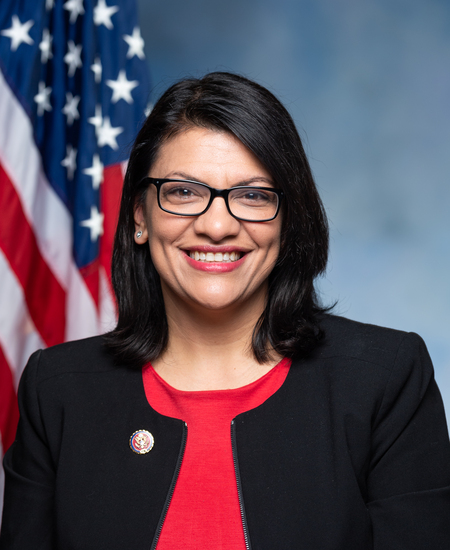
Rep. Rashida Tlaib
Sponsored bills
Sarah Keys Evans Congressional Gold Medal Act This bill provides for the award of a Congressional Gold Medal to Sarah Keys Evans in recognition of her achievements relating to the desegregation of passengers on interstate buses in the 1950s.
Maddy summaryThe Farm System Reform Act of 2023 establishes a moratorium on new large concentrated animal feeding operations (CAFOs) and requires existing large CAFOs to cease operations by January 1, 2040. It creates a voluntary debt forgiveness and transition assistance program to help AFO owners pay off construction and operational debts while transitioning to alternative agricultural activities. The bill also amends the Packers and Stockyards Act to require packers to purchase 50% of livestock through spot market sales from nonaffiliated producers and prohibits certain unfair pricing practices. Additionally, it restores mandatory country of origin labeling for beef and pork and expands labeling requirements to include dairy products, requiring "Product of U.S.A." labels only when meat is exclusively derived from animals born, raised, and slaughtered in the United States.
Maddy summaryThis bill establishes requirements for large industrial agricultural operations (defined as those owning or controlling significant numbers of livestock) to create disaster mitigation plans, register with a new Office of High-Risk AFO Disaster Mitigation and Enforcement, and report depopulation activities. It prohibits certain inhumane depopulation methods like ventilation shutdown and sodium nitrite poisoning, and requires covered operators to cover costs of depopulation, disposal, and compensation for workers and neighboring communities affected by disasters. The bill also sets new labor standards including health insurance coverage and severance pay for workers involved in disaster mitigation events, improves transport standards for livestock, and requires humane treatment of nonambulatory animals. It includes funding for additional OSHA and FSIS inspectors to enforce these requirements, directly affecting large industrial agricultural operators, their workers, and neighboring communities.
Maddy summaryHR 1369, the "Peace on the Korean Peninsula Act," directs the U.S. State Department to review restrictions on Americans traveling to North Korea, particularly for humanitarian reasons like family reunions (affecting approximately 100,000 Americans with relatives there). It also requires the State Department to create a diplomatic roadmap for ending the Korean War through formal negotiations with North and South Korea, including establishing liaison offices. The bill mandates reports to Congress within 180 days detailing these reviews and strategies, without changing existing military deployments or U.S. policy on North Korea's nuclear program. It focuses on diplomatic engagement to replace the 1953 armistice with a permanent peace agreement.
Long COVID Response is Care Optimized and Vitally Essential Resources that Yield New Opportunities for Wellness Act or the Long COVID RECOVERY NOW Act This bill establishes grants and requires actions to support treatment, research, and other efforts to address Long COVID (persistent, long-term symptoms following recovery from acute COVID-19 infection). Specifically, the bill establishes grants for treating individuals with Long COVID. These include grants for certain health clinics and primary care providers to treat patients, including by addressing food insecurity and other social needs that could interfere with treatment; health care providers or public health departments to set up or expand specialized clinics or programs using a multidisciplinary approach; and primary care providers to support the development of evidence and other resources related to treatments. The bill also establishes grants for Long COVID patient registries and research on Long COVID in pediatric populations. Additionally, the Office of the National Coordinator for Health Information Technology must convene stakeholders to identify best practices to make de-identified data related to Long COVID available to researchers. The office must also recommend policies for data standardization and related approaches to further a greater understanding of Long COVID. Further, the Department of Health and Human Services must (1) set up a website to educate health care providers and the public about Long COVID, and (2) issue guidance on ways to assist individuals with Long COVID through Medicaid and the Children's Health Insurance Program (CHIP). The bill also expands access for treating Long COVID through Medicaid, CHIP, and the Community Mental Health Services Block Grant.
Advancing Safe Medications for Moms and Babies Act of 2023 This bill establishes programs and requirements to support the inclusion of pregnant and lactating women in clinical research. For example, the bill requires the Department of Health and Human Services to align the Food and Drug Administration's regulations for human subjects in clinical trials with other departmental regulations for pregnant women in clinical research. The bill also establishes (1) a national online clearinghouse with information about clinical trials that enroll pregnant and lactating women, (2) an advisory committee to help coordinate federal activities with respect to clinical research for pregnant and lactating women, and (3) an educational campaign on the importance of including pregnant and lactating women in clinical research. The National Institutes of Health must also prioritize certain research projects on new and existing medications for pregnant and lactating women based on need, feasibility, and the potential impact of the research.
Maddy summaryThis bill allows asylum seekers not in detention to obtain work authorization 30 days after filing their asylum application, provided their application isn't deemed frivolous. It directly affects individuals seeking asylum in the U.S. who are awaiting a final decision on their case. The authorization remains valid until the asylum application receives a final denial, including any administrative or court appeals. This changes the prior system where many asylum seekers faced prolonged work restrictions while their cases were processed.
Maddy summaryHR 1302, the Gun Records Restoration and Preservation Act, repeals key restrictions known as the Tiahrt Amendments. It eliminates the requirement to destroy background check records within 24 hours, removes barriers to researchers accessing firearm trace data, and ends prohibitions on requiring gun dealers to conduct annual inventory audits. The bill directly affects law enforcement agencies (like the ATF), researchers studying gun violence, and federally licensed firearms dealers. These changes aim to improve access to data for tracking illegal gun trafficking and supporting evidence-based policy development.
Maddy summaryHR 1332, the Thirty-Two Hour Workweek Act, would amend the Fair Labor Standards Act to reduce the standard workweek from 40 hours to 32 hours, phased in over three years (38 hours in year one, 36 in year two, 34 in year three, and 32 hours after year three). It would require overtime pay at 1.5 times the regular rate for hours worked beyond 32 in a week (or beyond 8 hours in a workday), and double pay for hours beyond 12 in a workday. The bill directly affects most private-sector workers covered by the Fair Labor Standards Act, excluding certain exempt employees. This is a concrete policy change to adjust standard work hours and overtime thresholds, not a procedural measure.