

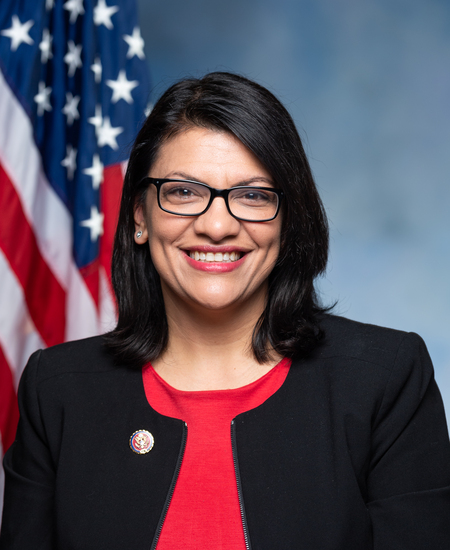
Photo of Rashida Tlaib
D United States House · District 12 · Michigan On the 2026 ballot

Rep. Rashida Tlaib

Compare
Total votes
2,837
all sessions
Attendance
98%
52 missed
Near the chamber average
With party
93%
of cast votes
Lower than 86% of chamber peers
Bipartisan score
4%
crosses aisle rarely
Higher than 85% of chamber peers
Sponsored
2,899
bills & resolutions
Higher than 99% of chamber peers
Committees
4
assignments
2,899 bills and resolutions

Sponsored bills

Total
2,899
Primary
101
Co-sponsor
2,798
This page
2,899
matching current filters
Co-sponsor HR 2807
In committee · United States House · Co-sponsor
Train Noise and Vibrations Reduction Act of 2023

Train Noise and Vibrations Reduction Act of 2023 This bill directs the Department of Transportation to develop and submit to Congress a report containing recommendations to reduce train noise and vibrations near homes and estimates of the costs and benefits of such recommendations.

In committee Apr 25, 2023 1 co-sponsor
Co-sponsor HR 1788
In committee · United States House · Co-sponsor
Goldie’s Act

Maddy summaryHR 1788, the "Goldie’s Act," strengthens USDA enforcement of the Animal Welfare Act. It requires annual inspections of all regulated animal businesses (like dealers, research facilities, and exhibitors) and mandates immediate, humane confiscation of animals suffering due to violations, while prohibiting owners from destroying animals during this process. The bill increases civil penalties to $10,000 per violation, requires hearing panels including veterinarians, and mandates that penalties consider business size and violation severity. It also requires USDA to share violation records with local animal control within 24 hours.

In committee Apr 25, 2023 1 co-sponsor
Co-sponsor HR 1729
In committee · United States House · Co-sponsor
Water Affordability, Transparency, Equity, and Reliability Act of 2023

Maddy summaryThe Water Affordability, Transparency, Equity, and Reliability Act of 2023 establishes a new trust fund funded by increasing the corporate tax rate from 21% to 24.5% to support water infrastructure and affordability programs. It allocates funds to clean water programs (42%), safe drinking water funding (42.5%), household water wells (1%), colonias assistance (0.5%), Indian health services (3%), and water operator job training (0.5%). The bill requires the EPA to conduct a study and submit a report on water affordability, discrimination in water services, public participation in regionalization, and data collection related to service disconnections. It includes specific provisions for colonias, household water wells, and job training programs for water system operators to improve water access and equity.

In committee Apr 25, 2023 1 co-sponsor
Co-sponsor HR 1705
In committee · United States House · Co-sponsor
A. Donald McEachin Environmental Justice For All Act

Maddy summaryThis bill establishes a comprehensive framework to address environmental justice by requiring federal agencies to identify and address disproportionately adverse environmental and health effects on communities of color, low-income communities, and Tribal and Indigenous communities. It creates a White House Environmental Justice Interagency Council to coordinate federal efforts, mandates that agencies develop environmental justice strategies, and requires consideration of cumulative impacts in permitting decisions for pollution sources. The bill also establishes grant programs for environmental justice communities, creates training requirements for federal employees, and includes specific provisions for safer cosmetics and economic revitalization in fossil fuel-dependent communities. These provisions aim to ensure fair treatment and meaningful involvement of all people in environmental decision-making processes, directly affecting federal agencies and communities disproportionately burdened by environmental hazards.

In committee Apr 25, 2023 1 co-sponsor
Co-sponsor HR 2803
In committee · United States House · Co-sponsor
Armenian Genocide Education Act

Maddy summaryThe Armenian Genocide Education Act (HR 2803) establishes a Library of Congress program to support U.S. schools in teaching about the Armenian Genocide of 1915-1923. The program will develop educational resources, provide teacher training, and maintain an online resource center to help schools incorporate accurate historical information into curricula. It prioritizes schools without existing Armenian Genocide education programs, with $2 million authorized annually for five years. The Librarian of Congress will report yearly on the program’s activities to Congress.

In committee Apr 24, 2023 1 co-sponsor
Co-sponsor HR 2552
In committee · United States House · Co-sponsor
Community Broadband Act of 2023

Maddy summaryThe Community Broadband Act of 2023 removes state-level legal barriers that prevent local governments, cooperatives, or public-private partnerships from building or operating broadband networks. It prohibits states from banning or effectively blocking these entities from providing advanced internet services to residents or businesses. The bill requires public entities to treat all broadband providers fairly under local rules, without favoring their own services or affiliated companies. It specifically defines "public providers" (like cities or counties) and "cooperatively organized providers" (like member-owned co-ops) to clarify who this law protects. The law does not fund new networks but ensures existing state laws cannot block community-led broadband projects.

In committee Apr 21, 2023 1 co-sponsor
Co-sponsor HR 2573
In committee · United States House · Co-sponsor
To express the Sense of Congress with respect to Federal preemption of State restrictions on dispensing medication abortion, and for other purposes.

This bill expresses the sense of Congress that (1) medication abortion is appropriately approved and regulated under federal law, and (2) federal law preempts any in-person dispensing requirements or telehealth restrictions with respect to medication abortion under state law.

In committee Apr 21, 2023 1 co-sponsor
Co-sponsor HR 2550
In committee · United States House · Co-sponsor
Special Diabetes Program Reauthorization Act of 2023

Maddy summaryThis bill extends the Special Diabetes Program for Type 1 diabetes through 2028, continuing existing federal funding that supports research, prevention, and treatment initiatives. It directly affects people living with Type 1 diabetes by ensuring ongoing access to critical resources funded under the Public Health Service Act. The key provision amends Section 330B(b)(2)(D) to update the program's funding period from ending in 2023 to ending in 2028. This is a straightforward reauthorization of current funding levels without new program requirements or eligibility changes.

In committee Apr 21, 2023 1 co-sponsor
Co-sponsor HR 2761
In committee · United States House · Co-sponsor
SPARC Act

Maddy summaryThe SPARC Act creates a federal loan repayment program to address specialty care shortages in rural areas. It provides up to $250,000 in repayment for specialty medicine physicians (like cardiologists or surgeons) and non-physician providers (such as nurse practitioners in specialty roles) who commit to six years of full-time work in designated rural communities facing provider shortages. Participants must agree to repay eligible education loans (including federal student loans) while serving in these areas, with strict rules preventing double-benefits from other loan forgiveness programs. The program requires annual reporting on participant locations and impact, aiming to improve access to specialty care in underserved rural regions.

In committee Apr 20, 2023 1 co-sponsor
Co-sponsor HR 2775
In committee · United States House · Co-sponsor
Nuclear Weapons Abolition and Conversion Act of 2023

Maddy summaryThis bill directs the U.S. government to support global nuclear disarmament by urging the U.S. to sign and ratify the Treaty on the Prohibition of Nuclear Weapons, contingent on ratification leading to verified worldwide elimination of nuclear weapons under international control. If the President certifies that all nuclear-armed nations have begun verified, irreversible elimination under the treaty, the U.S. must redirect funds currently used for nuclear weapons programs to: (1) develop clean energy and retrain nuclear industry workers; (2) address social needs like healthcare, housing, and environmental restoration (including radioactive waste monitoring); and (3) encourage other nations to join the treaty. It directly affects U.S. federal funding streams, nuclear weapons industry workers, and federal agencies managing defense resources. The bill focuses on policy shifts in resource allocation rather than creating new programs or mandating specific disarmament timelines.

In committee Apr 20, 2023 1 co-sponsor
Showing 1,931 to 1,940 of 2,899 bills