

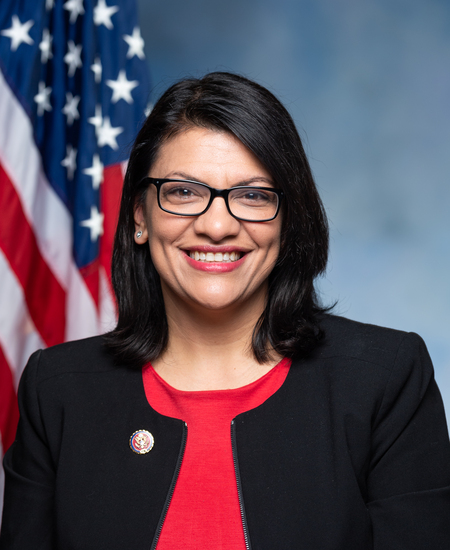
Photo of Rashida Tlaib
D United States House · District 12 · Michigan On the 2026 ballot

Rep. Rashida Tlaib

Compare
Total votes
2,837
all sessions
Attendance
98%
52 missed
Near the chamber average
With party
93%
of cast votes
Lower than 86% of chamber peers
Bipartisan score
4%
crosses aisle rarely
Higher than 85% of chamber peers
Sponsored
2,899
bills & resolutions
Higher than 99% of chamber peers
Committees
4
assignments
2,899 bills and resolutions

Sponsored bills

Total
2,899
Primary
101
Co-sponsor
2,798
This page
2,899
matching current filters
Co-sponsor HR 3619
In committee · United States House · Co-sponsor
Toxic-Free Beauty Act of 2023

Maddy summaryHR 3619, the Toxic-Free Beauty Act of 2023, bans the intentional addition of specific chemicals - including formaldehyde, certain parabens, phthalates, mercury, and two dyes - to cosmetic products sold across state lines. It directly affects cosmetic manufacturers and retailers, requiring them to reformulate products to remove these substances. The ban prohibits these chemicals in cosmetics introduced into interstate commerce starting January 1, 2025. This policy change updates federal safety standards under the Federal Food, Drug, and Cosmetic Act to restrict the use of identified chemicals in beauty products.

In committee May 26, 2023 1 co-sponsor
Co-sponsor HR 3620
In committee · United States House · Co-sponsor
Cosmetic Safety for Communities of Color and Professional Salon Workers Act of 2023

Maddy summaryThis bill establishes research programs to study health impacts of cosmetic chemicals on communities of color and professional salon workers. It requires manufacturers to provide translated safety data sheets for professional cosmetics in multiple languages, including Spanish, Vietnamese, Chinese, and Korean. The bill funds two resource centers: one focused on beauty justice for communities of color and another specifically for salon worker health and safety. It also allocates funds for research into developing safer cosmetic alternatives, particularly for products marketed to women and girls of color and used by salon workers.

In committee May 26, 2023 1 co-sponsor
Co-sponsor HR 3621
In committee · United States House · Co-sponsor
Cosmetic Fragrance and Flavor Ingredient Right to Know Act of 2023

Cosmetic Fragrance and Flavor Ingredient Right to Know Act of 2023 This bill imposes disclosure and labeling requirements on cosmetic products that contain certain ingredients. A cosmetic product that fails to meet such requirements may not be sold. Within two years of this bill's enactment, a cosmetic product's labeling or packaging must include a full list of its ingredients, as well as a specified statement that directs consumers to the brand owner's website for the health impacts of any ingredient that (1) is identified on specified lists of harmful or potentially harmful chemicals, such as chemicals identified as carcinogenic to humans by the Environmental Protection Agency or toxic air contaminants under California regulations; or (2) must be disclosed under certain European Union laws and is present in a product above specified concentrations. The Food and Drug Administration must publish and periodically update on its website a list of the ingredients subject to this requirement. Within one year of this bill's enactment, a brand owner must disclose the full list of ingredients for each cosmetic product on its website, as well as whether a cosmetic product contains any fragrance or flavor ingredient that is subject to this bill's labeling or packaging requirement and, if so, the ingredient's functional purpose.

In committee May 26, 2023 1 co-sponsor
Co-sponsor HR 3622
In committee · United States House · Co-sponsor
Cosmetic Supply Chain Transparency Act of 2023

Cosmetic Supply Chain Transparency Act of 2023 This bill requires the Food and Drug Administration (FDA) to maintain a list of certain nonfunctional constituents in cosmetics that are harmful to human health or the environment, authorizes the FDA to request from a brand owner (i.e., the entity bringing a cosmetic to market) certain information about a cosmetic's ingredients, and addresses related issues. For each listed nonfunctional constituent, the list must identify the ingredient or cosmetic (or category of ingredient or cosmetic) in which the constituent is known or reasonably expected to be present. The FDA must also (1) establish procedures for petitions to add substances to the list, (2) issue guidance for industry related to testing and detecting such nonfunctional constituents, and (3) establish a committee to provide advice on creating the list and developing the required industry guidance. Within a year of a nonfunctional constituent being added to the list, a supplier of an ingredient or cosmetic must test for that constituent and provide a brand owner the results and other information before selling the ingredient or cosmetic to the brand owner. A supplier of an ingredient or cosmetic must provide additional information about the item upon a brand owner's request. Brand owners must maintain records with information about the suppliers of ingredients and raw materials used in their cosmetics and provide such information to the FDA upon request. The bill also imposes civil penalties for brand owners and suppliers that violate this bill's provisions.

In committee May 26, 2023 1 co-sponsor
Co-sponsor HR 3645
In committee · United States House · Co-sponsor
To amend the Public Health Service Act to establish emergency grants to safeguard essential health care workers, and for other purposes.

Maddy summaryThis bill creates a new grant program under the Public Health Service Act to provide emergency funding for health care facilities during declared emergencies (like pandemics or natural disasters). It authorizes grants to public or private nonprofit health care facilities and home health agencies to pay hazardous duty compensation to eligible health care workers - such as nurses, medical technicians, and facility cleaners - performing essential on-site work. Grants can cover up to $13 per hour in hazard pay (capped at $25,000 annually per worker) or fund safety measures like personal protective equipment and alternative transit. The program requires the Secretary of Health and Human Services to determine if work or commutes are hazardous during emergencies.

In committee May 26, 2023 1 co-sponsor
Primary HR 3735
In committee · United States House · Lead sponsor
Expanding Health Care Providers for Veterans Act

Expanding Health Care Providers for Veterans Act This bill exempts certain workers involved with providing care for veterans from the annual cap on H-1B visas (specialty occupations). Specifically, an H-1B visa shall not count against the annual cap if the visa holder is employed (or has received a job offer) at the Department of Veterans Affairs or a State home (generally, a facility established by a state or Indian tribe for disabled veterans). (The annual H-1B cap is 65,000 visas with various exemptions and additional visas available to certain categories of workers.)

In committee May 25, 2023 0 co-sponsors
Co-sponsor HR 3694
In committee · United States House · Co-sponsor
Reward Work Act

Reward Work Act This bill prohibits issuers from purchasing their own securities on a national exchange. The bill also requires one-third of an issuer's board of directors to be elected by employees in order for the issuer to be allowed to register securities.

In committee May 25, 2023 1 co-sponsor
Co-sponsor HR 3721
In committee · United States House · Co-sponsor
United States Postal Service Shipping Equity Act

Maddy summaryThis bill allows the U.S. Postal Service to ship alcoholic beverages under specific conditions. It enables registered businesses (like wineries, breweries, and retailers) to mail alcohol directly to consumers, provided the recipient is at least 21 with valid ID, the shipment isn’t for resale, and state alcohol taxes are paid upfront. The Postal Service must establish rules for delivery, registration, and verification, while explicitly preserving all existing state, local, or tribal laws governing alcohol sales and shipments. The bill does not override state restrictions on alcohol delivery, and the Postal Service remains liable for violations under state law.

In committee May 25, 2023 1 co-sponsor
Co-sponsor HR 3697
In committee · United States House · Co-sponsor
Preemption of Real Property Discrimination Act

Preemption of Real Property Discrimination Act This bill preempts any state law that prohibits or restricts the purchase of real property by an individual based on the individual's citizenship.

In committee May 25, 2023 1 co-sponsor
Co-sponsor HR 3625
In committee · United States House · Co-sponsor
Ruthie and Connie LGBTQI Elder Americans Act of 2023

Maddy summaryThis bill amends the Older Americans Act to better serve LGBTQI older adults (defined as lesbian, gay, bisexual, transgender, queer, intersex individuals, and those living with HIV) by adding specific definitions and creating new support structures. It establishes an Office of LGBTQI Inclusion within the Administration on Aging, led by a Director and Assistant Director, to coordinate services, advocate for this community, and collect data on their challenges. The bill also creates a National Resource Center on LGBTQI Aging to provide training and resources to organizations serving LGBTQI older adults and requires data collection on discrimination against them in long-term care settings. These changes aim to improve access to culturally competent services and address the unique needs of LGBTQI older adults through concrete policy updates.

In committee May 24, 2023 1 co-sponsor
Showing 1,831 to 1,840 of 2,899 bills