

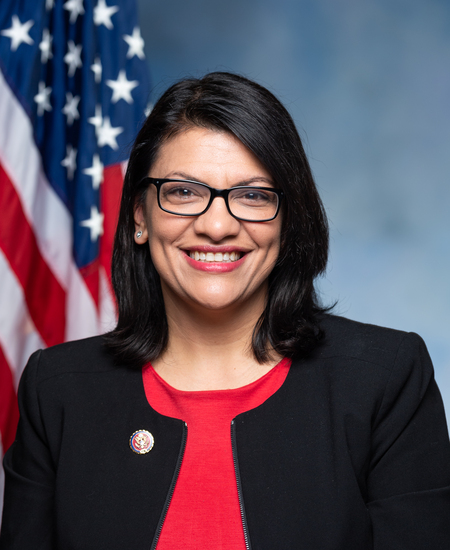
Photo of Rashida Tlaib
D United States House · District 12 · Michigan On the 2026 ballot

Rep. Rashida Tlaib

Compare
Total votes
2,837
all sessions
Attendance
98%
52 missed
Near the chamber average
With party
93%
of cast votes
Lower than 86% of chamber peers
Bipartisan score
4%
crosses aisle rarely
Higher than 85% of chamber peers
Sponsored
2,899
bills & resolutions
Higher than 99% of chamber peers
Committees
4
assignments
2,899 bills and resolutions

Sponsored bills

Total
2,899
Primary
101
Co-sponsor
2,798
Matching
2,899
matching current filters
Co-sponsor HR 7547
In committee · United States House · Co-sponsor
Young Adult Tax Credit Act

Young Adult Tax Credit Act  This bill allows a refundable young adult tax credit and a monthly advance payment of such credit. The bill defines young adult as an individual who is at least age 18, but not yet 25, and is either a citizen, national, or resident of the United States. The amount of such credit is the sum of $500 for each taxpayer or taxpayer dependent who is a young adult in any calendar month.

In committee Mar 5, 2024 1 co-sponsor
Co-sponsor HR 6148
In committee · United States House · Co-sponsor
Advancing Tribal Parity on Public Land Act

Maddy summaryHR 6148, the Advancing Tribal Parity on Public Land Act, requires federal agencies to consult with Native American tribes before selling public land that contains culturally significant sites. The bill creates a "tribal right of first refusal," allowing tribes with cultural or historical connections to the land to purchase it at fair market value within 60 days of notification. If multiple tribes bid, the sale is deferred for up to 180 days to allow for negotiation, and land purchased by tribes must be held in trust by the Department of the Interior. The bill defines "cultural sites" to include sacred sites, historic properties, and traditional gathering areas, and amends federal land management laws to require tribal consultation in land disposal decisions. This legislation directly affects Native American tribes with connections to specific public lands and federal agencies managing those lands.

In committee Mar 1, 2024 1 co-sponsor
Co-sponsor HR 6147
In committee · United States House · Co-sponsor
Tribal Cultural Areas Protection Act

Maddy summaryThe Tribal Cultural Areas Protection Act would establish a system to permanently protect Tribal cultural sites on public land by designating them as Tribal cultural areas, directly affecting Indian Tribes, federal land management agencies (Interior and Agriculture), and the public. Federal agencies must manage these areas in consultation with Tribal commissions, limiting new development that would disturb the land while preserving existing traditional practices like religious ceremonies and gathering of medicinal plants. The law requires management plans that incorporate Native knowledge and traditional practices, with special protections for sacred sites including restrictions on public disclosure of their locations. This bill ensures existing treaty rights are preserved while preventing commercial development that would harm cultural resources, without affecting existing water rights or federal environmental laws.

In committee Mar 1, 2024 1 co-sponsor
Co-sponsor HCONRES 92
In committee · United States House · Co-sponsor
Honoring the Mary Meachum Freedom Crossing.

This concurrent resolution honors the lives and work of Mary and John Meachum and recognizes the importance of the Mary Meachum Freedom Crossing, which is part of the National Underground Railroad Network to Freedom.

In committee Feb 29, 2024 1 co-sponsor
Co-sponsor HRES 1035
In committee · United States House · Co-sponsor
Recognizing the significance of the Greensboro Four sit-in during Black History Month.

Maddy summaryThis resolution honors the Greensboro Four (Joseph McNeil, Jibreel Khazan, Franklin McCain, and David Richmond) for their 1960 sit-in at a Greensboro, North Carolina Woolworth's store, which sparked the civil rights movement. It formally recognizes their role in challenging racial segregation and inspiring nationwide protests during Black History Month. The resolution encourages schools to include the Greensboro Four's story in their educational curriculum to highlight their contributions to civil rights. As a commemorative resolution, it has no binding effect but aims to promote historical awareness.

In committee Feb 29, 2024 1 co-sponsor
Co-sponsor HRES 1040
In committee · United States House · Co-sponsor
Recognizing and celebrating the significance of Black History Month.

Maddy summaryHRES 1040 is a ceremonial House resolution recognizing February as Black History Month. It formally acknowledges the achievements of Black Americans throughout U.S. history and encourages continued celebration of this observance. The resolution highlights the cultural and artistic contributions of Black Americans, including historical figures and movements like the Harlem Renaissance and hip-hop. As a non-binding resolution, it does not create new programs or affect any specific group, but serves to affirm the importance of commemorating Black history.

In committee Feb 29, 2024 1 co-sponsor
Co-sponsor HRES 1032
In committee · United States House · Co-sponsor
Expressing support for the designation of the week of February 26 through March 1, 2024, as "Public Schools Week".

Maddy summaryHRES 1032 is a symbolic resolution designating the week of February 26-March 1, 2024, as "Public Schools Week" in the U.S. House of Representatives. It expresses congressional support for public education, highlighting its role in preparing students and communities. The resolution has no legal effect or funding provisions - it solely serves as a formal expression of backing for public schools. It directly affects no individuals or entities but aims to raise awareness about public education. This is a non-binding gesture, not a policy change.

In committee Feb 26, 2024 1 co-sponsor
Co-sponsor HRES 1026
In committee · United States House · Co-sponsor
Supporting the goals and ideals of Black History Month and honoring the outstanding contributions of African-American Congressional Medal of Honor recipients.

Maddy summaryThis symbolic resolution (HRES 1026) recognizes Black History Month and honors the 94 African-American recipients of the Congressional Medal of Honor for their military bravery, heroism, and valor. It does not create new laws or policies but formally acknowledges their contributions, referencing historical context like Sergeant William Harvey Carney’s 1863 actions and the 1993 study revealing racial discrimination in Medal of Honor awards during WWII. The resolution specifically calls for the House to recognize Black History Month and honor these 94 service members. It is a non-binding expression of support with no concrete policy changes.

In committee Feb 23, 2024 1 co-sponsor
Co-sponsor HR 7429
In committee · United States House · Co-sponsor
Negating Neighborhood Noise Act of 2024

Maddy summaryThis bill modifies federal highway funding rules to allow the use of Highway Trust Fund money for constructing specific noise barriers near highways. It permits Type II noise barriers (designed to reduce highway noise) if they separate highways from older residential areas (at least 10 years old) or meet other defined criteria, while generally restricting such funding otherwise. The bill also enables "multipurpose" noise barriers that can host renewable energy or broadband infrastructure, and requires project sponsors to consider aesthetics when building these barriers. It directly affects highway construction projects near residential neighborhoods and state transportation agencies managing federal highway funds.

In committee Feb 21, 2024 1 co-sponsor
Co-sponsor HR 7424
In committee · United States House · Co-sponsor
Renewable Roadsides Act

Maddy summaryHR 7424, the Renewable Roadsides Act, requires the U.S. Departments of Transportation and Energy to study the feasibility of developing solar energy projects (including generation, storage, and transmission) on federal land adjacent to the National Highway System. The study, due by December 2025, will assess land suitability, identify barriers like safety concerns or competing land uses, and evaluate federal requirements. By December 2026, the agencies must submit a report to Congress with findings, recommendations for enabling such projects, and a process for entities to apply for leases or agreements to build and operate these facilities. The bill does not fund or mandate solar projects but sets the stage for potential future development by analyzing logistical and regulatory pathways. It directly affects federal agencies and could influence future policy on utilizing highway-adjacent federal land for renewable energy.

In committee Feb 20, 2024 1 co-sponsor
Showing 1,501 to 1,510 of 2,899 bills