

Maddy summaryHR 3303, the Maternal Health for Veterans Act, requires the Department of Veterans Affairs (VA) to annually report on maternity care coordination programs and maternal health outcomes for veterans receiving care through VA facilities or VA-contracted providers. The bill mandates the VA to collect data on maternal outcomes - including disparities affecting high-risk demographic groups - and submit recommendations to Congress by September 2028. It authorizes $15 million annually (2024-2028) for VA maternity care coordination programs, supplementing existing funding without reducing current resources. The law directly affects veterans using VA maternity services, aiming to improve care through data-driven strategies.
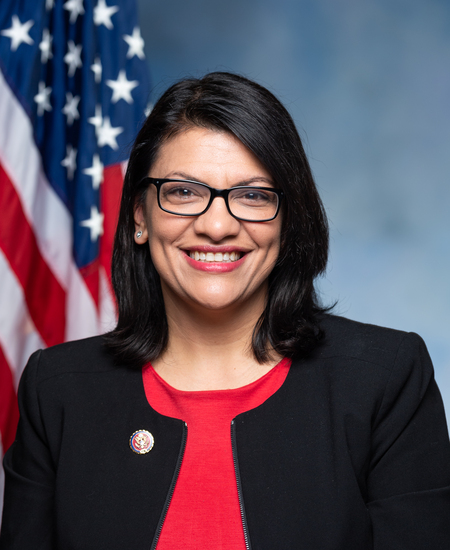
Rep. Rashida Tlaib
Sponsored bills
Maddy summaryHR 8013, the Gig Is Up Act, requires large employers (those with $100 million+ in annual gross receipts and 10,000+ independent contractors) to treat payments to certain gig workers as wages for payroll tax purposes. This means these employers must withhold Social Security and Medicare taxes at double the standard rate (instead of the usual 7.65%), similar to how they handle employee wages. The change applies to payments made after December 31, 2024, and directly affects major gig platforms and their workers who currently pay self-employment taxes. The bill does not reclassify workers as employees but alters how their payments are taxed under the Social Security system.
Maddy summaryThis bill creates a new federal tax credit for family child care providers who operate from their primary residence and hold state licenses. It allows qualifying providers to claim up to $5,000 in startup costs per year, including licensing fees, supplies, insurance, safety equipment, furniture, and required home renovations. The credit applies only once per provider (no repeat claims) and expires after 7 years. It directly benefits small-scale, licensed family child care providers serving at least two non-family children, aiming to reduce their initial business setup costs.
Maddy summaryThis bill authorizes $5 billion annually (2025-2034) for three key housing programs - Home Investment Partnerships, Community Development Block Grants, and the Housing Trust Fund - but restricts funding to areas already designated with a "high housing cost adjustment" by HUD. It mandates a two-year assessment by the Secretary of Housing and Urban Development to evaluate how area median income (AMI) calculations impact affordability, particularly in high-cost urban areas, including analyzing ZIP code-level metrics and alternatives to AMI. The study must examine rent burdens, income limits for tax-subsidized housing, and the specific effects of high-cost adjustments in places like New York City. The bill directly affects low-income and middle-class families in urban areas where housing costs significantly exceed local median income, aiming to inform potential reforms to housing affordability metrics.
Maddy summaryThe Teen Dating Violence Prevention Act establishes a federal grant program to fund schools and youth organizations in developing and delivering evidence-based educational resources and training focused on preventing teen dating violence. The program, funded with $10 million annually from 2025-2029, supports creating materials to help teens recognize, prevent, and report abuse, training school staff to identify and respond to abuse, and hosting workshops for students and parents. Eligible applicants include schools, community groups, and youth organizations that work with teens aged 12-18, with requirements for involving domestic violence professionals and stakeholders in program design. The bill defines teen dating violence as abuse in intimate relationships among youth, including physical, sexual, emotional, or technological harm.
Maddy summaryHRES 1135 is a non-binding resolution supporting the "Rise Up for LGBTQI+ Youth in Schools" initiative. It calls for communities to demand equal educational opportunities, civil rights protections, and an end to exclusion for LGBTQI+ students in K-12 schools, particularly transgender, nonbinary, Black, Indigenous, and disabled youth. The resolution encourages states and school districts to adopt policies prohibiting bias-based bullying, harassment, and erasure - such as inclusive sports participation, bathroom access, and curriculum inclusion - without creating new legal requirements. It references growing state-level restrictions targeting LGBTQI+ students, including sports bans and curriculum censorship, as context for the call to action. The resolution itself does not enact new laws but formally recognizes efforts to foster safer, affirming school environments.
Maddy summaryHR 7940, the Coal Cleanup Taxpayer Protection Act of 2024, changes bonding rules for coal mining reclamation. It bans self-bonding (where mining companies guarantee their own cleanup costs) for both federal and state programs, requiring operators to replace existing self-bonds within 90 days or at permit renewal. The bill also mandates states to submit detailed reports on past bond forfeitures and financial forecasts, and establishes new rules for surety bonds and collateral - prohibiting coal mines, equipment, or coal itself as collateral. These changes directly affect coal mining operators, state regulators, and federal oversight under the Surface Mining Control and Reclamation Act.
Maddy summaryThe Bond Improvement and Reclamation Assurance Act updates bond requirements for surface coal mining under the 1977 Surface Mining Control and Reclamation Act. It requires mining operators to post bonds covering the full cost of land reclamation, with amounts adjusted annually for inflation and based on factors like mine closure timing, topography, and reclamation difficulty. The bill mandates bond recalculations when permits are transferred, conditions change (e.g., mine closure or water pollution), or permit renewals occur, and holds both original operators and controlling owners jointly liable for reclamation costs. This ensures sufficient funds are available to reclaim mined land if operators fail to meet their obligations, protecting public lands and water resources.
Maddy summaryHRES 1128 is a non-binding resolution recognizing the Muslim holy month of Ramadan and extending best wishes for Eid al-Fitr. It formally acknowledges Ramadan's significance as a period of fasting and spiritual renewal for Muslims worldwide, and expresses solidarity with Muslim communities in the United States and globally. The resolution does not create new laws or policies - it is purely ceremonial, affirming respect for the observance without any concrete policy changes or direct effects on individuals or groups. Introduced by Representatives Dingell, Tlaib, Carson, Grijalva, Cárdenas, Omar, and Schakowsky on April 10, 2024, it serves as a symbolic gesture of inclusion.
This resolution recognizes the anniversary of the Civil Rights Act of 1866 and its impact on establishing that all Americans are protected equally under the law.