

Maddy summaryHR 576 makes Executive Order 14096 legally binding by codifying it into federal law. This order directs federal agencies to prioritize environmental justice, focusing on communities disproportionately affected by pollution and environmental hazards. The bill requires agencies to integrate environmental justice considerations into their decision-making processes, directly affecting federal departments managing environmental programs. It transforms an executive directive into a permanent legal requirement, ensuring continued focus on equitable environmental policies.
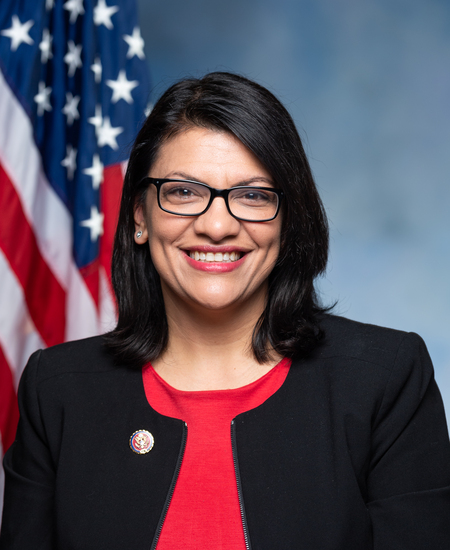
Rep. Rashida Tlaib
Sponsored bills
Maddy summaryHRES 48 is a ceremonial resolution honoring Dr. Martin Luther King, Jr., by commemorating his 96th birthday on January 20, 2025. The resolution affirms his teachings on diversity, equality, and nonviolence, and specifically condemns hate, discrimination, and harassment targeting Black Americans, Indigenous peoples, Jewish communities, Asian-American/Pacific Islander groups, Muslim communities, Hispanic/Latino communities, LGBTQ+ individuals, and others. It calls on all people to uphold Dr. King’s values of justice, tolerance, and peace. As a symbolic gesture, this resolution has no legal effect but expresses the House’s commitment to these principles.
Maddy summaryHRES 52 is a symbolic resolution recognizing community organizations and individuals who create and maintain services and educational programs for LGBTQIA+ communities. It does not establish new laws, funding, or policy changes, but formally honors their work in fostering safe spaces and resilience. The resolution cites historical examples like Stonewall and ACT UP, along with statistics on declining LGBTQIA+ venues and hate violence, to underscore the importance of these efforts. It calls for Congress to acknowledge this work through non-binding statements of support.
Maddy summaryHRES 51 is a ceremonial resolution passed by the U.S. House of Representatives to honor Zeta Phi Beta Sorority, Inc. on its 105th anniversary. The resolution commends the sorority for its founding in 1920 at Howard University and its decades of work in scholarship, service, and community leadership. It recognizes the organization's global membership (over 100,000 members across 875 chapters) and its historic milestones, including being the first National Pan-Hellenic Council organization to centralize operations and charter chapters in Africa. This resolution has no policy impact - it is purely symbolic recognition of the sorority's legacy.
Chiropractic Medicare Coverage Modernization Act of 2025 This bill expands Medicare coverage of chiropractic services to include all services provided by chiropractors, rather than only subluxation corrections through manual manipulation of the spine.
Maddy summaryThe Inaugural Fund Integrity Act regulates donations to official presidential inaugural committees. It prohibits these committees from accepting money from corporations, foreign nationals, or donations made under another person's name. Individuals can donate up to $50,000 annually (adjusted for inflation), and committees must disclose all donations over $1,000 within 24 hours, plus detailed final reports showing all spending over $200. Unused funds may still be transferred to tax-exempt charities. This applies to inaugural committees organizing the 2029 and later presidential inaugurations.
Maddy summaryThis bill prohibits discrimination based on gender identity, sexual orientation, or sex characteristics in military service. It requires that eligibility for military service and all personnel policies consider only an individual's ability to meet job-specific military standards, banning the use of race, color, national origin, religion, or gender-related factors. The law directly affects all current and prospective members of the Armed Forces by mandating that military occupational standards apply equally to everyone. It amends Title 10 of the U.S. Code to establish these protections as a formal requirement for all military personnel policies.
Maddy summaryHR 485, the Muhammad Ali Congressional Gold Medal Act, authorizes Congress to award a gold medal in recognition of Muhammad Ali's lifetime contributions to sports, civil rights, and humanitarian causes. The bill directs the Treasury Secretary to strike the medal and present it to Ali's widow, Lonnie Ali, following his death in 2016. It also permits the sale of bronze duplicates to cover costs, with proceeds going to the U.S. Mint. This is a commemorative measure with no policy impact, solely honoring Ali's legacy through a symbolic medal.
Maddy summaryHR 500, the Medicare Hearing Aid Coverage Act of 2025, removes Medicare's longstanding exclusion of hearing aids and related examinations from coverage. This change would directly affect Medicare beneficiaries with hearing loss by allowing them to receive coverage for hearing aids starting January 1, 2026. The bill amends the Social Security Act to eliminate the specific exclusion, making hearing aid coverage a standard Medicare benefit. Additionally, it requires the Government Accountability Office (GAO) to study existing hearing aid programs and submit a report with recommendations to Congress within 18 months of the effective date.
Maddy summaryHR 486, the Young Americans Financial Literacy Act, authorizes $27.5 million to $55 million annually through 2029 to fund competitive grants for centers of excellence focused on financial literacy education for individuals aged 8-24. These centers, established by eligible institutions like schools, nonprofits, or financial organizations, must develop research-based programs covering budgeting, debt management, student loan guidance, and avoiding pitfalls like predatory lending. The bill specifically requires programs to address at-risk populations, include evidence-based teaching methods, and serve groups such as high school graduates, college students, young families, and military personnel. It mandates annual reporting to Congress on grant recipients and the populations they serve, with funding ending in 2029.