

Maddy summaryThis bill expands access to family and medical leave under the FMLA by reducing the required employment period from 12 months to 90 days for most workers. It also lowers the employer size threshold from "50 or more employees" to "1 or more employees," requiring nearly all employers to provide this leave. The changes specifically apply to private-sector workers, federal employees (covered under Title 5), and congressional staff, removing previous eligibility barriers. Key provisions include updating definitions in the FMLA and modifying federal employee leave rules to align with the 90-day requirement. This directly affects millions of workers who previously had to wait a full year for leave eligibility.
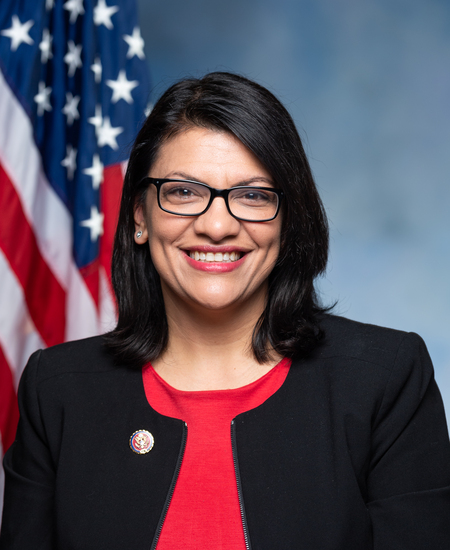
Rep. Rashida Tlaib
Sponsored bills
Maddy summaryThis bill modifies corporate tax rules to prevent companies from avoiding US taxes by moving operations overseas. It targets tax breaks that companies currently use when they outsource work to foreign countries or reorganize as foreign entities (so-called "inverted corporations"). The bill requires companies to pay tax on foreign profits based on each country where they operate, limits tax deductions for interest by multinational corporations, and treats foreign corporations managed in the US as domestic for tax purposes. These changes aim to close loopholes that allow companies to reduce their US tax burden through foreign operations.
Maddy summaryHR 994, the "Stop Musk Act," is a procedural bill prohibiting federal employee retaliation for resisting actions by Elon Musk or his representatives against federal agencies. It specifically bans retaliation against employees who resist, circumvent, or prevent Musk (a private individual) from taking actions deemed "unlawful or unconstitutional" regarding federal agencies. The bill's key provision creates a new protection for federal workers facing retaliation for opposing Musk's alleged interference, though it does not define what constitutes unlawful or unconstitutional actions. This is a symbolic, narrow-scope bill targeting a specific private actor rather than establishing broad policy changes.
Maddy summaryThis bill establishes a federal right to access contraception, protecting individuals' ability to obtain contraceptives and health care providers' ability to offer them without government interference. It prohibits states from banning or restricting contraceptive services, products, or information, including laws that force providers to deny care based on personal beliefs or limit access to specific methods. The law immediately overrides conflicting state regulations and ensures that contraception remains available regardless of factors like race, income, disability, or location. It applies to all individuals and providers, building on existing federal protections like the Affordable Care Act's coverage requirements.
Maddy summaryThe Caring for All Families Act expands family medical leave eligibility under the FMLA to include domestic partners, adult children, children of domestic partners, and extended family members such as grandparents, grandchildren, siblings, and in-laws. It also adds new "parental involvement and family wellness" leave allowing employees to attend school activities for their children/grandchildren or meet routine medical needs for themselves, their children, spouse/domestic partner, or elderly individuals with family-like relationships. Employees may take up to 4 hours per 30-day period or 24 hours per year for these purposes, with the leave being in addition to existing FMLA protections. This bill directly affects private sector employees covered by the FMLA and federal employees, broadening who qualifies for leave and expanding leave purposes to include family wellness activities.
Maddy summaryHR 412 authorizes the Bay Mills Indian Community in Michigan to sell, lease, or transfer its own land (not held in trust by the U.S. government) without needing additional federal approval. It specifically excludes land held in trust by the U.S. for the Tribe, which remains subject to existing federal oversight. The bill also states the U.S. government won't be liable for losses from these transactions unless it was directly involved. This changes the Tribe's ability to manage its non-trust land holdings while maintaining federal control over trust lands.
This resolution supports federal investment in public K-12 schools, affirms that the Department of Education (ED) plays a vital role in the public education system, and states that public education funding should not be diverted (e.g., through the use of vouchers) to privately run K-12 schools. The resolution also rejects any claim that the executive branch has the legal authority to (1) dismantle or relocate ED or any of its major offices; or (2) reduce federal funding for public education, block federal grants for education, or transfer funding burdens for education to state and local governments.
Maddy summaryThis resolution (HRES 95) is a commemorative measure recognizing the Greensboro Four sit-in during Black History Month. It honors Joseph McNeil, Jibreel Khazan, Franklin McCain, and David Richmond for initiating the 1960 sit-in at a Woolworth’s lunch counter in Greensboro, North Carolina, which catalyzed the civil rights movement. The resolution specifically acknowledges their role as catalysts for student-led activism, the value of racial diversity, and the effectiveness of nonviolent protest, while encouraging states to include their history in school curricula. As a symbolic gesture with no binding policy changes, it directly affects public recognition of this historical event and its significance to civil rights education.
This resolution condemns Russia's nuclear escalatory rhetoric and implied threats on the potential use of nuclear weapons in the context of its invasion of Ukraine. The resolution also (1) condemns Russia's purported suspension of participation in the New START Treaty, (2) emphasizes the value of arms control agreements between the United States and Russia, and (3) calls on the administration to continue pursuing nuclear arms control and risk reduction with Russia and China.
Maddy summaryHR 916, the Rosa Parks Commemorative Coin Act, authorizes the U.S. Treasury to mint and sell commemorative coins (gold $5, silver $1, and half-dollar) in honor of Rosa Parks, a pivotal civil rights leader whose 1955 bus protest sparked the Montgomery Bus Boycott. The coins, to be issued in 2029, will feature designs reflecting her legacy and be sold to the public at face value plus a fixed surcharge ($35 for gold, $10 for silver, $5 for half-dollar). All surcharge funds will be directed to the Rosa and Raymond Parks Institute for Self Development to support its youth development and civil rights education programs. The bill ensures the coins are legal tender, with the Treasury recovering all costs without net government expense.