

Maddy summaryHR 1788, the Fair Grocery Pricing Act, prohibits food producers from using data analytics services (coordinators) to facilitate tacit price coordination among competitors. It directly affects food manufacturers and the data companies that provide pricing coordination services, making it unlawful for producers to contract with such services or for coordinators to enable price-fixing agreements. The bill empowers the Federal Trade Commission and Department of Justice to enforce these rules under existing antitrust laws and allows consumers to sue for triple damages plus legal fees if harmed by violations. It also invalidates pre-dispute arbitration agreements for these cases, ensuring affected consumers can pursue legal action.
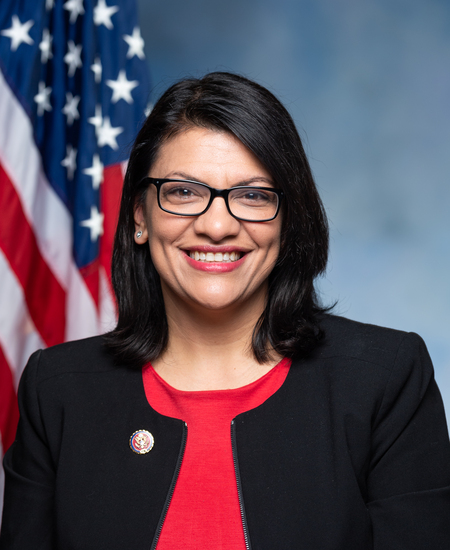
Rep. Rashida Tlaib
Sponsored bills
Maddy summaryHR 1787 authorizes the U.S. Mint to produce commemorative coins honoring baseball legend Roberto Clemente, including $5 gold, $1 silver, and half-dollar coins, with specific specifications for weight, size, and metal content. The bill requires the coins to feature Clemente's image and commemorative inscriptions, and mandates a surcharge ($35 for gold, $10 for silver, $5 for half-dollar) paid to the Roberto Clemente Foundation for its educational, youth sports, and disaster relief programs. All coins must be minted in 2027, sold at face value plus surcharge and production costs, and will be legal tender. The bill focuses solely on the coin program, not broader policy changes.
Maddy summaryHR 1811, the Judicial Ethics Enforcement Act of 2025, creates an Office of Inspector General (IG) specifically for the federal judicial branch to investigate misconduct by judges and court staff. The IG would conduct audits, investigate alleged violations of judicial ethics rules (excluding Supreme Court decisions' merits), prevent fraud/waste, and report findings to the Chief Justice and Congress. The bill explicitly prohibits the IG from reviewing court rulings, disciplining judges, or investigating matters related to a judge's decision-making. This bill directly affects all federal judges, court employees, and judicial entities like the Judicial Conference, establishing a new oversight mechanism within the courts.
Safe Schools Improvement Act This bill requires states to direct their local educational agencies (LEAs) to establish policies that prevent and prohibit bullying and harassment of elementary and secondary school students. In particular, these policies must prohibit bullying and harassment based on race, color, national origin, disability, religion, or sex. Sex includes sexual orientation, gender identity, and sex characteristics (including intersex traits). Further, LEAs must provide (1) students, parents, and educational professionals with annual notice of the conduct prohibited in their disciplinary policies; (2) students and parents with grievance procedures that target such conduct; and (3) the public with annual data on the incidence and frequency of that conduct at the school and LEA level. The Department of Education must conduct and report on an independent biennial evaluation of programs and policies to combat bullying and harassment in elementary and secondary schools. The National Center for Education Statistics must collect state data to determine the incidence and frequency of the conduct prohibited by LEA disciplinary policies.
Maddy summaryThis bill amends Section 5(e)(6) of the Food and Nutrition Act of 2008 by removing a reference to "subparagraph (B)" and renumbering the following provisions. It does not change SNAP eligibility rules or benefits; it only adjusts the internal numbering of existing provisions. The change takes effect January 1 following enactment. As a procedural amendment, it directly affects how the law is cited but does not alter policy or impact beneficiaries.
Maddy summaryThis bill (HJRES 63) would rename the Robert E. Lee Memorial, a National Park Service site in Arlington, Virginia, to "Arlington House National Historic Site." It directly affects the National Park Service, which manages the site, and all federal government documents, maps, and records referencing the location. The key provision updates all official references to the site to the new name and repeals two prior resolutions that established the memorial. As a procedural renaming bill, it does not create new policies or funding but changes the site's official designation.
Maddy summaryHRES 173 is a symbolic resolution, not a bill, calling for federal recognition and support of historically Black Freedmen's Settlements. It honors communities like Sand Branch, Texas (facing water contamination and poverty), Africatown, Alabama (surrounded by pollution), and Mossville, Louisiana (enduring industrial pollution), which were established by formerly enslaved people after emancipation. The resolution urges federal coordination to preserve these communities through documentation, historic preservation, and leveraging existing programs like EPA’s Environmental Justice initiatives and Justice40 funding - without creating new mandates or direct funding. It emphasizes collaboration between federal agencies, states, and nonprofits to address legacy inequities in infrastructure, environmental health, and economic opportunity. The resolution focuses on acknowledgment and strategic support, not new legislation or financial commitments.
Maddy summaryHRES 170 is a non-binding resolution expressing the House's support for Black workers and affirming the need for legislation to address workforce disparities. It highlights specific issues affecting Black workers, including a 3-point higher unemployment rate, 87% of median weekly earnings compared to overall averages, and higher workplace discrimination. The resolution specifically endorses passing four key bills: the PRO Act (labor organizing rights), National Apprenticeship Act, Raise the Wage Act, and Workforce Innovation Act. It does not create new laws but calls for action on these existing legislative proposals to reduce inequalities. The resolution directly affects Black workers across the U.S. workforce, emphasizing their historical and economic contributions.
Maddy summaryHRES 171 is a non-binding resolution introduced in the U.S. House of Representatives that reaffirms the constitutional limit established by the Twenty-second Amendment, which prohibits any person from being elected president more than twice. The resolution specifically states that this amendment applies to two terms in aggregate and prohibits former President Donald Trump from seeking another presidential term. It cites multiple public statements by Trump from 2018 to 2025 where he expressed interest in serving beyond two terms or questioned the amendment's limits. The resolution serves as a symbolic statement of congressional support for the existing constitutional term limit, with no legal effect on actual eligibility. It does not create new law or alter the Twenty-second Amendment.
Maddy summaryHRES 168 is a congressional resolution expressing the House's position on U.S.-Mexico relations. It reaffirms U.S. respect for Mexico's sovereignty under international law and explicitly condemns any proposed U.S. military action in Mexico without Mexico's consent or congressional authorization. The resolution states that using military force for issues like drug trafficking (e.g., fentanyl) does not justify unilateral action and violates constitutional separation of powers. It emphasizes diplomatic engagement with Mexico as the preferred path to address security challenges like transnational crime, rather than military intervention. This resolution does not create new law but formally states congressional expectations regarding executive actions.