

Maddy summaryThis bill (HR 1988) provides unemployment benefits eligibility for certain federal workers and military members during government shutdowns. It deems eligible employees - such as military personnel, NOAA Commissioned Corps members, and excepted civilian workers performing emergency duties - as "totally separated from federal service" during funding gaps. This allows them to access unemployment benefits immediately, without waiting periods, for weeks of unemployment starting March 14, 2025. The bill directly affects federal employees who remain on duty but are unpaid due to shutdowns.
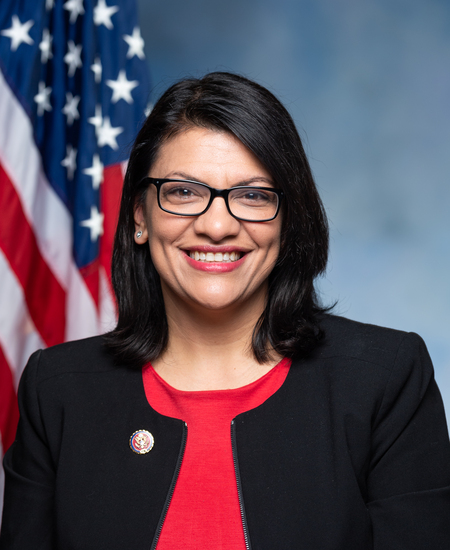
Rep. Rashida Tlaib
Sponsored bills
Maddy summaryThe Salary Transparency Act (HR 2007) requires most employers to disclose the pay range for open positions in job postings or upon request before discussing compensation, and to share the pay range for current employees at hire and annually. It prohibits employers from retaliating against workers or applicants who ask for pay information or exercise these disclosure rights. Employers violating the law face civil penalties up to $10,000 per violation and must pay employees statutory damages of $1,000-$10,000 per violation, plus legal fees. This directly affects employers covered by the Fair Labor Standards Act and job seekers seeking transparent pay information.
Maddy summaryThis bill provides federal grants to public or nonprofit health care providers serving minority, low-income, or medically underserved communities to expand maternal and infant health services. It specifically funds prenatal, postnatal, and postpartum care while requiring grantees to offer culturally appropriate services and limit administrative costs to 10% of grant funds. Priority is given to organizations led by or located within the communities they serve, aiming to reduce racial and economic disparities in care access and health outcomes. The funding is authorized for fiscal years 2026-2030, with grantees required to coordinate with other federal maternal health programs to avoid duplication.
Maddy summaryHR 1950, the Protect Social Security and Medicare Act, requires a two-thirds vote in both the House and Senate to consider any bill or amendment that would reduce Social Security or Medicare benefits administered by the Social Security Administration (SSA) or Centers for Medicare & Medicaid Services (CMS). This rule applies directly to lawmakers who would need supermajority support to advance proposals affecting these programs. An exception allows changes to Medicare Advantage plan payments if offset by increased payments elsewhere in Medicare. Determinations about whether a provision reduces benefits are made solely by the SSA's Office of the Chief Actuary during legislative consideration.
Maddy summaryHR 1918, the Farewell to Foam Act of 2025, prohibits the sale of most foam food containers, packaging peanuts, and foam coolers starting January 1, 2028. It directly affects restaurants, grocery stores, food vendors, manufacturers, and retailers who sell these items, excluding medical coolers used for drugs or medical products. The bill imposes escalating civil penalties for violations: $250 for the second offense, $500 for the third, and $1,000 for fourth or subsequent violations, with reduced penalties for small businesses under specific revenue thresholds. Enforcement is led by the EPA Administrator, with states allowed to enforce under federal guidelines.
Maddy summaryHR 1967 would rename the National School Lunch Program Act to honor Jean E. Fairfax, a civil rights activist who worked to expand equitable access to school meals for marginalized communities. The bill amends over 40 federal statutes to replace "Richard B. Russell" with "Jean E. Fairfax" in all official references, including program titles and legal citations. This is a purely procedural change that updates naming conventions without altering program eligibility, funding, or operations. The renaming follows findings that Richard B. Russell opposed civil rights legislation and segregation, while Jean E. Fairfax advocated for inclusive school meal access.
Maddy summaryHR 1938 requires the Department of Defense to request modifications to stormwater permits at military facilities, mandating quarterly monitoring of PFAS discharges and implementation of best management practices to reduce them. The bill directly affects all Department of Defense facilities subject to federal stormwater permits under the Clean Water Act. It allocates at least 1% of annual PFAS remediation funds specifically for testing stormwater runoff at these sites. The legislation focuses on preventing PFAS contamination in waterways by strengthening monitoring and reduction measures at military operations.
Maddy summaryThis bill restores pension benefits for retirees affected by the termination of specific Delphi pension plans. It requires the Pension Benefit Guaranty Corporation (PBGC) to recalculate monthly benefits to the "full vested plan benefit" (the amount retirees would have received without prior reductions) and pay lump-sum payments for past underpayments, including 6% annual interest. The law applies to retirees of six Delphi pension plans, including the Delphi Hourly-Rate Employees Pension Plan and Delphi Retirement Program for Salaried Employees, who are currently receiving benefits or eligible for future payments. Payments will be funded from existing PBGC resources without changing prior asset allocations.
Maddy summaryThis symbolic resolution (HRES 194) designates March 6, 2025, as "Great Lakes Day" to honor the Great Lakes region. It does not create new laws or funding but expresses non-binding support for the designation and recognizes the lakes' importance to the region's environment, economy (serving 40 million people, supporting $3.1 trillion in GDP), and cultural heritage. The resolution calls for continued preservation efforts through existing programs like the Great Lakes Restoration Initiative. It directly affects the eight Great Lakes-bordering states (MI, WI, MN, OH, IN, IL, PA, NY) and their residents.
Maddy summaryHRES 192 is a ceremonial resolution recognizing the start of Ramadan, the Muslim holy month of fasting and spiritual renewal, and commending Muslims in the U.S. and globally. It acknowledges that approximately 4.5 million Muslims live in the United States and highlights Ramadan’s significance as the ninth month of the Islamic calendar, observed from February 28, 2025. The resolution notes American Muslims’ contributions to society through charitable work, diverse professions, and community leadership, while referencing historical U.S. government recognition of Ramadan, including presidential iftars since 1996. As a symbolic gesture, it has no legal effect or direct impact on any group, policy, or funding.