

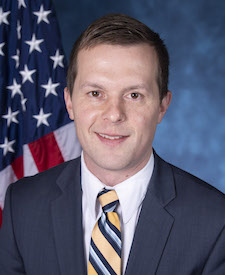
Photo of Jared F. Golden
D United States House · District 2 · Maine

Rep. Jared F. Golden

Compare
Total votes
2,837
all sessions
Attendance
97%
98 missed
Near the chamber average
With party
84%
of cast votes
Lower than 99% of chamber peers
Bipartisan score
8%
crosses aisle rarely
Higher than 98% of chamber peers
Sponsored
716
bills & resolutions
Near the chamber average
Committees
7
assignments
716 bills and resolutions

Sponsored bills

Total
716
Primary
56
Co-sponsor
660
This page
716
matching current filters
Primary HR 1308
In committee · United States House · Lead sponsor
FISC Act

Maddy summaryThe FISC Act establishes a new monthly payment program for pregnant women after 20 weeks of pregnancy and caregivers of eligible children under 18. Payments are $800 per month for pregnancy, $400 for children under 6, and $250 for children 6 and older, with a 20% increase if married. Payments phase out for higher earners (starting at $125,000 individual income or $250,000 for joint filers) and are capped at 1/12 of the previous year's adjusted gross income. The bill repeals the existing child tax credit and requires the Social Security Administration to track program data through a new Bureau of Family Statistics, submitting annual reports to Congress.

In committee Feb 13, 2025 0 co-sponsors
Co-sponsor HR 1340
In committee · United States House · Co-sponsor
More Homes on the Market Act

More Homes on the Market Act This bill increases the amount of gain from the sale of a principal residence that an individual may exclude from gross income (for federal tax purposes). Under the bill, an individual may exclude from gross income gain from the sale of a principal residence of up to $500,000 (currently $250,000), and taxpayers who are married and file a joint federal income tax return may exclude up to $1 million (currently $500.000). The bill also requires these amounts to be adjusted annually for inflation.

In committee Feb 13, 2025 1 co-sponsor
Co-sponsor HR 1229
In committee · United States House · Co-sponsor
United States-Israel Defense Partnership Act of 2025

United States-Israel Defense Partnership Act of 2025 This bill requires or authorizes certain actions to increase defense-related cooperation between the United States and Israel. Specifically, the bill requires the Department of Defense (DOD) to establish a cooperative program, with the concurrence of Israel's Ministry of Defense (MOD), to develop and deploy advanced technologies for countering unmanned systems that threaten the United States and Israel; establish in Israel an office of the Defense Innovation Unit (an organization that focuses on rapidly fielding and scaling commercial technology across the U.S. military); and seek to engage Israel's MOD on the ascension of Israel into the national technology and industrial base (currently defined in law as the persons and organizations engaged in research, development, production, integration, services, or information technology activities conducted within the United States, the United Kingdom, Australia, New Zealand, and Canada). The bill authorizes DOD, upon request of Israel's MOD, to jointly conduct research, development, test, and evaluation (RDT&E) of emerging technologies such as artificial intelligence and robotics to meet defense challenges. Additionally, the bill extends the authority for DOD to (1) carry out RDT&E on a joint basis with Israel to establish anti-tunnel and counter unmanned aerial systems capabilities through 2028, and (2) transfer defense articles intended for use as reserve stocks for Israel through January 1, 2029.

In committee Feb 12, 2025 1 co-sponsor
Co-sponsor HR 1269
In committee · United States House · Co-sponsor
Honoring Our Fallen Heroes Act of 2025

Maddy summaryHR 1269, the Honoring Our Fallen Heroes Act of 2025, expands benefits for public safety officers (like police and firefighters) who develop certain cancers linked to their work. It adds 22 specific cancers - including lung, mesothelioma, and breast cancer - to the list of conditions presumed to be "exposure-related" and sustained in the line of duty. This presumption applies if the officer served at least 5 years, was diagnosed with the cancer within 15 years after last active duty, and the cancer directly caused death or permanent disability. The bill also establishes a process for adding new cancers every 3 years based on medical evidence from agencies like NIOSH, and allows claims to be filed within 3 years of the law's enactment.

In committee Feb 12, 2025 1 co-sponsor
Co-sponsor HR 1267
In committee · United States House · Co-sponsor
Water Systems PFAS Liability Protection Act

Maddy summaryHR 1267, the Water Systems PFAS Liability Protection Act, exempts certain water and wastewater treatment facilities from liability under the federal environmental cleanup law (CERCLA) for releases of specific PFAS chemicals. It directly affects public water systems, wastewater treatment plants, municipalities with stormwater permits, and their contractors who handle PFAS while following all applicable laws. The exemption applies only if facilities manage PFAS in compliance with existing federal or state water quality rules, such as through proper biosolids disposal or treated water discharge under permits. However, the bill does not protect facilities that act with gross negligence or willful misconduct in handling PFAS. This law changes liability rules for water systems but does not alter PFAS regulation standards.

In committee Feb 12, 2025 1 co-sponsor
Co-sponsor HR 1254
In committee · United States House · Co-sponsor
Rural Obstetrics Readiness Act

Rural Obstetrics Readiness Act This bill creates and expands federal grant programs within the Health Resources and Services Administration (HRSA) to increase capacity to provide emergency obstetric health services in rural areas or areas without practitioners or facilities specializing in obstetric services.  Specifically, HRSA must establish a program for providing grants to certain hospitals or consortiums that include hospitals in rural areas or areas with maternal health care professional shortages for training, developing a workforce, and purchasing equipment relating to obstetric emergencies. In addition, the bill requires HRSA’s Alliance for Innovation on Maternal Health Capacity program to provide grants for training on emergency obstetric services for practitioners in rural health care facilities without dedicated obstetric units. HRSA must also establish a pilot program to provide grants to government entities for developing or improving telehealth access programs to support urgent maternal health care in rural facilities without a dedicated obstetric unit.

In committee Feb 12, 2025 1 co-sponsor
Co-sponsor HR 1249
In committee · United States House · Co-sponsor
INFORM Act of 2025

Maddy summaryThe INFORM Act of 2025 requires the U.S. Postal Service to provide clear notices to the public when making nationwide changes to postal services. Specifically, it mandates that the Postal Service submit proposed changes to the Postal Regulatory Commission for an advisory opinion and post detailed notices at affected retail locations for at least 30 days after the change takes effect. These notices must include the change details, implementation timelines, nationwide service impacts, public meeting information, and contact details for comments. The bill directly affects all postal customers nationwide by ensuring they receive advance notice and opportunities to comment on significant service changes. It does not alter postal service operations but establishes a formal notification process for major adjustments.

In committee Feb 12, 2025 1 co-sponsor
Primary HR 1193
In committee · United States House · Lead sponsor
Future in Logging Careers Act

Maddy summaryThis bill amends the Fair Labor Standards Act to create child labor exemptions for specific logging work. It allows 16- and 17-year-olds to work in mechanized timber harvesting operations (like felling, processing, and transporting timber using machinery) that the Secretary of Labor deems particularly hazardous, provided the employer is not owned or operated by a parent or guardian. The exemption applies to jobs involving equipment such as feller-bunchers, forwarders, and whole tree processors, but excludes children working for non-family-owned logging businesses. It does not create new career programs but modifies existing child labor restrictions for certain logging occupations.

In committee Feb 11, 2025 0 co-sponsors
Co-sponsor HR 220
In committee · United States House · Co-sponsor
Veterans Infertility Treatment Act of 2025

Maddy summaryThis proposed bill (HR 220) would expand VA healthcare benefits to cover infertility treatments like in vitro fertilization (IVF) and fertility preservation services for veterans with infertility or at risk of infertility (e.g., due to medical treatments), and their partners. It limits VA coverage to three successful IVF cycles or ten attempts, requires consent from veterans, partners, and donors, and allows use of donated eggs or embryos. Partners would receive travel reimbursement as if they were veterans, and temporary rules during implementation will immediately allow partners to access care without marriage requirements. The bill clarifies VA isn’t required to cover maternity care beyond existing rules and defers full implementation until VA issues final regulations within one year of enactment.

In committee Feb 11, 2025 1 co-sponsor
Co-sponsor HR 1175
In committee · United States House · Co-sponsor
Blind Americans Return to Work Act of 2025

Blind Americans Return to Work Act of 2025 This bill requires the Social Security Administration to carry out a demonstration project during which blind Social Security Disability Insurance (SSDI) beneficiaries receive reduced benefits commensurate with income above certain thresholds. Under current law, only individuals who earn under a specified monthly income, known as the substantial gainful activity (SGA) threshold, are considered disabled and thereby eligible for SSDI benefits. For blind workers, this limit is $2,700 per month in 2025. SSDI beneficiaries may earn beyond the SGA threshold for a limited period of time, known as the trial work period , before their benefits are suspended and ultimately terminate. The bill establishes a 20-year demonstration project during which individuals who are entitled to SSDI benefits by reason of blindness and who earn above the SGA threshold continue to receive benefits at an amount gradually reduced commensurate with their earnings beyond a specified amount. During this period, blind workers’ SSDI benefits must be reduced by $1 for every $2 that a worker earns above the sum of (1) the SGA threshold, and (2) the worker’s expenses reasonably attributable to their work. The SGA threshold may not be used to determine whether an individual is disabled during this period, and blind workers’ SSDI benefits may not be terminated due to work-related earnings. The trial work period also must not apply.  After 10 years, affected beneficiaries may opt out of the modified benefits structure.

In committee Feb 10, 2025 1 co-sponsor
Showing 201 to 210 of 716 bills
Previous 1 … 20 21 22 … 72 Next