

This joint resolution proposes a constitutional amendment authorizing Congress and the states to (1) regulate and impose reasonable viewpoint-neutral limitations on the raising and spending of money by candidates and others to influence elections; and (2) regulate and enact public campaign financing systems, including those designed to restrict the influence of private wealth by offsetting the raising and spending of money by candidates and others with increased public funding. The amendment grants Congress and the states the power to implement and enforce this amendment by legislation. They are allowed to distinguish between natural persons and corporations or other artificial entities created by law, including by prohibiting such entities from spending money to influence elections.
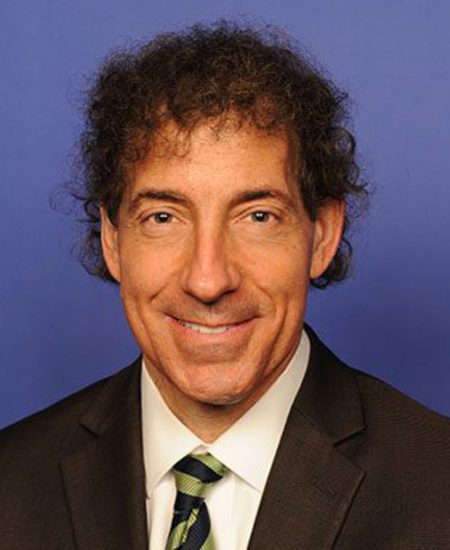
Rep. Jamie Raskin
Sponsored bills
Maddy summaryHR 51, the Washington, D.C. Admission Act, would admit Washington, D.C. as the 51st state, named "Washington, Douglass Commonwealth," granting its residents full representation in Congress with two Senators and one Representative. The bill establishes procedures for admission, including elections for state officials, with the state initially having one Representative until the next congressional apportionment. It would create a "Capital" area (including the White House, Capitol, and other key federal buildings) that remains under federal jurisdiction as the seat of the U.S. government, while the rest of the District becomes the new state. The bill also includes provisions to ensure continuity of federal services, property management, and legal procedures during the transition to statehood.
Maddy summaryThis bill extends a tax credit for employer social security taxes paid on employee tips at beauty service businesses (including barbering, nail care, esthetics, and spa treatments), but only for tips customary in these services. It creates a "tip reporting safe harbor" requiring beauty businesses to implement quarterly employee training on tip reporting, monthly tip tracking, and proper tax filings to avoid IRS audits on tips. Additionally, it mandates businesses renting space to beauty service providers to report annual rental income over $600 to the IRS. These provisions directly affect beauty service establishments and landlords in this sector, applying to tax years beginning after 2022 or 2023.
Cover Outstanding Vulnerable Expansion-eligible Residents Now Act or the COVER Now Act This bill establishes a demonstration program to allow local governments to provide health benefits to the Medicaid expansion population in states that have not expanded Medicaid. Under the program, local governments may provide coverage for individuals who are newly eligible for Medicaid under the Patient Protection and Affordable Care Act (i.e., the Medicaid expansion population) for a maximum of 10 years, or until their respective states expand Medicaid. The bill provides a 100% federal matching rate for the first three years of program participation. The bill prohibits states from taking certain actions against participating localities, such as withholding funding, increasing taxes, or restricting provider participation. States that violate these requirements are subject to certain funding penalties.
This bill authorizes the Thomas Paine Memorial Association to establish a commemorative work on federal land in the District of Columbia in honor of the philosopher and patriot, Thomas Paine. Thomas Paine is best known for writing Common Sense , a pamphlet that helped to inspire the Revolutionary War. The establishment of the commemorative work shall be in accordance with the Commemorative Works Act. Federal funds may not be used to pay any expense to establish the commemorative work.
American Music Fairness Act of 2022 This bill establishes that the copyright holder of a sound recording shall have the exclusive right to perform the sound recording through an audio transmission and addresses other related issues. (Currently, the public performance right only covers performances through a digital audio transmission in certain instances, which means that nonsubscription terrestrial radio stations generally do not have to secure a license to publicly perform a copyright-protected sound recording.) Under the bill, a nonsubscription broadcast transmission must have a license to publicly perform such sound recordings. The Copyright Royalty Board must periodically determine the royalty rates for such a license. When determining the rates, the board must base its decision on certain information presented by the parties, including the radio stations' effect on other streams of revenue related to the sound recordings. Terrestrial broadcast stations (and the owners of such stations) that fall below certain revenue thresholds may pay certain flat fees, instead of the board-established rate, for a license to publicly perform copyright-protected sound recordings.
Environmental Justice For All Act This bill establishes several environmental justice requirements, advisory bodies, and programs and modifies the scope of environmental review under the National Environmental Policy Act of 1969. The bill sets forth provisions to address the disproportionate adverse human health or environmental effects of federal laws or programs on communities of color, low-income communities, or tribal and indigenous communities. It also prohibits disparate impacts on the basis of race, color, or national origin as discrimination. Aggrieved persons may seek legal remedy when faced with such discrimination. In addition, the bill directs agencies to follow certain requirements concerning environmental justice. For example, agencies must prepare community impact reports that assess the potential impacts of their actions on environmental justice communities under certain circumstances. It also raises coal, oil, and gas royalty rates to create a funding source to support fossil fuel-dependent communities and displaced workers as they transition away from fossil fuel industries. Additionally, the bill creates a variety of advisory bodies and positions, such as the White House Environmental Justice Interagency Council. Among other things, the council must issue an environmental justice strategy. It also establishes requirements and programs concerning chemicals or toxic ingredients in certain products. For example, the bill (1) requires certain products (e.g., cosmetics) to include a list of ingredients or warnings; and (2) provides grants for research on designing safer alternatives to chemicals in certain consumer, cleaning, toy, or baby products that have an inherent toxicity or that are associated with chronic adverse health effects. Finally, it creates a variety of funding programs, such as a grant program to enhance access to park and recreational opportunities in urban areas.
War Crimes Rewards Expansion Act This act expands the Department of State's rewards program to authorize rewards for providing information leading to the arrest, conviction, or transfer of a foreign national accused of war crimes, crimes against humanity, or genocide as such crimes are defined under the law of an international criminal tribunal, the applicable country, or the United States. Currently, rewards are authorized for information leading to the arrest, conviction, or transfer of a foreign national accused of such crimes only as defined under the statutes of the relevant tribunal.
21st Century President Act This act revises the definition of immediate family for purposes of a criminal offense involving a threat to kill, kidnap, or inflict bodily harm on a former President or a member of the immediate family of a former President. Specifically, it replaces gender-specific references to a former President's wife and widow with the gender-neutral terms spouse and surviving spouse .
This resolution promotes increased public awareness of motorcyclist profiling. The resolution also encourages the motorcyclist community and law enforcement to collaborate and communicate on efforts to end motorcyclist profiling.