

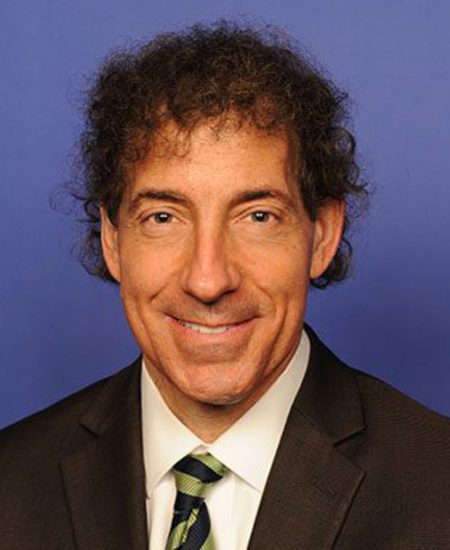
Photo of Jamie Raskin
D United States House · District 8 · Maryland On the 2026 ballot

Rep. Jamie Raskin

Compare
Total votes
2,837
all sessions
Attendance
99%
38 missed
Near the chamber average
With party
98%
of cast votes
Higher than 83% of chamber peers
Bipartisan score
1%
crosses aisle rarely
Lower than 83% of chamber peers
Sponsored
1,784
bills & resolutions
Near the chamber average
Committees
1
assignment
1,784 bills and resolutions

Sponsored bills

Total
1,784
Primary
95
Co-sponsor
1,689
This page
1,784
matching current filters
Co-sponsor HR 2801
In committee · United States House · Co-sponsor
Kids PRIVACY Act

Maddy summaryThe Kids PRIVACY Act strengthens privacy protections for children under 13 and teenagers aged 12-18 online. It requires digital services that collect data from these age groups to obtain verifiable consent, limit data collection to what's necessary, and prevent targeted advertising based on their information. The bill establishes new requirements for transparency (including clear privacy policies), data minimization, security measures, and privacy impact assessments. It also creates a dedicated Youth Privacy and Marketing Division at the Federal Trade Commission to enforce these rules and repeals existing safe harbor provisions that previously protected operators from liability.

In committee Apr 28, 2023 1 co-sponsor
Co-sponsor HR 2961
In committee · United States House · Co-sponsor
Audit the Pentagon Act of 2023

Maddy summaryThis bill requires the Pentagon to obtain a clean audit of its finances. If the Department of Defense fails to get an unqualified audit (a "clean" opinion) for a department or agency, it triggers automatic spending cuts: 0.5% in the first year of failure and 1.0% in subsequent years. These cuts apply broadly across programs but exclude military personnel, National Guard, reserve forces, and the Defense Health Program. The President may temporarily waive cuts for national security reasons, but must justify the waiver to Congress. The goal is to link defense spending to financial accountability, using existing audit standards.

In committee Apr 27, 2023 1 co-sponsor
Co-sponsor HR 2987
In committee · United States House · Co-sponsor
Election Mail Act

Maddy summaryThe Election Mail Act (HR 2987) establishes new requirements for handling mail-in ballots in federal elections to improve reliability and accessibility. It requires the Postal Service to process absentee ballots on the same day received, place postmarks indicating mailing dates on ballot envelopes, and treat election mail as first-class mail with free postage for completed ballots. The bill also mandates states to use intelligent mail barcodes on return envelopes, affix specific tags for ballot visibility, and adopt a uniform 7-day deadline for accepting mailed ballots postmarked on or before election day. These changes apply to federal elections, with most provisions taking effect for the 2024 election cycle. The bill includes additional provisions for the Postal Service to consult with Indian Tribes about voting barriers on tribal lands.

In committee Apr 27, 2023 1 co-sponsor
Co-sponsor HR 2976
In committee · United States House · Co-sponsor
Child Care for Working Families Act

Maddy summaryThe Child Care for Working Families Act establishes a federal entitlement program providing subsidized child care for working families with children under age 6 who are not yet in kindergarten. It creates a sliding fee scale where families at or below 85% of State median income pay no copayment, while higher-income families pay up to 7% of their income based on income thresholds. The bill requires states to develop quality rating systems for child care providers and ensures providers receive sufficient funding to meet quality standards, including wages equivalent to elementary educators. It prioritizes access for underserved populations including children with disabilities, infants and toddlers, children experiencing homelessness, and families in low-income communities. The program is funded with $20 billion for fiscal year 2024 and subsequent years through 2029.

In committee Apr 27, 2023 1 co-sponsor
Co-sponsor HR 2871
In committee · United States House · Co-sponsor
Performing Artist Tax Parity Act of 2023

Performing Artist Tax Parity Act of 2023 This bill modifies the above-the-line tax deduction for the expenses of performing artists (including commissions paid to managers or agents) to provide for a phaseout of such deduction for taxpayers whose adjusted gross income exceeds $100,000 ($200,000 for joint return filers). The $100,000 phaseout threshold is adjusted for inflation annually for taxable years beginning after 2023.

In committee Apr 26, 2023 1 co-sponsor
Co-sponsor HR 2870
In committee · United States House · Co-sponsor
Raise the Age Act of 2023

Raise the Age Act of 2023 This bill establishes new restrictions on the sale or transfer of certain semiautomatic firearms to individuals under 21 years of age. Specifically, this bill makes it unlawful for a licensed gun dealer, importer, manufacturer, or collector to sell or deliver a semiautomatic center-fire rifle or semiautomatic center-fire shotgun that has (or has the capacity to accept) an ammunition feeding device with a capacity of more than five rounds to an individual who the licensee knows or has reasonable cause to believe is under age 21. The prohibition does not apply if the individual under age 21 is a full-time law enforcement officer or active-duty member of the Armed Forces. The bill also requires the Federal Bureau of Investigation to report on the operation of its public access line, including a description of information sharing protocols and recommendations for improving such protocols.

In committee Apr 26, 2023 1 co-sponsor
Co-sponsor HR 2899
In committee · United States House · Co-sponsor
STOP Violence Act of 2023

Maddy summaryHR 2899, the STOP Violence Act of 2023, adds $20 million in federal grants to help states, local governments, and nonprofits prepare public assembly facilities (like schools, malls, and event venues) for mass violence. The funds are specifically for providing compensation, training, and technical assistance to these facilities to enhance their safety measures against incidents such as active shooter attacks or targeted violence. The bill defines "mass violence" to include active shooter incidents (where someone uses a firearm to kill or attempt to kill in a crowded area) and targeted violence (where an assailant identifies a specific person, group, or institution before attacking). These grants aim to directly support facilities that host large gatherings of people, focusing on practical safety improvements.

In committee Apr 26, 2023 1 co-sponsor
Co-sponsor HR 2898
In committee · United States House · Co-sponsor
Secure Background Checks Act of 2023

Secure Background Checks Act of 2023 This bill extends federal restrictions on the receipt, possession, shipment, and transportation of firearms and ammunition to two new categories of persons: persons who fail to meet the minimum age requirements imposed by federal law and by the law of their resident state; and persons who are out-of-state residents and do not qualify for an exception, such as the temporary loan or rental of a firearm for lawful sporting purposes. Additionally, the bill imposes criminal penalties—a fine, a prison term of up to 10 years, or both—on an individual who ships, transports, or receives a firearm or ammunition while under indictment for a crime punishable by imprisonment for a term exceeding 1 year.

In committee Apr 26, 2023 1 co-sponsor
Co-sponsor HR 2897
In committee · United States House · Co-sponsor
End Gun Violence Act of 2023

End Gun Violence Act of 2023 This bill extends federal restrictions on the sale or disposition of firearms and ammunition to a new category of persons: persons who have been convicted in any court of a violent misdemeanor within the preceding five years.

In committee Apr 26, 2023 1 co-sponsor
Co-sponsor HR 2828
In committee · United States House · Co-sponsor
Family Building FEHB Fairness Act

Maddy summaryThe Family Building FEHB Fairness Act (HR 2828) amends the Federal Employees Health Benefits (FEHB) program to add assisted reproductive treatment as a covered benefit for federal employees and their families. It specifically defines these treatments to include procedures like in vitro fertilization, intrauterine insemination, and the preservation of eggs, sperm, or embryos. The bill requires the Office of Personnel Management to include these services under FEHB coverage, expanding access to reproductive care for eligible federal workers. The change would take effect one year after the bill's enactment, directly affecting federal employees enrolled in the FEHB program seeking fertility-related medical services.

In committee Apr 25, 2023 1 co-sponsor
Showing 811 to 820 of 1,784 bills
Previous 1 … 81 82 83 … 179 Next