

Maddy summaryHRES 1473 is a non-binding resolution passed by the U.S. House of Representatives that condemns racism, bigotry, and misinformation targeting Haitian people and their descendants. It celebrates the historical contributions of Haitian Americans to U.S. society, including founding cities (like Chicago via Jean Baptiste Point du Sable), advancing civil rights (W.E.B. Du Bois), and enriching healthcare, education, and culture. The resolution specifically calls on all Americans to reject racist tropes and misinformation, and urges elected officials to promote inclusivity and responsible communication. It was introduced in response to recent false claims that fueled threats against Haitian communities, such as the bomb threats in Springfield, Ohio.
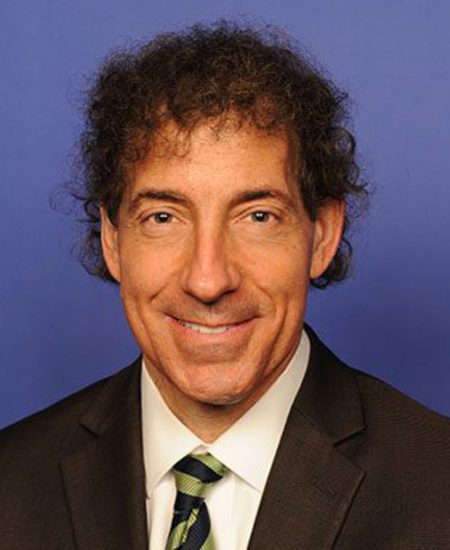
Rep. Jamie Raskin
Sponsored bills
Maddy summaryHR 9691 establishes the Julius Rosenwald and Rosenwald Schools National Historical Park as a unit of the National Park System. The park will preserve specific sites, including the San Domingo School in Maryland and the St. George Rosenwald School in South Carolina, plus a Chicago headquarters at the former Sears complex. It aims to commemorate Julius Rosenwald's philanthropy - particularly his partnership with Booker T. Washington to build over 5,000 schools for African-American students in the segregated South - and his broader legacy of social justice. The bill directs the Secretary of the Interior to administer the park, develop a management plan, and create a national network connecting related Rosenwald School sites for educational interpretation.
Maddy summaryThis bill makes the Union Station Redevelopment Corporation (USRC) eligible to receive 100% federal funding for infrastructure projects under four existing transportation grant programs: RAISE, National Infrastructure Project Assistance, Consolidated Rail Infrastructure, and Federal-State Partnership for Intercity Rail. It amends each program’s rules to specifically include the USRC as an eligible recipient and eliminates the typical requirement for state or local cost-sharing. The bill directly affects the USRC by providing full federal funding for its projects, such as those related to Union Station redevelopment.
Maddy summaryThis bill creates a new occupational category (code 31-1123) within the federal Standard Occupational Classification system specifically for direct support professionals (DSPs) who assist people with intellectual or developmental disabilities. It directly affects DSPs, state agencies, and federal data collectors by reclassifying their work - currently grouped under home health aides - into a distinct category. The key mechanism is revising the SOC system to better track DSP workforce data, address high turnover rates (43% nationally), and recognize their unique role in promoting clients' independence and community inclusion. This change aims to improve data accuracy for addressing staffing challenges, without altering service delivery or benefits.
Maddy summaryThe Homes Act of 2024 would establish a new Housing Development Authority within the Department of Housing and Urban Development to develop permanently affordable housing. The Authority would acquire properties and convey them to eligible entities (including community land trusts, tenant organizations, and public housing agencies) under strict requirements for permanent affordability, climate resilience, and community control. The bill would set rents at 25% of household income, limit annual rent increases to 3% or the Consumer Price Index, and require "just-cause" evictions with tenant protections. It would also create a tenant right to purchase their rental properties through a "first look" process and prioritize housing for underserved communities and families experiencing homelessness.
Maddy summaryThis bill directs the U.S. government to immediately restore funding to the United Nations Relief and Works Agency for Palestine Refugees (UNRWA), reversing a temporary funding pause. It repeals two appropriations acts that halted payments and requires the Secretary of State to resume UNRWA funding under existing authorities. The legislation specifically aims to support UNRWA’s critical humanitarian work - providing shelter, education, healthcare, and aid to Palestinian refugees across Gaza, the West Bank, Syria, Lebanon, and Jordan - during an acute famine risk in Gaza. It also mandates quarterly reports to Congress on UNRWA’s implementation of reforms from an independent review, ensuring accountability for its humanitarian mission.
Maddy summaryThis bill modifies Medicaid and CHIP rules to let eligible out-of-state healthcare providers enroll without extra state screening. It applies to providers already in Medicare or their home state program, with low fraud risk, serving children under 21 with complex medical conditions. Providers would receive 5 years of enrollment under this streamlined process, eliminating state-level barriers. The change directly affects children seeking specialized care across state lines and the providers who serve them.
Maddy summaryHRES 1461 is a symbolic resolution designating September 2024 as "National Voting Rights Month" to raise awareness about voting access. It encourages all U.S. citizens to uphold voting rights, supports existing voting rights legislation like the Freedom to Vote Act, and recommends schools teach about voting history and current restrictions. The resolution specifically aims to highlight efforts to address historical and ongoing barriers affecting historically marginalized groups, including Black, Latino, and disabled voters. It does not create new laws but promotes educational initiatives and media campaigns about registration deadlines and election access.
Maddy summaryThe Polluters Pay Climate Fund Act of 2024 would require major fossil fuel companies that emitted more than 1 billion metric tons of carbon dioxide between 2000 and 2022 to pay a tax based on their historical emissions. The tax revenue would fund a new Climate Fund that would provide $15 billion annually for disaster response and resilience programs through FEMA, $6 billion for clean air initiatives, and mandate 40% of funds support environmental justice communities. The fund would finance climate resilience projects including climate-resilient infrastructure, ecosystem restoration, and support for vulnerable communities affected by climate change. Companies could pay the tax over nine years, and the bill explicitly states it does not affect existing legal claims against polluters for climate-related damages.
Maddy summaryHR 9577, the STOP Suicide Act, provides $30 million annually (2025-2029) to fund grants for community health centers, schools, crisis centers, and tribal organizations to implement immediate suicide crisis intervention services. The grants support evidence-based outpatient, virtual, or peer-led care in the least restrictive setting to stabilize individuals experiencing acute suicidal thoughts. Grant recipients must include a plan for sustaining services after the 5-year grant period ends, and the program requires annual evaluations of the funded models. This bill directly affects health providers serving at-risk individuals by creating new funding for crisis stabilization services.