

Philippine Human Rights Act This bill imposes limitations on providing assistance to the police or military of the Philippines. No federal funds may be used to provide such assistance until the Philippines government has taken certain actions, including (1) investigating and successfully prosecuting members of its military and police forces who have violated human rights, (2) withdrawing the military from domestic policing activities, and (3) establishing that it effectively protects the rights of journalists and civil society activists. The President shall also direct U.S. representatives at multilateral development banks to vote against providing loans to the police or military of the Philippines.
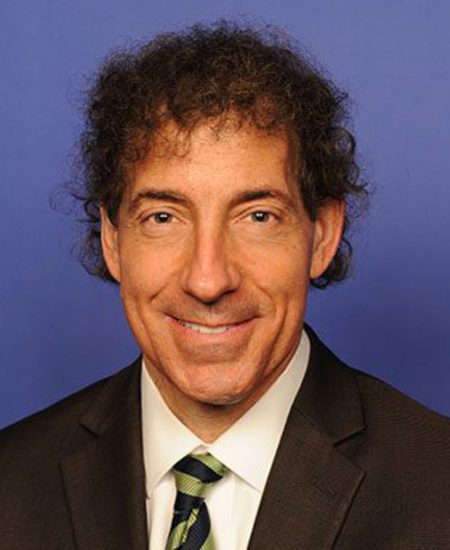
Rep. Jamie Raskin
Sponsored bills
LGBTQ Essential Data Act This bill directs the Centers for Disease Control and Prevention to more frequently collect information on the sexual orientation and gender identity of deceased individuals through the National Violent Death Reporting System.
Pink Tax Repeal Act This bill prohibits product manufacturers or service providers from selling substantially similar products at different prices based on the gender of the intended purchaser. If, for example, the only difference between two products is the color, they are substantially similar. The bill provides authority for the Federal Trade Commission and state attorneys general to enforce these requirements.
Equal Dignity for Married Taxpayers Act of 2021 This bill modifies several tax provisions that refer to married couples to make the provisions equally applicable to legally married same-sex couples.
Supplemental Security Income Restoration Act of 2021 This bill modifies eligibility for, and other components of, the Supplemental Security Income (SSI) program, including by (1) increasing applicable income and resource limits used to determine SSI eligibility, (2) equalizing treatment of married couples when both spouses receive SSI as compared to two unmarried individuals, and (3) eliminating the penalty on SSI applicants or recipients who transfer resources to another individual for less than fair market value.
Services and Trauma-informed Research of Outcomes in Neighborhoods Grants for Support for Children Act of 2021 or the STRONG Support for Children Act of 2021 This bill establishes two grant programs for governmental health departments to prevent and mitigate childhood trauma and adverse childhood experiences. For the first program, the Department of Health and Human Services (HHS) must award grants to health departments to use data analysis methods to identify interventions to prevent and mitigate childhood trauma. Grant activities include using data analysis to identify geographic areas with a high prevalence of adverse childhood experiences and to implement strategies to improve outcomes for infants, children, and adolescents. For the second program, HHS must award grants to local or tribal governments to establish or expand early childhood trauma-informed care coordination services, including by instituting risk and needs assessments to respond to adverse childhood experiences. For both grants, the bill prohibits the use of funds for certain purposes, such as using the data analysis methods to inform individual case decisions, including child removals, or increasing the presence of law enforcement. In addition, HHS must evaluate and report on these programs and make findings and recommendations publicly available on its website.
Medical Nutrition Equity Act of 2021 This bill expands coverage under Medicare, Medicaid, other specified federal health care programs, and private health insurance to include foods, vitamins, and individual amino acids that are medically necessary for the management of certain digestive and metabolic disorders and conditions.
Parity Implementation Assistance Act This bill provides grants to assist states with the implementation of the federal mental health parity requirements. States receiving the grants must request and review from private health insurance plans their required comparative analysis of nonquantitative treatment limitations (NQTLs) with respect to mental health or substance use disorder benefits. (NQTLs are limitations on the scope or duration of benefits for treatment, such as preauthorization requirements.)
State-Based Universal Health Care Act of 20 21 This bill establishes the option for states, or groups of states, to apply to waive certain federal health insurance requirements and provide residents with health insurance benefits plans through a state-administered program. Such programs must cover 95% of the residents in the state within five years and plan benefits must be at least as comprehensive and affordable as the coverage under the equivalent federal program. State programs are supported with funds from the federal programs the state programs replace, which may include Medicare, Medicaid, the Children's Health Insurance Program, the Federal Employee Health Benefits program, certain federal tax credits, and premium-assistance funds, among others. The bill requires the Department of Health and Human Services to appoint an Independent Assessment Panel for Comprehensive Care to review and recommend whether to approve state applications. Each approved state program must be independently reviewed every five years to evaluate changes in health benefits access, quality, and coverage, including whether the state has met the 95% coverage requirement. The federal government must pay all health insurance costs for American Indians and Alaska Natives who enroll in a plan through a state insurance program.
FAIR Leave Act or the Fair Access for Individuals to Receive Leave Act This bill repeals the limit on the aggregate number of workweeks of family and medical leave that spouses employed by the same employer may be entitled to during any 12-month period. The current limit is 12 aggregate workweeks.