

Afghan Adjustment Act This bill expands eligibility for special immigrant visas to certain Afghan nationals (and accompanying spouse and children) and addresses related issues. The Department of Homeland Security may provide such visas to Afghan nationals who provided qualifying service as a member of the Afghan Air Force or other specified entities and meet eligibility requirements, such as passing a background check. Currently, special immigrant visas for Afghan nationals are generally only available to those who were employed by or on behalf of the U.S. government in Afghanistan. Such visas shall also be available to an Afghan national who is a qualifying relative of a veteran or member of the U.S. Armed Forces. The bill also modifies procedures for providing lawful permanent resident status to certain classes of Afghan nationals, such as by (1) providing a streamlined process with specified vetting requirements for certain individuals, including those who provided support to the U.S. government in Afghanistan; and (2) preserving the eligibility of certain battered spouses whose eligibility for such status stemmed from a marriage that has terminated. Furthermore, the Department of State (1) must respond to inquiries from Members of Congress about specific applications from Afghan nationals seeking special immigrant or refugee status; and (2) establish an office in Afghanistan to perform certain tasks, such as issuing visas, if no U.S. embassies are operational in Afghanistan. The President must establish a task force to develop and implement a strategy to assist Afghan nationals who qualify for admission to the United States.
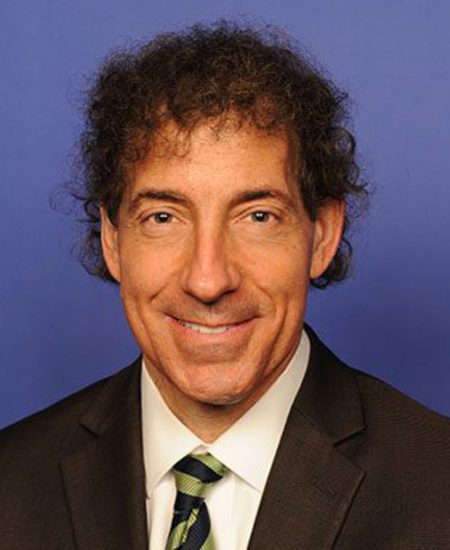
Rep. Jamie Raskin
Sponsored bills
This bill establishes a civil action through which an individual may be disqualified from holding office under Section 3 of the Fourteenth Amendment of the U.S. Constitution. This includes an individual who has engaged in insurrection or rebellion against the United States or has given aid or comfort to the enemies of the United States.
Multiple Firearm Sales Reporting Modernization Act of 2022 This bill expands reporting requirements with respect to sales or dispositions of multiple firearms. Currently, a federal firearms licensee (e.g., a gun dealer) must report multiple sales or dispositions of pistols or revolvers to the same person within five business days. This bill requires a federal firearms licensee to report multiple sales or dispositions of any firearms to the same person within five business days.
Protect Vulnerable Immigrant Youth Act This bill exempts Special Immigrant Juveniles visas from certain annual numerical limitations on such visas. (Generally, Special Immigrant Juvenile status is available to qualifying non-U.S. nationals under 21 years of age who are in the United States and have been abused, abandoned, or neglected by a parent.)
Generic Substitution Noninterference Act This bill prohibits drug manufacturers from helping or directing health care providers to limit prescriptions to brand-name drugs when generic versions are available. The Federal Trade Commission and states may enforce this bill through civil actions.
Open App Markets Act This bill establishes rules related to the operation of an app store by a covered company (i.e., the owner or controller of an app store with more than 50 million U.S. users). An app is a software application or electronic service that may be run or directed by a user on a computer or mobile device. An app store is a publicly available website, software application, or other electronic service that distributes apps from third-party developers to users. The bill prohibits a covered company from (1) requiring developers to use an in-app payment system owned or controlled by the company as a condition of distribution or accessibility, (2) requiring that pricing or conditions of sale be equal to or more favorable on its app store than another app store, or (3) taking punitive action against a developer for using or offering different pricing terms or conditions of sale through another in-app payment system or on another app store. A covered company may not interfere with legitimate business communications between developers and users, use non-public business information from a third-party app to compete with the app, or unreasonably prefer or rank its own apps (or those of its business partners) over other apps. The bill provides for enforcement of its provisions by the Federal Trade Commission and the Department of Justice, as well as through suits brought by developers that are injured by reason of anything prohibited by this bill.
Stopping Harmful Image Exploitation and Limiting Distribution Act of 2022 or the SHIELD Act of 2022 This bill establishes a new criminal offense related to the distribution of intimate visual depictions. Specifically, it makes it a crime to knowingly distribute (or intentionally threaten to distribute) an intimate visual depiction of an individual (1) with knowledge of or reckless disregard for the individual's lack of consent and reasonable expectation of privacy, and (2) without a reasonable belief that distributing the depiction touches a matter of public concern. A violator is subject to criminal penalties—a fine, a prison term of up to two years for each individual victim depicted, or both.
Latonya Reeves Freedom Act of 2022 This bill prohibits government entities and insurance providers from denying community-based services to individuals with disabilities that require long-term service or support that would enable such individuals to live in the community and lead an independent life. Specifically, these entities may not discriminate against such individuals in the provision of community-based services by such actions as imposing prohibited eligibility criteria, cost caps, or waiting lists or failing to provide a specific community-based service. Additionally, community-based services must be offered to individuals with such disabilities prior to institutionalization. Institutionalized individuals must be notified regularly of community-based alternatives. The bill requires the Department of Justice to issue regulations requiring government entities and insurance providers to offer community-based long-term services to individuals with such disabilities who would otherwise qualify for institutional placement. Government entities must ensure sufficient availability of affordable, accessible, and integrated housing that is not a disability-specific residential setting or a setting where services are tied to tenancy. Regulations shall also (1) require government entities and insurance providers to perform self-evaluation on current services, policies, and practices and concerning compliance with requirements of this bill; and (2) require government entities to submit a transition plan. The bill provides funds for FY2022 for the Department of Health and Human Services to provide technical assistance with respect to transition plans. The bill allows civil actions by individuals subjected to, or about to be subjected to, a violation of its requirements.
Special Inspector General for Law Enforcement Act This bill establishes the Office of the Special Inspector General for Law Enforcement. The bill sets forth the duties of the office, including investigating racial profiling, officer misconduct, use of force, use of deadly force, or pattern or practice of unconstitutional misconduct involving federal law enforcement agencies or officers; and use-of-deadly-force cases referred by state and local law enforcement agencies. The bill requires a state or local government that receives funding under the Edward Byrne Memorial Justice Assistance Grant program or the Community Oriented Policing Services grant program to have in effect a law establishing a process by which use-of-deadly-force cases can be referred to the office for investigation.
Constitutional Accountability Act This bill extends civil liability to federal, state, and local government entities and officials for constitutional violations committed by law enforcement officers. Current law provides a statutory civil cause of action against state and local government actors (e.g., law enforcement) for violations of constitutional rights (also known as Section 1983 lawsuits); the Supreme Court has also found an implied cause of action against federal law enforcement officers in certain situations (e.g., Fourth Amendment violations). However, under the judicial doctrine of qualified immunity, government officials performing discretionary duties are generally shielded from civil liability except when their actions violate clearly established rights of which a reasonable person would have known. Additionally, under the doctrine of sovereign immunity, federal and state government entities generally cannot be sued without their consent. Further, the Supreme Court has held that a local government entity cannot be sued for an injury inflicted by its employees. The bill provides a statutory civil cause of action against and extends liability to federal, state, and local government entities and officials for violations of constitutional rights committed by law enforcement officers in their employment, regardless of any immunity that would otherwise apply.