

Maddy summaryThe Working Dog Commemorative Coin Act (HR 807) directs the U.S. Treasury to mint three types of commemorative coins honoring working dogs' service: $5 gold coins, $1 silver coins, and half-dollar coins with specific weight and composition requirements. Each coin will carry a surcharge ($35 for $5 coins, $10 for $1 coins, $5 for half-dollars) that will be paid directly to America's VetDogs to support their programs providing service dogs for veterans, the disabled, and others. The coins will be issued in 2027 with designs reflecting working dogs' roles in military, detection, therapy, and assistance work. The legislation specifies that all surcharge revenue must fund America's VetDogs' operations without creating new government programs. This is a commemorative measure focused on honoring working dogs' contributions through coin sales, with all surcharge funds going to a specific nonprofit organization.
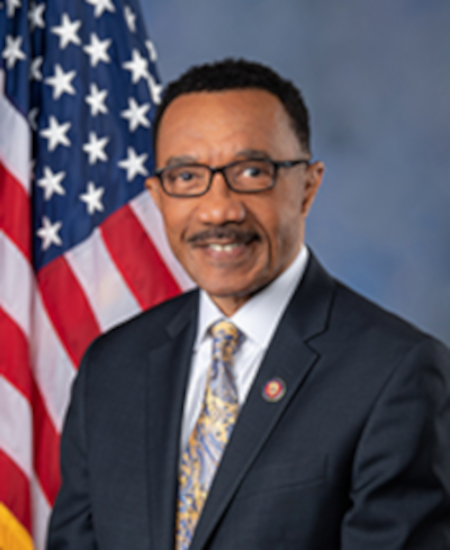
Rep. Kweisi Mfume
Sponsored bills
Maddy summaryThis bill establishes the Justice Thurgood Marshall National Historic Site at Public School 103 in Baltimore, Maryland - the elementary school attended by Justice Thurgood Marshall (the first Black U.S. Supreme Court Justice). The site, owned and managed by the nonprofit Beloved Community Services Corporation, will be designated as an "affiliated area" of the National Park System. Management will be handled by the nonprofit under a cooperative agreement with the National Park Service, which will provide technical assistance but not acquire the property or take over operations. The site aims to preserve and interpret Marshall's early life and legacy for public education.
Maddy summaryHR 5658, the Vote by Mail Tracking Act, requires that all mail-in ballots for federal elections be sent in envelopes containing a Postal Service barcode for tracking. This applies to every ballot mailed for federal office elections after the bill becomes law. The envelope must also meet Postal Service design standards for ballot envelopes, be machineable, and display the Official Election Mail Logo. The bill directly affects voters using mail-in ballots for federal races and mandates this tracking system to be implemented by the Postal Service.
Maddy summaryThe VA Employee Fairness Act of 2024 modifies collective bargaining rules for employees of the Veterans Health Administration (VHA). It removes existing subsections (b), (c), and (d) from the law governing VHA employee bargaining and renumbers the remaining provision. This change streamlines the collective bargaining framework but does not alter the Secretary of Veterans Affairs' existing authorities over incentive pay and expedited hiring. The bill directly affects VHA employees by changing how their collective bargaining rights are structured under federal law. The law remains neutral, focusing solely on procedural adjustments to the existing bargaining framework.
Maddy summaryThe National Food as Medicine Program Act of 2024 creates a federal grant program to help states implement or expand initiatives that provide medically prescribed, nutrient-rich food (like fresh produce or tailored meals) to address chronic health conditions and food insecurity. States must partner with healthcare providers and community organizations to offer these interventions, using locally-sourced, sustainably produced food grown through regenerative or organic methods. The program requires states to evaluate outcomes like reduced hospital visits and improved health metrics, with reports submitted to the federal government after three years. It directly affects state Medicaid programs and healthcare providers participating in these initiatives.
Maddy summaryThis bill establishes a Diversity and Inclusion Administrator at the Department of Labor to increase African American participation in apprenticeship programs. It requires all new and renewing registered apprenticeship programs to submit plans for boosting African American enrollment, and authorizes competitive grants for programs targeting underrepresented groups in industries like construction, tech, and healthcare. Grant recipients must report on metrics including participant demographics, program completion rates, and job placement in related fields. The law directly affects African American youth and other underrepresented groups by mandating systemic changes to apprenticeship programs nationwide.
Maddy summaryHR 6319 (the 911 SAVES Act of 2023) requires the Office of Management and Budget to reclassify public safety telecommunicators as "Protective Service Occupations" within 30 days of enactment. This change corrects their current misclassification in the federal Standard Occupational Classification (SOC) system, which is used for statistical data on jobs. The bill directly affects how these professionals - critical in emergency calls involving missing children, active threats, and officer safety - are officially categorized in government workforce data. It does not create new benefits or funding but aims to better recognize their lifesaving role through accurate federal job classification.
Maddy summaryThis bill directs the U.S. government to immediately restore funding to the United Nations Relief and Works Agency for Palestine Refugees (UNRWA), reversing a temporary funding pause. It repeals two appropriations acts that halted payments and requires the Secretary of State to resume UNRWA funding under existing authorities. The legislation specifically aims to support UNRWA’s critical humanitarian work - providing shelter, education, healthcare, and aid to Palestinian refugees across Gaza, the West Bank, Syria, Lebanon, and Jordan - during an acute famine risk in Gaza. It also mandates quarterly reports to Congress on UNRWA’s implementation of reforms from an independent review, ensuring accountability for its humanitarian mission.
Maddy summaryThis bill expands online privacy protections under the Children's Online Privacy Protection Act to cover teens aged 12-17, in addition to children under 13. It requires website and app operators to obtain verifiable consent from parents for children and from teens themselves before collecting personal information. The bill restricts operators from using collected data for individual-specific advertising to children or teens and mandates clear notices about data practices. Operators must provide users with the right to access, delete, and correct personal information they've collected. These requirements apply to websites, online services, and mobile applications that collect information from children or teens or have actual knowledge a user is a child or teen.
Maddy summaryThe Kids Online Safety Act (HR 7891) would require major online platforms (with high revenue or user numbers) to implement safety features for children and teens, including default protective settings, parental controls, and age verification. It would mandate platforms to report annually on risks to minors and their safety measures, and prohibit advertising harmful products (like tobacco, alcohol, or gambling) to minors. The bill directly affects social media platforms, online video games, and video streaming services that are used by minors, with the goal of preventing mental health harms, compulsive usage, and cyberbullying.